
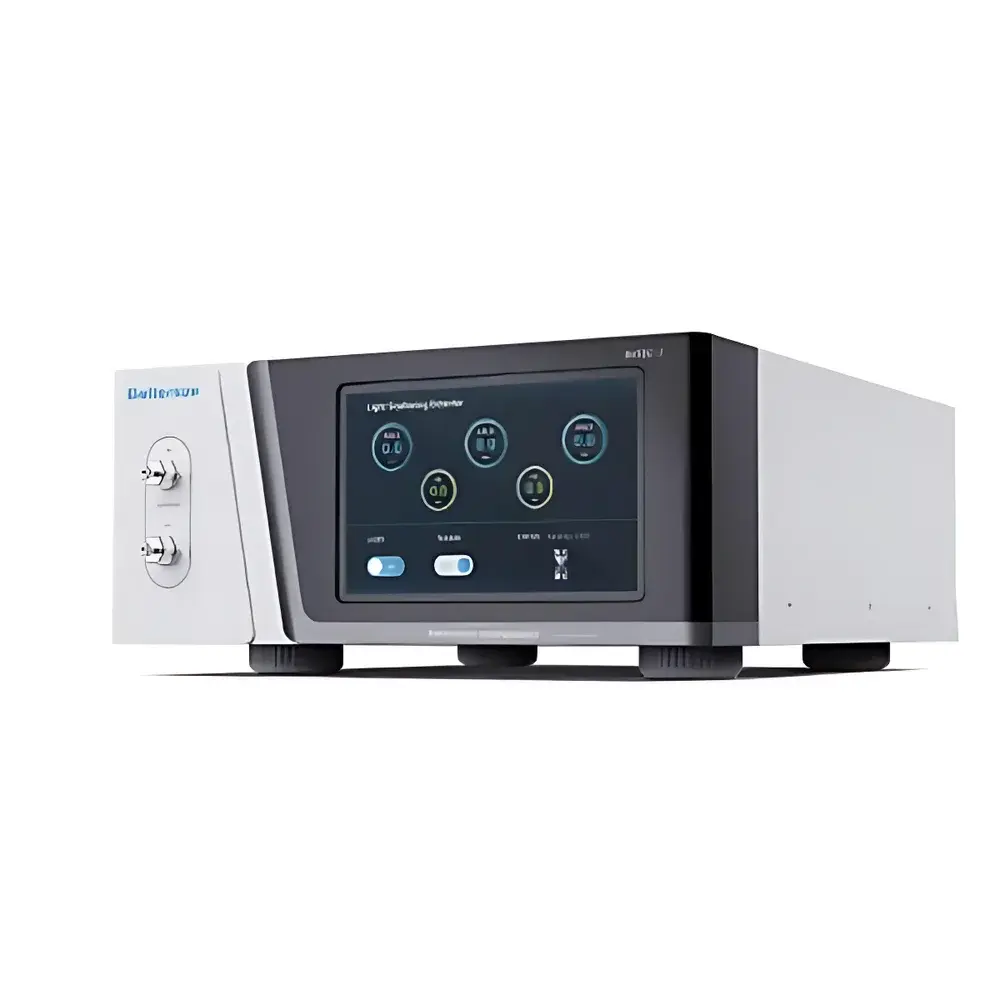
Bettersize BeSEC Static Light Scattering Detector
| Brand | Bettersize |
|---|---|
| Model | BeSEC |
| Type | Gel Permeation Chromatography (GPC) / Size Exclusion Chromatography (SEC) Light Scattering Detector |
| Laser | 640 nm semiconductor laser, 10 mW output |
| Detection angles | 7° and 90° |
| Flow cell volume | 18 µL |
| Sampling rate | 5 Hz |
| Molecular weight range | 1,000 Da – 2 × 10⁷ Da (LS1), 1,000 Da – 2 × 10⁹ Da (LS2) |
| Radius of gyration (Rg) detection limit | >12 nm |
| Supported detection modes | Homopolymer mode, protein mode |
| Output parameters | Mn, Mw, Mz, Mp, polydispersity (PD), molecular weight distribution, concentration, dn/dc, Rg |
| Input interfaces | RI detector input, UV detector input, trigger signal input |
| Power supply | 100–240 VAC, 50/60 Hz, 4 A |
| Dimensions (L×W×H) | 450 × 325 × 157 mm |
| Weight | 11 kg |
| PC requirements | Windows 10/11 (64-bit) |
| Software language | English & Chinese |
| Compliance | Designed for GLP/GMP-aligned laboratory workflows |
Overview
The Bettersize BeSEC Static Light Scattering (SLS) Detector is a precision-engineered, modular light scattering interface designed for integration with any third-party gel permeation chromatography (GPC) or size exclusion chromatography (SEC) system. It operates on the fundamental principle of Rayleigh scattering, where monochromatic laser light (640 nm, 10 mW) interacts with solute macromolecules eluting from the column. By simultaneously measuring scattered light intensity at two distinct angular positions—7° (low-angle) and 90° (right-angle)—and correlating these signals with concurrent concentration data from a differential refractometer (RI) or UV-Vis detector, the BeSEC enables absolute determination of molecular weight averages (Mn, Mw, Mz, Mp), polydispersity index (PD), radius of gyration (Rg), second virial coefficient (A2), and dn/dc. Unlike relative calibration methods reliant on polymer standards, SLS delivers primary-standard-independent quantification, making it indispensable for characterizing synthetic polymers, biopharmaceuticals, polysaccharides, and complex supramolecular assemblies under native solution conditions.
Key Features
- Dual-angle detection architecture (7° and 90°) optimized for broad molecular weight coverage—from oligomers (~1 kDa) to ultra-high-MW biopolymers (>2 × 10⁹ Da in LS2 configuration)
- Low-volume, temperature-stable flow cell (18 µL) minimizing band broadening and ensuring high-resolution SEC coupling
- Synchronized 5 Hz sampling rate aligned with typical SEC data acquisition systems for precise peak-resolved light scattering quantification
- Dedicated operational modes: homopolymer mode for synthetic polymers and protein mode with built-in Debye plot linearization and Zimm extrapolation support
- Modular analog/digital I/O interface supporting direct integration with commercial RI, UV, and fraction collector systems via trigger, analog voltage, and TTL signaling
- Robust optical design featuring thermally stabilized semiconductor laser and low-noise photodiode detection, engineered for long-term baseline stability and inter-laboratory reproducibility
Sample Compatibility & Compliance
The BeSEC is compatible with aqueous and organic mobile phases commonly used in SEC/GPC—including PBS, acetate buffers, DMF, THF, and chloroform—provided refractive index matching and compatibility with the fused silica flow cell are maintained. It supports characterization of linear, branched, and globular macromolecules across diverse sectors: synthetic polymer R&D (e.g., PEG, PMMA, PS), biopharmaceutical quality control (monoclonal antibodies, ADCs, fusion proteins), natural product analysis (hyaluronic acid, heparin, dextran), and nanomaterial dispersion studies. The system adheres to foundational metrological principles outlined in ISO 16014 (polymers — determination of average molecular weights by SEC) and ASTM D5296 (standard test method for molecular weight averages of polystyrene by SEC). When operated with version-controlled software and configured with electronic signature and audit trail functionality, the BeSEC workflow aligns with FDA 21 CFR Part 11 and EU Annex 11 expectations for regulated environments.
Software & Data Management
The BeSEC workstation software provides a unified platform for real-time signal monitoring, multi-detector synchronization, and advanced data reduction. It implements rigorous Debye and Zimm plot generation, automatic baseline correction, and iterative fitting algorithms for simultaneous determination of Mw, A2, and Rg. All raw and processed datasets—including chromatograms, scattering intensity vs. elution volume, and molecular weight distribution histograms—are stored in vendor-neutral HDF5 format with embedded metadata (instrument ID, date/time stamp, user ID, method parameters). Export options include CSV, TXT, and XML for LIMS integration. The software supports bilingual operation (English/Chinese), role-based access control, and optional 21 CFR Part 11-compliant configuration with electronic signatures, change history logging, and user activity auditing.
Applications
- Quantitative assessment of batch-to-batch consistency in therapeutic protein manufacturing
- Branching ratio determination in copolymers via combined Rg/Mw scaling analysis
- Aggregation state profiling of monoclonal antibodies under stress conditions (pH, temperature, excipients)
- Characterization of synthetic dendrimers and hyperbranched polymers without calibration standards
- Verification of conjugation efficiency in antibody-drug conjugates (ADCs) using dn/dc-dependent mass recovery
- Stability evaluation of polysaccharide-based vaccine adjuvants and delivery vehicles
FAQ
Can the BeSEC be used with non-Bettersize chromatography systems?
Yes. The BeSEC features universal analog and digital I/O ports compatible with major GPC/SEC platforms including Waters, Agilent, Shimadzu, and Thermo Fisher systems.
Is dn/dc required for molecular weight calculation?
Yes. Accurate absolute molecular weight determination requires a known or experimentally determined dn/dc value, which must be entered into the software prior to analysis.
What is the minimum sample concentration required for reliable detection?
Typical lower limits range from 0.1–0.5 mg/mL depending on molecular weight, solvent, and detector configuration—validated during method development per ISO 16014-2 guidelines.
Does the BeSEC support batch-mode analysis for routine QC testing?
Yes. The software includes template-driven method files, automated report generation, and configurable pass/fail criteria aligned with internal SOPs or pharmacopeial standards (e.g., USP <1054>).
How is thermal drift managed during extended runs?
The optical module incorporates active temperature stabilization, and the flow cell is housed within a thermally insulated chamber calibrated to ±0.1 °C, minimizing refractive index fluctuations and signal drift over multi-hour acquisitions.
Related Products






