
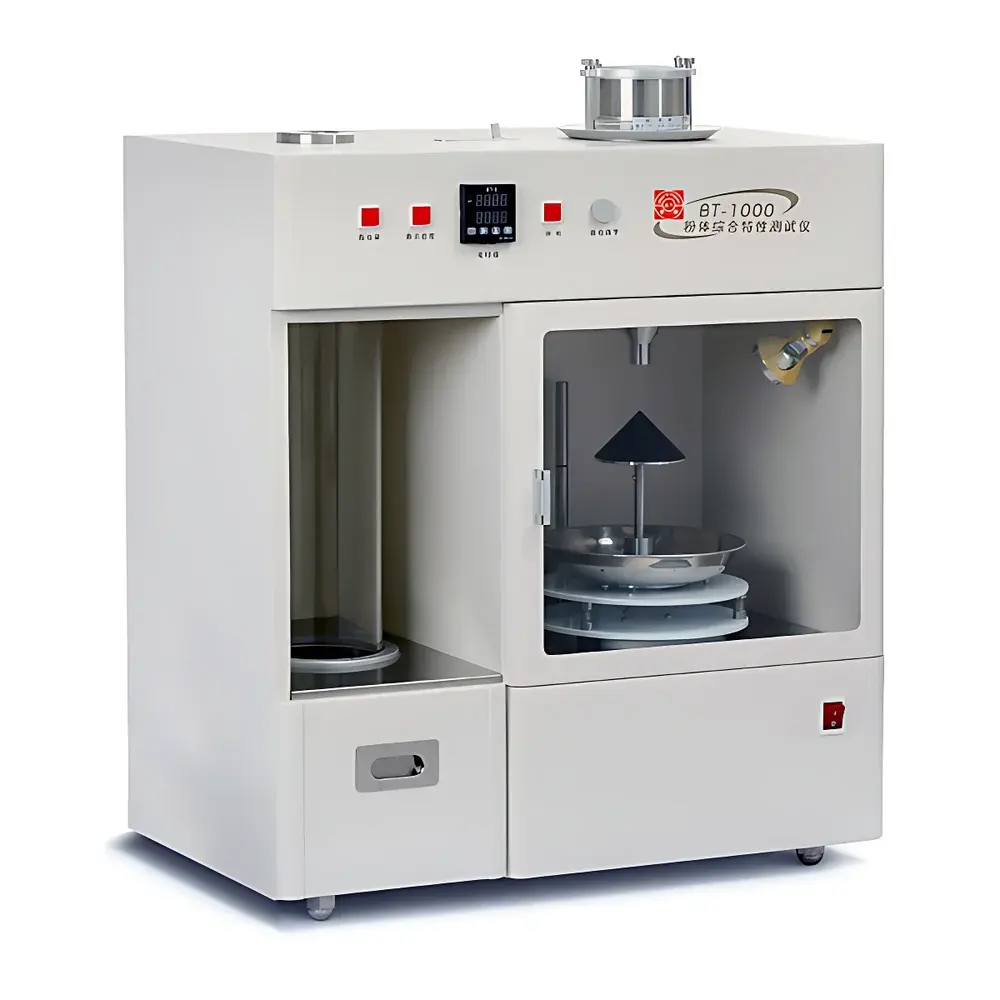
Bettersize BT-1000 Multi-Parameter Powder Flow and Bulk Property Analyzer
| Brand | Bettersize |
|---|---|
| Origin | Liaoning, China |
| Manufacturer | Bettersize Instrument Co., Ltd. |
| Model | BT-1000 |
| Instrument Type | Multi-Parameter Powder Flow and Bulk Property Analyzer |
| Measurable Parameters | Angle of Repose, Collapse Angle,平板 Angle (Heaped Angle), Sliding Angle, Dispersibility, Tapped Density, Bulk Density, Difference Angle, Compressibility, Porosity, Agglomerate Index, Uniformity Index, Hall Flow Rate, Flowability Index, Jet Flow Index |
| Maximum Sample Vessel Capacity | 40 mL |
| Minimum Sample Requirement | 0.1 mL |
| Tapping Frequency | 250 cycles/min |
| Tapping Amplitude | 3 mm or 14 mm (user-selectable) |
| Compliance | GB/T 31057.2–2018, GB/T 31057.3–2018, GB/T 16913–2008, GB/T 1479.1–2011, GB/T 5162–2006, ASTM D6393–14, USP <616>, Ph. Eur. 07/2010:20934 |
Overview
The Bettersize BT-1000 Multi-Parameter Powder Flow and Bulk Property Analyzer is an engineered solution for quantitative characterization of bulk powder behavior under standardized mechanical and gravitational conditions. It operates on principles derived from empirical powder mechanics—specifically the interplay between interparticle forces (van der Waals, capillary, electrostatic), particle morphology, and dynamic response to controlled energy input. Unlike single-parameter testers, the BT-1000 integrates 15 distinct physical indices—including angle of repose, tapped and bulk density, compressibility, dispersibility, and flowability indices—within a single platform using calibrated mechanical actuators, optical angle measurement, and gravimetric detection. Designed for laboratories requiring reproducible, operator-independent data in compliance with international pharmacopeial and industrial standards, the instrument supports method development, QC release testing, formulation optimization, and process scale-up validation across regulated and non-regulated environments.
Key Features
- Single-platform acquisition of 15 standardized powder parameters—including angle of repose, collapse angle, difference angle, heaped angle (tablet angle), sliding angle, dispersibility, tapped density, bulk density, compressibility, porosity, agglomerate index, uniformity index (D60/D10), Hall flow rate, flowability index, and jet flow index.
- Motorized, programmable tapping mechanism with dual amplitude options (3 mm and 14 mm) and fixed frequency of 250 cycles per minute, conforming to ASTM D6393–14 and USP specifications.
- Optical angle measurement system using precision protractor-based geometry, eliminating parallax error and enabling repeatable determination of surface inclination angles under static and perturbed states.
- Modular sample vessel design accommodating volumes from 0.1 mL to 40 mL, supporting both high-sensitivity microanalysis and representative bulk sampling for heterogeneous powders.
- Integrated gravimetric module with high-resolution load cell for direct mass measurement during density determinations, traceable to national metrological standards.
- Pre-configured test protocols aligned with GB/T, ASTM, USP, and Ph. Eur. requirements—enabling out-of-the-box compliance for pharmaceutical, battery material, and advanced ceramic applications.
Sample Compatibility & Compliance
The BT-1000 accommodates free-flowing, cohesive, and mildly adhesive powders ranging from submicron pharmaceutical actives to granular battery cathode materials (e.g., NMC, LFP) and micronized food additives. Its mechanical test methodology avoids reliance on air pressure or fluidization, making it suitable for moisture-sensitive, electrostatic-prone, or thermally labile samples. The instrument meets regulatory expectations for data integrity in GMP environments: all measurements are timestamped, user-logged, and stored with full audit trail capability. Test methods align with ISO 4762 (for flow through orifices), ASTM D6393–14 (flow function and compressibility), USP (powder flow assessment), and Ph. Eur. 20934 (bulk density and angle of repose). For GLP/GMP workflows, raw data files include metadata on environmental temperature, humidity, operator ID, calibration status, and parameter configuration—ensuring full traceability during FDA 21 CFR Part 11–compliant audits.
Software & Data Management
The BT-1000 is operated via dedicated Windows-based software that provides guided workflow execution, real-time visualization of angle formation and tapping dynamics, and automated calculation of derived indices (e.g., compressibility = (ρtapped − ρbulk) / ρtapped). All raw sensor outputs—angular displacement, mass, cycle count—are logged at 10 Hz resolution and exported in CSV or PDF report format. Software supports multi-user access control, electronic signature capture for critical steps, and customizable report templates compliant with ALCOA+ principles (Attributable, Legible, Contemporaneous, Original, Accurate, Complete, Consistent, Enduring, Available). Historical datasets can be compared using built-in statistical tools (mean, SD, CV%, confidence intervals), facilitating trend analysis across batches, suppliers, or process modifications.
Applications
- Pharmaceutical Development: Quantifying flow risk for direct compression tablet formulations; screening excipients for blend uniformity; validating post-milling or drying steps per ICH Q5C.
- Battery Materials: Assessing electrode slurry feedstock consistency; correlating tapped density with calendering performance; evaluating cohesion in silicon-anode composites.
- Powder Coating & Additive Manufacturing: Predicting fluidization stability in spray booths; qualifying metal powders (e.g., Ti-6Al-4V, Inconel 718) against ASTM B213 and ISO/ASTM 52907.
- Food & Agricultural Products: Monitoring caking propensity in powdered dairy, spices, or fertilizers; optimizing anti-caking agent dosage via dispersibility and agglomerate index trends.
- Academic & Standards Laboratories: Teaching powder rheology fundamentals; generating reference datasets for ISO/TC 24/SC 4 working groups; supporting round-robin interlaboratory studies.
FAQ
What standards does the BT-1000 directly support?
The instrument implements test sequences and calculation algorithms specified in GB/T 31057.2–2018, ASTM D6393–14, USP , and Ph. Eur. 20934, with documented traceability to each clause.
Can the BT-1000 be used for regulatory submissions?
Yes—when operated within validated SOPs and paired with appropriate calibration records, its output meets data integrity requirements for FDA, EMA, and PMDA submissions involving powder flow characterization.
Is operator training required to achieve reproducible results?
Minimal training is needed due to automated angle detection and preset tapping profiles; however, ISO/IEC 17025–accredited labs should document operator qualification per internal procedures.
Does the system support custom index development?
Yes—the software allows user-defined formulas using any combination of measured or calculated parameters, enabling proprietary flow scoring systems for internal quality gates.
How is calibration verified?
Angle measurement is verified using NIST-traceable angular gauge blocks; density modules are calibrated with certified stainless-steel weights; tapping frequency and amplitude are confirmed with laser vibrometry per annual maintenance protocol.
Related Products



