
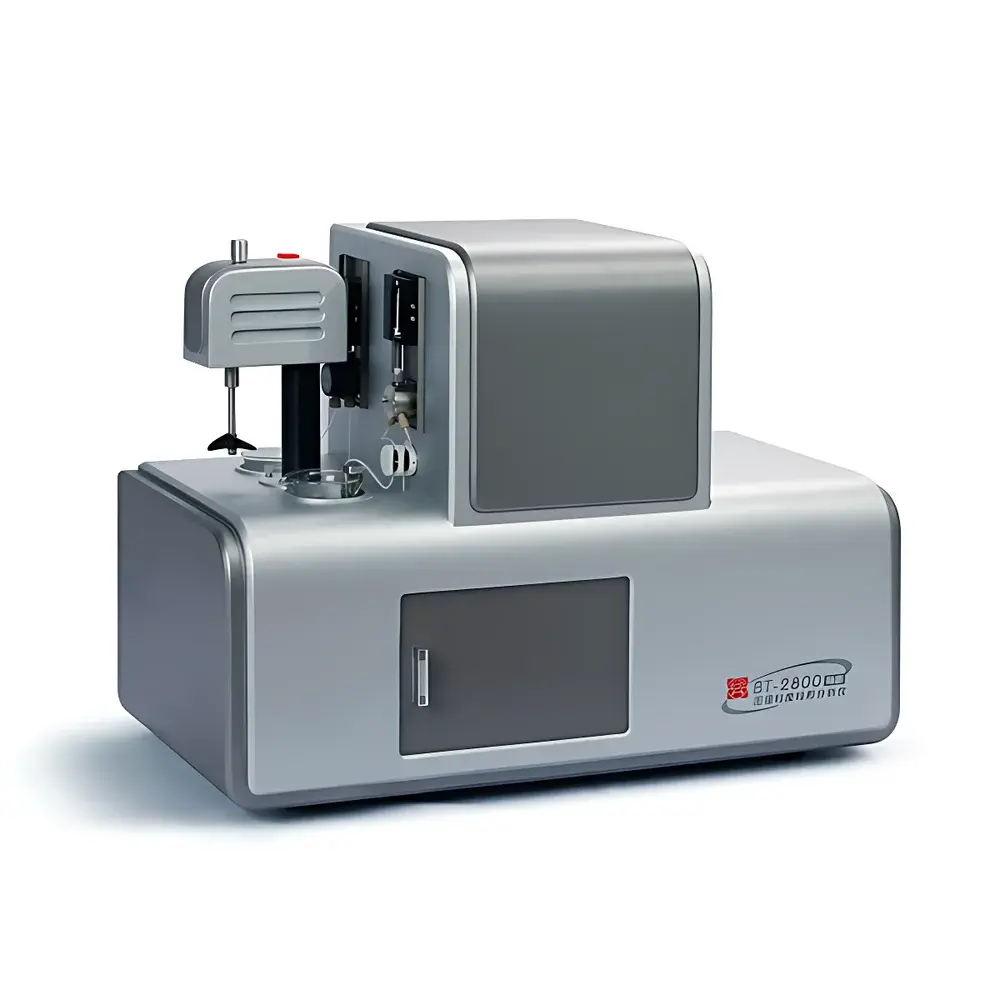
Bettersize BT-2800 Dynamic Image-Based Particle Size and Shape Analyzer with Sheath Flow Technology
| Brand | Bettersize |
|---|---|
| Model | BT-2800 |
| Origin | Liaoning, China |
| Manufacturer | Bettersize Instruments Co., Ltd. |
| Instrument Type | Dynamic |
| Measurement Range | 4–400 µm |
| Magnification | 20×–1400× |
| Repeatability Error | ≤1% (D50, certified reference material) |
| Accuracy Error | ≤1% (D50, certified reference material) |
| High-Speed CCD | 120 fps |
| Particle Recognition Speed | ≥10,000 particles/min |
| Power Supply | 100–240 VAC, 50/60 Hz, 4 A |
| Dimensions | 610 × 300 × 450 mm |
| Weight | 22 kg |
Overview
The Bettersize BT-2800 is a high-throughput, dynamic image-based particle size and shape analyzer engineered for precision characterization of anisotropic and irregularly shaped particles in suspension. Unlike static microscopy-based systems that capture stationary particles on slides, the BT-2800 employs hydrodynamic sheath flow technology to align and transport particles through the focal plane of a telecentric optical system at controlled velocity. As particles pass single-file through the observation zone—encapsulated by a coaxial sheath fluid stream—they are imaged in real time by a 120 fps monochrome CCD camera coupled to a high-magnification (20×–1400×), aberration-corrected microscope. This continuous-flow imaging architecture eliminates focus drift, motion blur, and particle overlap—key sources of error in conventional static image analysis—thereby enabling statistically robust quantification of both size and morphological parameters across populations exceeding 100,000 particles per measurement.
Key Features
- Sheath flow hydrodynamic focusing: Ensures laminar, single-file particle transit through the microscope’s depth-of-field-limited focal plane, maximizing image sharpness and dimensional fidelity.
- Telecentric optical design: Eliminates perspective distortion and magnification variation across the field of view—critical for accurate aspect ratio and circularity calculations.
- Real-time, synchronized acquisition & processing: High-speed CCD imaging (120 fps) paired with multi-threaded edge-detection algorithms enables on-the-fly particle segmentation and feature extraction at ≥10,000 particles per minute.
- Automated dispersion and injection: Integrated stirrer, ultrasonic disperser, and dual syringe pumps (sample + sheath fluid) ensure consistent suspension homogeneity and reproducible sample introduction without manual pipetting.
- Comprehensive morphometric output: Computes per-particle metrics including aspect ratio (length/width), circularity (4π·area/perimeter²), convexity, solidity, ellipticity, and Feret diameters—each with full distribution histograms and cumulative curves.
Sample Compatibility & Compliance
The BT-2800 is optimized for suspensions of non-agglomerating or weakly agglomerating particles within the 4–400 µm range, particularly suited for narrow-distribution samples (Dmax/Dmin < 30). It supports aqueous and low-viscosity organic dispersions, with sheath fluid typically deionized water or ethanol. The system meets ISO 13322-2:2020 (Particle size analysis — Image analysis methods — Part 2: Dynamic image analysis) requirements for measurement traceability, repeatability (≤1% RSD on D50 using NIST-traceable reference materials), and documented calibration protocols. Its hardware architecture and software audit trail support GLP-compliant operation, including user access control, electronic signatures, and immutable raw data archiving—facilitating FDA 21 CFR Part 11 readiness when deployed in regulated QC environments.
Software & Data Management
BT-2800’s proprietary analysis software (v5.x) provides a validated, modular interface for acquisition, real-time visualization, and post-processing. Each measurement session automatically logs metadata—including instrument configuration, dispersion parameters, environmental conditions, and operator ID—ensuring full analytical traceability. Particle-level data (coordinates, grayscale intensity, contour, and all derived metrics) are stored in HDF5 format for interoperability with MATLAB, Python (Pandas/H5Py), or LIMS platforms. Distribution outputs include interval-based histograms, cumulative undersize/oversize curves, scatter plots (e.g., circularity vs. aspect ratio), and statistical summaries (D10, D50, D90, span, skewness). Batch reporting supports customizable PDF/Excel export with embedded raw images and QA/QC flags.
Applications
The BT-2800 delivers critical insights in R&D and quality assurance for industries requiring rigorous morphological control: mineral processing (wollastonite, mica), advanced abrasives (SiC, Al2O3, synthetic diamond), battery materials (spherical graphite, silicon anode powders), metal AM feedstocks (spherical Al, Ti, Ni alloys), pharmaceutical excipients (milled lactose, spray-dried proteins), and biologics (cell aggregates, liposomes). Its ability to quantify aspect ratio distributions makes it indispensable for evaluating fiber aspect ratios in composites or detecting needle-like impurities in injectables per USP .
FAQ
What particle types are best suited for BT-2800 analysis?
Particles with moderate density contrast against the dispersant, minimal aggregation tendency, and aspect ratios between 1:1 and 20:1—especially fibrous, flaky, or irregular shapes in the 4–400 µm range.
How does sheath flow improve measurement accuracy compared to conventional flow cells?
Sheath flow confines particles to a narrow, centered stream within the optical axis, ensuring consistent focus, eliminating out-of-plane motion artifacts, and preventing particle stacking—directly enhancing repeatability of length/width measurements.
Can the system comply with regulatory data integrity requirements?
Yes—the software supports role-based access, electronic signatures, audit trails, and raw data immutability, aligning with ALCOA+ principles and enabling validation for GMP/GLP environments.
Is calibration traceable to international standards?
Calibration uses NIST-traceable stage micrometers and certified particle reference standards (e.g., NIST SRM 1980), with documentation conforming to ISO/IEC 17025 guidelines.
What dispersion methods are integrated?
Ultrasonic bath (optional probe), magnetic stirring, and programmable shear-controlled injection—configurable per material sensitivity to avoid breakage or reagglomeration.



