
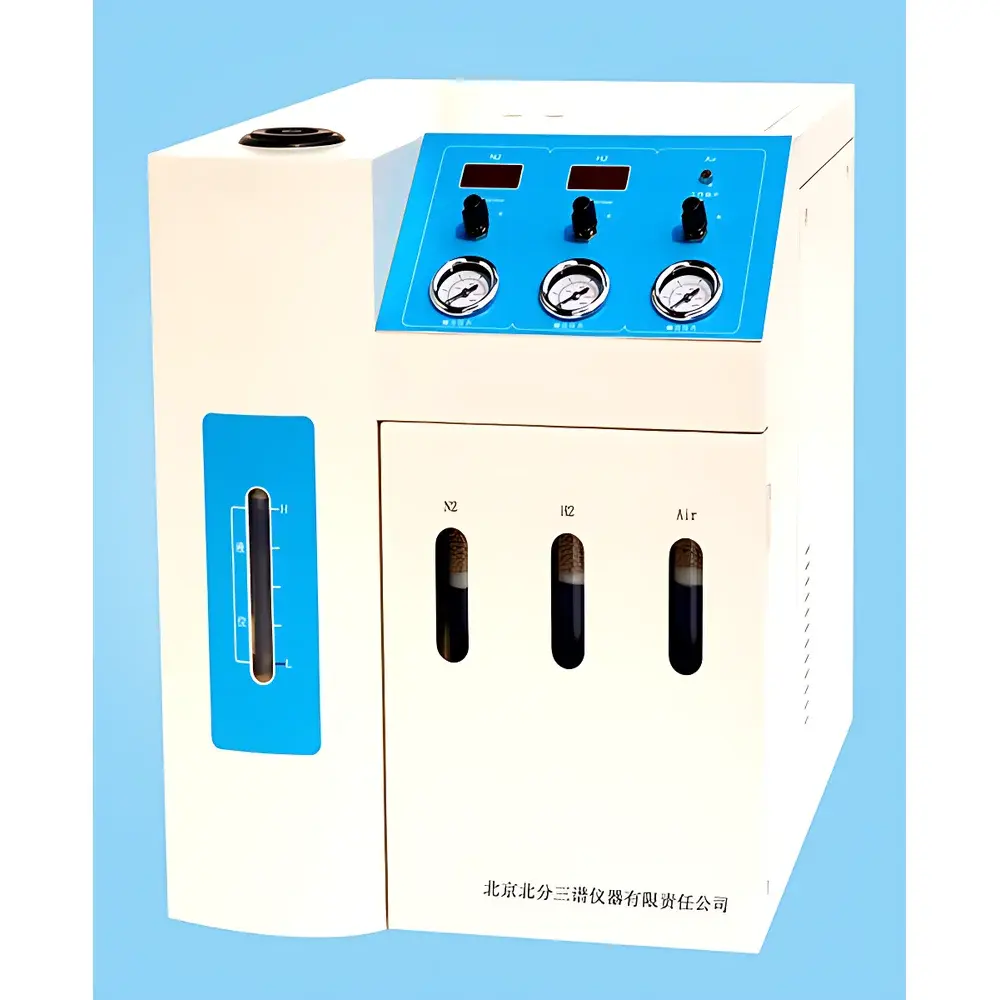
BF-300G Tri-Gas Generator (Nitrogen, Hydrogen & Zero Air)
| Brand | Beifen Sanpu |
|---|---|
| Origin | Beijing, China |
| Manufacturer Type | Direct Manufacturer |
| Country of Origin | China |
| Model | BF-300G |
| Hydrogen Generation Principle | Electrolytic (PEM-compatible architecture) |
| Hydrogen Output Flow | 0–300 mL/min |
| Nitrogen Output Flow | 0–300 mL/min |
| Zero Air Output Flow | 0–2 L/min |
| Maximum Output Pressure | 0.4 MPa (4 bar) |
| Hydrogen Purity | ≥99.999% (O₂ < 1 ppm, H₂O < 1 ppm) |
| Nitrogen Purity | ≥99.994% (O₂ < 60 ppm) |
| Zero Air Specifications | Oil-free, dew point ≤ –40 °C, hydrocarbon-free |
| Power Consumption | 120 W (H₂ mode), 350 W (full tri-gas operation) |
| Input Voltage | AC 220 V, 50 Hz |
| Operating Temperature | 0–40 °C |
| Relative Humidity | <85% non-condensing |
| Dimensions (L×W×H) | 500 × 400 × 450 mm |
| Net Weight | 40 kg |
| Safety Compliance | Overpressure protection, electrolyte level monitoring, gas leak detection, auto-shutdown on fault |
Overview
The BF-300G Tri-Gas Generator is an integrated, benchtop laboratory gas supply system engineered to simultaneously deliver high-purity nitrogen, hydrogen, and zero-grade air—each independently regulated and continuously monitored. Designed for compatibility with analytical instrumentation requiring stable, contaminant-free carrier, fuel, and combustion gases—particularly gas chromatography (GC) systems equipped with flame ionization detectors (FID), thermal conductivity detectors (TCD), and electron capture detectors (ECD)—the BF-300G replaces conventional high-pressure gas cylinders without compromising performance or safety. Its core architecture employs three parallel, isolated gas-generation modules: a membrane-based pressure-swing adsorption (PSA) nitrogen generator, a low-temperature alkaline electrolytic hydrogen cell with high-surface-area electrode stack, and a multi-stage oil-free air compression and purification train incorporating activated carbon, molecular sieve, and desiccant beds. All modules operate under closed-loop pressure control, maintaining output stability within ±0.01 MPa across the full flow range—a critical requirement for GC retention time reproducibility and detector baseline stability.
Key Features
- Triple independent gas outputs—nitrogen, hydrogen, and zero air—with fully decoupled flow and pressure regulation
- Hydrogen generation via optimized alkaline electrolysis: high-efficiency electrode geometry, low-cell-temperature operation (<45 °C), and integrated oxygen venting ensure sustained purity ≥99.999% (O₂ < 1 ppm, H₂O < 1 ppm)
- Nitrogen module utilizes multi-stage PSA with layered alumina/silica membranes and repetitive purification cycles to achieve ≥99.994% purity (O₂ < 60 ppm)
- Zero air system features three-stage filtration (particulate → coalescing → activated carbon + molecular sieve), dual-stage pressure regulation, and dew point control ≤ –40 °C
- Digital LED flow displays for both nitrogen and hydrogen channels—real-time, calibrated readouts with ±2% full-scale accuracy
- Non-return liquid traps in N₂ and H₂ circuits prevent backflow into electrolyte or adsorption columns during shutdown or pressure transients
- Integrated safety suite: overpressure cut-off valves, electrolyte level sensors, automatic thermal shutdown, and continuous gas leak detection
- Energy-efficient design: switch-mode power supply reduces standby consumption; full-load power draw remains ≤350 W during concurrent tri-gas operation
- Maintenance-light operation: only deionized or distilled water replenishment required for hydrogen generation—no consumable cartridges or scheduled membrane replacements
Sample Compatibility & Compliance
The BF-300G is validated for use with all major GC platforms—including Agilent, Thermo Fisher, Shimadzu, PerkinElmer, and Waters—supporting FID, TCD, ECD, and PID configurations. Its gas specifications meet or exceed ASTM D6299 (precision and bias requirements for GC carrier gases), ISO 8573-1 Class 2:2:2 for compressed air quality, and USP criteria for hydrogen used in analytical applications. The instrument’s firmware logs operational parameters (pressure, flow, temperature, runtime) with timestamped records, supporting GLP/GMP data integrity requirements. While not inherently 21 CFR Part 11 compliant, its audit-trail-capable software interface (via optional RS-232/USB) enables integration into validated laboratory information management systems (LIMS) when deployed with appropriate electronic signature controls.
Software & Data Management
The BF-300G operates in standalone mode with front-panel controls but supports optional PC connectivity via RS-232 or USB for remote monitoring and configuration. The companion software provides real-time graphical display of gas pressures, flow rates, and system status flags; stores up to 30 days of operational history with export to CSV; and allows user-defined alarm thresholds for pressure deviation, low-water warning, or temperature excursion. All data entries are immutable and include operator ID, event timestamp, and system-generated checksum—facilitating traceability during internal audits or regulatory inspections. Firmware updates are delivered via signed binary packages to preserve system integrity.
Applications
- GC carrier gas supply (N₂) for capillary column separation with minimal baseline drift
- FID fuel gas (H₂) and make-up gas (air or N₂) in split/splitless and on-column injection modes
- TCD reference and measurement gas streams requiring consistent thermal conductivity
- Calibration gas blending systems where ultra-high-purity base gases are prerequisites
- Lab-scale hydrogenation reactors requiring continuous, low-flow H₂ feed
- Environmental air monitoring stations needing zero air for span calibration of NOₓ, SO₂, and O₃ analyzers
- Research laboratories performing method development under controlled gas composition protocols
FAQ
What is the expected service life of the electrolytic cell?
Under normal operating conditions (≤300 mL/min H₂, ambient temperature <35 °C), the alkaline electrolytic cell is rated for ≥15,000 hours of cumulative runtime, equivalent to approximately 5–7 years of typical lab usage.
Does the BF-300G require external cooling or ventilation?
No forced ventilation is required; the unit is designed for natural convection cooling. However, minimum clearance of 10 cm on all sides is recommended to maintain ambient airflow and prevent heat buildup in enclosed cabinets.
Can nitrogen and hydrogen be used simultaneously without cross-contamination?
Yes. All three gas paths are physically isolated—no shared manifolds, valves, or filters—ensuring zero cross-talk between nitrogen, hydrogen, and zero air streams.
Is distilled water sufficient for electrolyte replenishment, or is KOH solution required?
Only deionized or distilled water is added to the reservoir; the system contains a sealed, pre-charged KOH electrolyte cartridge with no user-serviceable components.
How often must the air filter elements be replaced?
Under standard lab conditions (<85% RH, low particulate load), the three-stage air filter set requires replacement every 12 months or after 3,000 operating hours—whichever occurs first—as indicated by the maintenance alert on the front panel display.



