
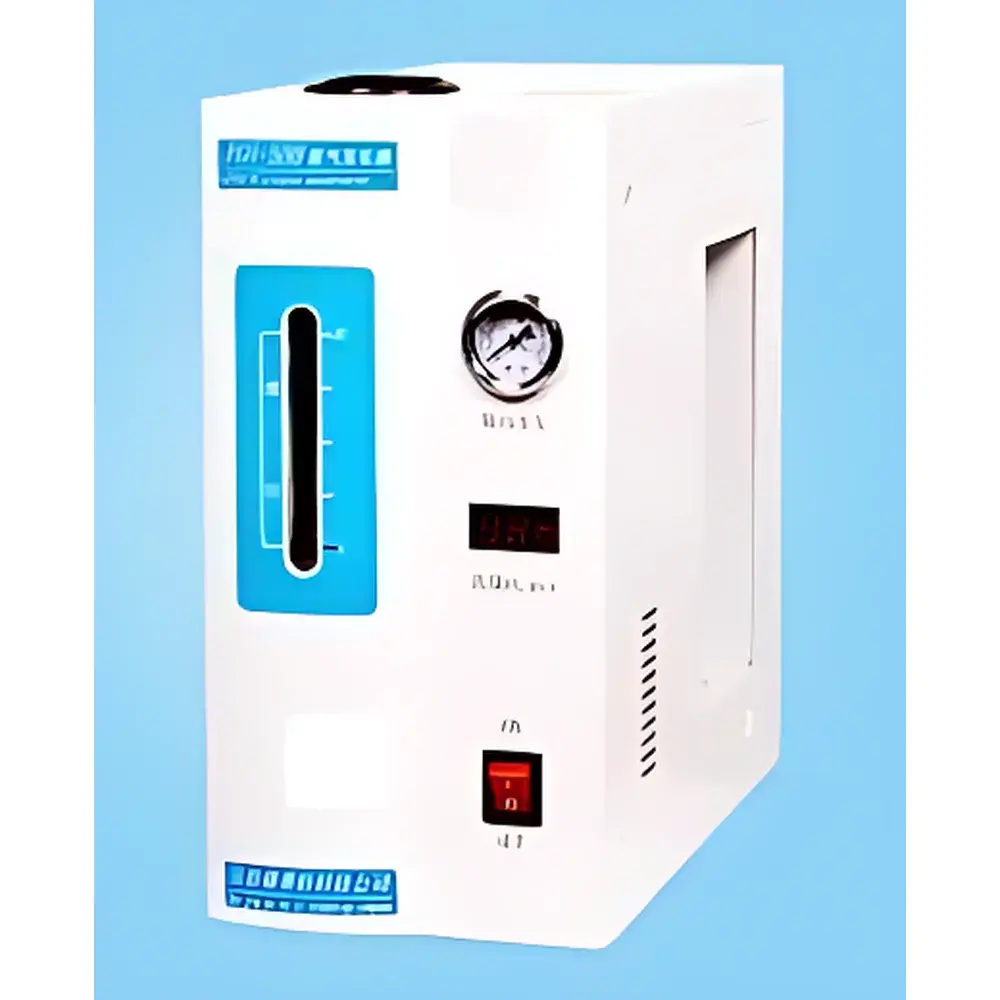
BF-300N Nitrogen Generator by Beifen Sanpu
| Brand | Beifen Sanpu |
|---|---|
| Model | BF-300N |
| Output Flow | 0–300 mL/min |
| Nitrogen Purity | 99.99% (v/v, O₂-equivalent) |
| Output Pressure | 0.4 MPa |
| Input Air Pressure | ≤0.5 MPa |
| Power Consumption | 80 W |
| Dimensions (L×W×H) | 360 × 190 × <380 mm |
| Weight | 15 kg |
| Operating Temperature | 10–40 °C |
| Relative Humidity | <85% RH |
| Compliance | CE-marked design principles |
Overview
The BF-300N Nitrogen Generator is a compact, membrane-based gas separation system engineered for reliable on-demand nitrogen supply in analytical laboratories. It utilizes compressed air as the feedstock and employs a proprietary hollow-fiber membrane module to selectively permeate oxygen, water vapor, and other trace gases—leaving behind high-purity nitrogen with consistent composition and pressure stability. Unlike cryogenic or PSA-based systems, this generator operates without moving parts or consumable adsorbents, delivering continuous nitrogen at up to 300 mL/min with nominal purity of 99.99% (v/v, referenced to residual oxygen content). Its design targets applications requiring stable, low-flow inert gas—particularly where cylinder dependency introduces logistical constraints, safety concerns, or baseline instability in sensitive detection systems.
Key Features
- Membrane Separation Architecture: Integrates high-selectivity polymeric hollow-fiber membranes optimized for long-term thermal and mechanical stability under continuous operation.
- Auto-Start & Auto-Flush Sequence: Built-in programmable logic initiates automatic purge upon power-up, removing residual moisture and ambient air from the internal gas path before stable output is established.
- No-Liquid-Backflow Protection: A passive, gravity-independent non-return valve assembly prevents condensate or lubricant migration from upstream compressors into the membrane module—eliminating risk of irreversible membrane fouling.
- Fail-Safe Gas Shutoff: Integrated solenoid valve closes automatically during power interruption, isolating the nitrogen outlet and preserving downstream system integrity.
- Low Thermal Load Design: Heat-dissipating finned housing and optimized airflow routing maintain membrane temperature below 45 °C during sustained operation, extending service life beyond 15,000 hours under typical lab conditions.
- Modular Service Access: Front-panel quick-release cover enables tool-free inspection of filter cartridges and membrane housing—minimizing downtime during routine maintenance.
Sample Compatibility & Compliance
The BF-300N is compatible with all standard laboratory-grade compressed air sources meeting ISO 8573-1 Class 3:3:3 specifications (oil content ≤0.1 mg/m³, particle size ≤5 µm, dew point ≤−20 °C). It delivers nitrogen suitable for GC carrier gas, LC-MS mobile phase sparging, sample preparation blanking, glove box purging, and inert atmosphere storage. While not certified to ISO 8573-1 for final gas quality, its output meets ASTM D6352-22 criteria for “nitrogen suitable for general-purpose instrumental analysis.” The unit adheres to IEC 61010-1 safety standards for laboratory electrical equipment and incorporates reinforced insulation, overcurrent protection, and earth leakage monitoring. Its firmware architecture supports audit-ready event logging (power cycles, pressure anomalies, runtime), aligning with GLP documentation requirements for instrument qualification.
Software & Data Management
The BF-300N operates as a standalone analog-controlled system with no embedded microprocessor or digital interface. All operational parameters—including inlet pressure, outlet flow, and output pressure—are monitored via calibrated analog gauges and regulated via mechanical pressure-reducing valves and needle valves. This analog architecture ensures electromagnetic immunity in high-RF environments (e.g., adjacent to NMR spectrometers or plasma sources) and eliminates cybersecurity vulnerabilities associated with networked controllers. For labs requiring integration into centralized monitoring systems, optional 4–20 mA analog output modules (sold separately) provide real-time pressure and flow telemetry compatible with SCADA or LIMS platforms. All calibration records, maintenance logs, and performance verification data (e.g., purity verification via handheld O₂ analyzer) are maintained externally per institutional SOPs.
Applications
- Carrier gas for capillary gas chromatography (GC) and GC-MS systems requiring stable, low-part-per-trillion oxygen content.
- Blank gas for headspace analysis and purge-and-trap sample introduction.
- Inert overlay gas for solvent evaporation stations and rotary evaporators handling oxygen-sensitive compounds.
- Purging medium for FTIR sample compartments and UV-Vis cuvette holders to eliminate atmospheric CO₂ and H₂O absorption artifacts.
- Supply gas for nitrogen-sealed reagent bottles and anhydrous reaction setups in synthetic chemistry labs.
- Backup source for nitrogen-dependent calibration procedures in environmental testing labs accredited to ISO/IEC 17025.
FAQ
What compressed air quality is required for optimal BF-300N performance?
A minimum of ISO 8573-1 Class 3:3:3 compressed air is recommended—achieved using coalescing pre-filters, refrigerated dryers, and activated carbon post-filters. Oil carryover >0.1 mg/m³ may irreversibly coat membrane surfaces and reduce nitrogen yield.
Can the BF-300N be used as a carrier gas for ECD or TCD detectors?
Yes—its 99.99% purity (≤10 ppmv O₂) meets detector manufacturer specifications for most ECD and TCD applications. However, users performing ultra-trace analysis (<100 pg) should verify baseline noise profiles against certified cylinder nitrogen.
Is routine membrane replacement necessary?
No scheduled replacement is required. Under compliant air feed conditions and ambient temperatures ≤35 °C, the membrane module maintains rated performance for ≥5 years or 15,000 operating hours—whichever occurs first.
Does the unit comply with FDA 21 CFR Part 11 requirements?
As an analog-only device with no electronic data storage or user-accessible software, the BF-300N falls outside the regulatory scope of Part 11. Its operational logs must be manually recorded per lab SOPs to satisfy ALCOA+ data integrity principles.
How does ambient humidity affect output purity?
High inlet humidity (>85% RH) increases water vapor load on the membrane, potentially elevating residual moisture in output gas. Pre-drying compressed air to a dew point ≤−20 °C mitigates this effect and ensures consistent O₂-equivalent purity.



