
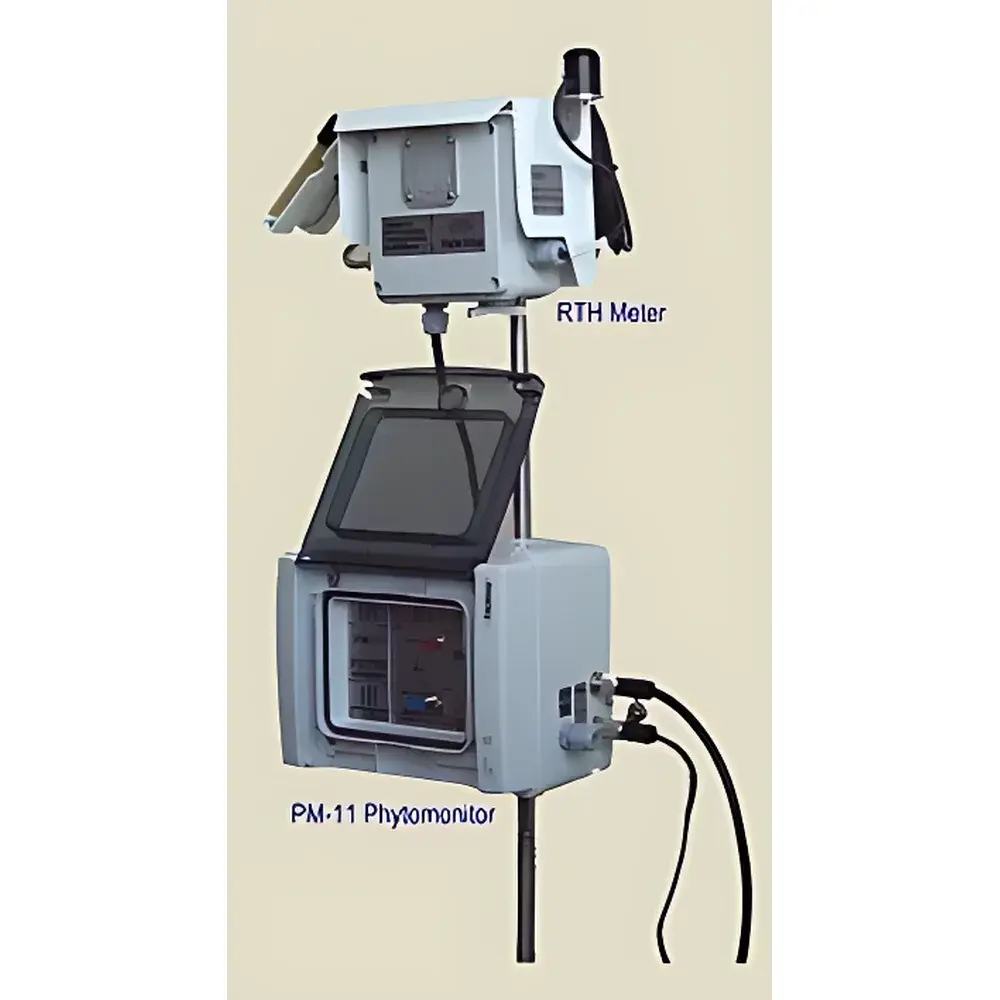
BF-Agritech PM-11 Plant Physiological and Ecological Monitoring System
| Brand | BF-Agritech |
|---|---|
| Origin | Imported |
| Manufacturer Type | Authorized Distributor |
| Model | PM-11 |
| Input Channels | 8 × 11-bit analog + dedicated digital RTH interface |
| Sampling Rate | Configurable from 1 s to 1 h |
| Memory | 512 KB non-volatile |
| Power Supply | 12 V DC (AC adapter 90–260 V AC / rechargeable battery / solar kit optional) |
| Communication | RS-232 (1 m), RS-485 (up to 1.2 km), or wireless modem (0.3–64 km range) |
| Enclosure | IP65-rated weatherproof housing |
| Dimensions | 18 W × 14 H × 11.5 L cm |
| Operating Temperature | 0–50 °C |
| Humidity Range | 0–100 % RH |
| Compatible Sensors | RTH (air T/RH/PAR/leaf wetness), SD-5M (stem diameter change, 0–5000 µm), SD-6M (trunk diameter change, 0–5000 µm), DE-1 (dendrometer, 0–10 mm), FI-LM/FI-MM/FI-SM (fruit expansion, 7–160 mm), LT-2M (leaf temperature, 5–50 °C), SF-4M/SF-5M (sap flow, up to ~3 mL/h), SA-20 (growth gauge, 0–2000 mm, ~2 mm resolution), TIR-4 (global solar radiation, 0–1000 W/m², 300–1100 nm), PAR-2 (photosynthetically active radiation, 0–2500 µmol/m²·s, 400–700 nm), ATH-2 (air T/RH), ST-21 (soil temperature, 0–50 °C) |
Overview
The BF-Agritech PM-11 Plant Physiological and Ecological Monitoring System is a field-deployable, autonomous data acquisition platform engineered for continuous, high-temporal-resolution observation of plant biophysical responses to environmental stimuli. It operates on the principle of in situ physiological signal transduction—capturing dynamic metrics such as stem/trunk diameter variation, fruit expansion, sap flow velocity, leaf temperature differentials, and microclimate parameters (air temperature, relative humidity, PAR, leaf wetness, global radiation). Unlike laboratory-based assays, the PM-11 enables longitudinal monitoring under natural or controlled-environment conditions without requiring constant PC connectivity. Its architecture supports long-term unattended operation in orchards, vineyards, greenhouses, and ecological research plots, delivering time-synchronized datasets essential for phenotypic trait quantification, irrigation scheduling validation, stress physiology studies, and climate-resilience modeling.
Key Features
- Autonomous operation with integrated 512 KB non-volatile memory—no real-time PC connection required for data logging.
- Eight 11-bit analog input channels supporting millivolt- and voltage-output sensors (e.g., dendrometers, thermistors, pyranometers) with programmable gain and offset calibration.
- Dedicated digital interface for RTH sensor modules, which integrate four co-located measurements: air temperature (0–50 °C), relative humidity (0–100 % RH), photosynthetically active radiation (0–2000 µmol/m²·s), and binary leaf wetness detection.
- User-configurable sampling intervals ranging from 1 second (for transient events such as rapid stomatal closure or diurnal turgor shifts) to 1 hour (for seasonal growth trends).
- IP65-rated enclosure with waterproof connectors compatible with industry-standard agricultural and ecological sensors.
- Flexible power architecture: supports 12 V DC input from AC adapters (90–260 V AC, 50/60 Hz), rechargeable batteries, or complete solar charging kits (panel, regulator, and deep-cycle battery).
- Multi-mode communication: local RS-232 (1 m), extended-range RS-485 (up to 1.2 km over twisted-pair), or licensed-band wireless modems (operational range 0.3–64 km depending on terrain and antenna configuration).
Sample Compatibility & Compliance
The PM-11 is designed for direct integration with a validated suite of plant physiology sensors—including BF-Agritech’s SD-series dendrometers (for stem and trunk microvariation), FI-series fruit gauges (with calibrated mechanical ranges for spherical produce), SF-series thermal dissipation sap flow probes, and TIR-4/PAR-2 radiometric sensors traceable to NIST-calibrated reference standards. All connected sensors comply with IEC 61000-6-2 (immunity) and IEC 61000-6-4 (emissions) for industrial environments. While the PM-11 itself is not CE-marked as a medical device, its data output structure adheres to FAO’s Agroecological Data Standards v2.1 and supports metadata tagging compliant with ISA-Tab (Investigation-Study-Assay) frameworks. For regulated trials (e.g., OECD GLP-compliant crop protection studies), raw binary logs can be exported with full audit trail timestamps and sensor ID headers, enabling traceability per ISO/IEC 17025:2017 clause 7.5.2.
Software & Data Management
The system ships with PM-Link Desktop Suite (Windows 98 through Windows XP compatible), providing firmware update capability, channel configuration, trigger-based event logging, and export to CSV, Excel, or MATLAB-compatible .mat formats. Data files include embedded UTC timestamps, sensor serial numbers, and user-defined site identifiers. The software supports batch processing of multi-node deployments and includes built-in anomaly detection algorithms—flagging deviations exceeding ±3σ from rolling 24-h baselines for parameters such as stem contraction rate or PAR-to-transpiration coupling efficiency. Although native cloud synchronization is not implemented, ASCII-formatted outputs are interoperable with third-party platforms including CropX, FarmShots, and custom Python-based analytics pipelines using Pandas and SciPy. Audit logs record all configuration changes, ensuring alignment with FDA 21 CFR Part 11 requirements when used in GxP-aligned agronomic trials.
Applications
- Irrigation optimization: Real-time sap flow and stem diameter variation data inform deficit irrigation strategies by detecting onset of water stress before visible symptoms emerge.
- Phenotyping pipelines: High-frequency trunk diameter records serve as proxies for carbon allocation dynamics in breeding programs evaluating drought tolerance or fruit load resilience.
- Micrometeorological partitioning: Co-located PAR, net radiation, and leaf temperature enable calculation of canopy conductance and decoupling coefficients per Monteith’s formulation.
- Fruit quality modeling: Synchronized fruit expansion rates (FI-series) with thermal time accumulation allow predictive modeling of harvest windows and cracking risk indices.
- Climate adaptation research: Multi-year deployment across elevation gradients captures plasticity in diurnal growth rhythms under varying vapor pressure deficits.
FAQ
Is the PM-11 suitable for outdoor deployment in tropical climates with high humidity and frequent rainfall?
Yes—the housing meets IP65 ingress protection standards, and all sensor interfaces use sealed, UV-stabilized polyurethane connectors rated for continuous exposure at 95 % RH and 50 °C ambient.
Can multiple PM-11 units be synchronized for networked monitoring across a large farm plot?
Yes—RS-485 daisy-chaining supports up to 32 nodes on a single bus; wireless modems enable time-synchronized sampling via GPS-disciplined oscillators (optional add-on module).
Does the system support calibration certificate traceability for accredited laboratories?
Sensor-specific calibration certificates (NIST-traceable where applicable) are provided with each optional probe; the PM-11’s analog input linearity is factory-verified to ±0.2 % FS across its operating temperature range.
What is the expected battery life under typical field conditions using the solar kit?
With a 20 W solar panel and 12 Ah LiFePO₄ battery, continuous operation at 10-minute sampling intervals sustains >12 months autonomy in mid-latitude temperate zones (≥3.5 peak sun hours/day).
Are firmware updates and technical support available post-purchase?
BF-Agritech provides lifetime firmware revision access and remote diagnostic support via secure SSH tunneling to registered devices; critical security patches are distributed quarterly.
Related Products







