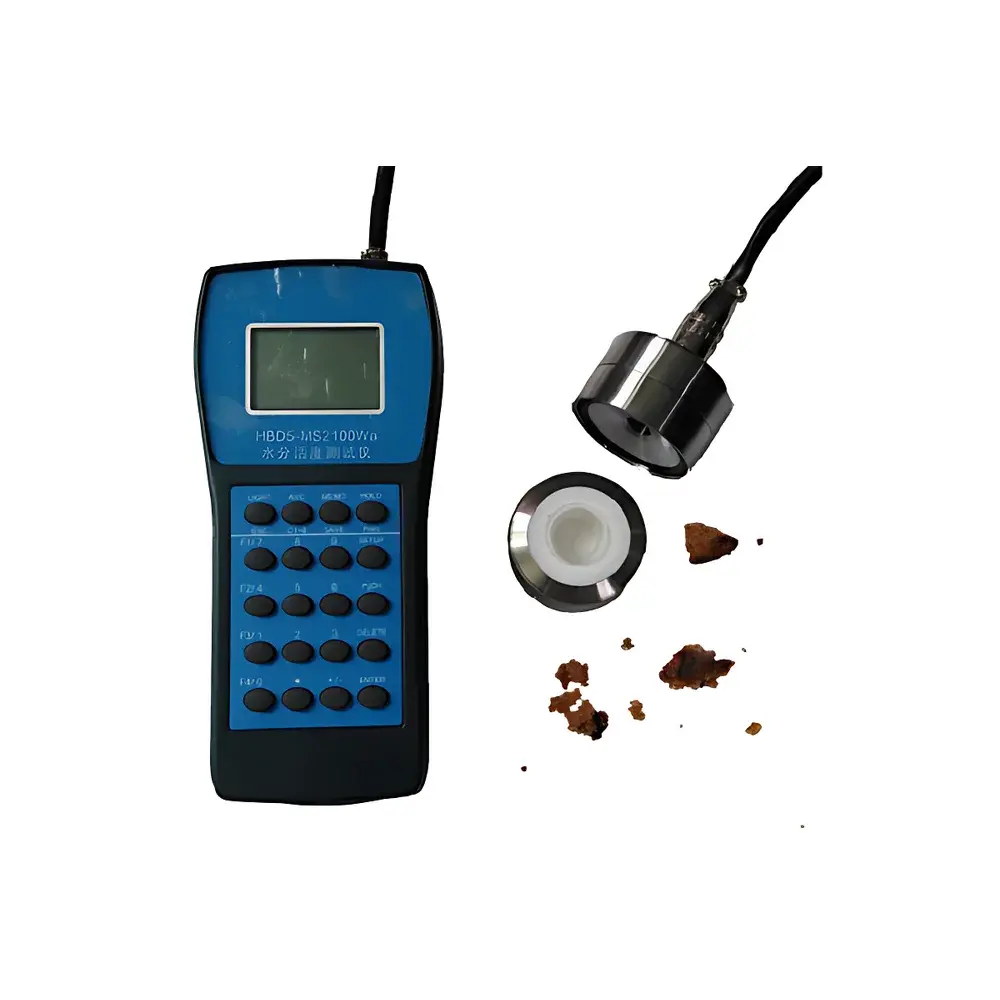
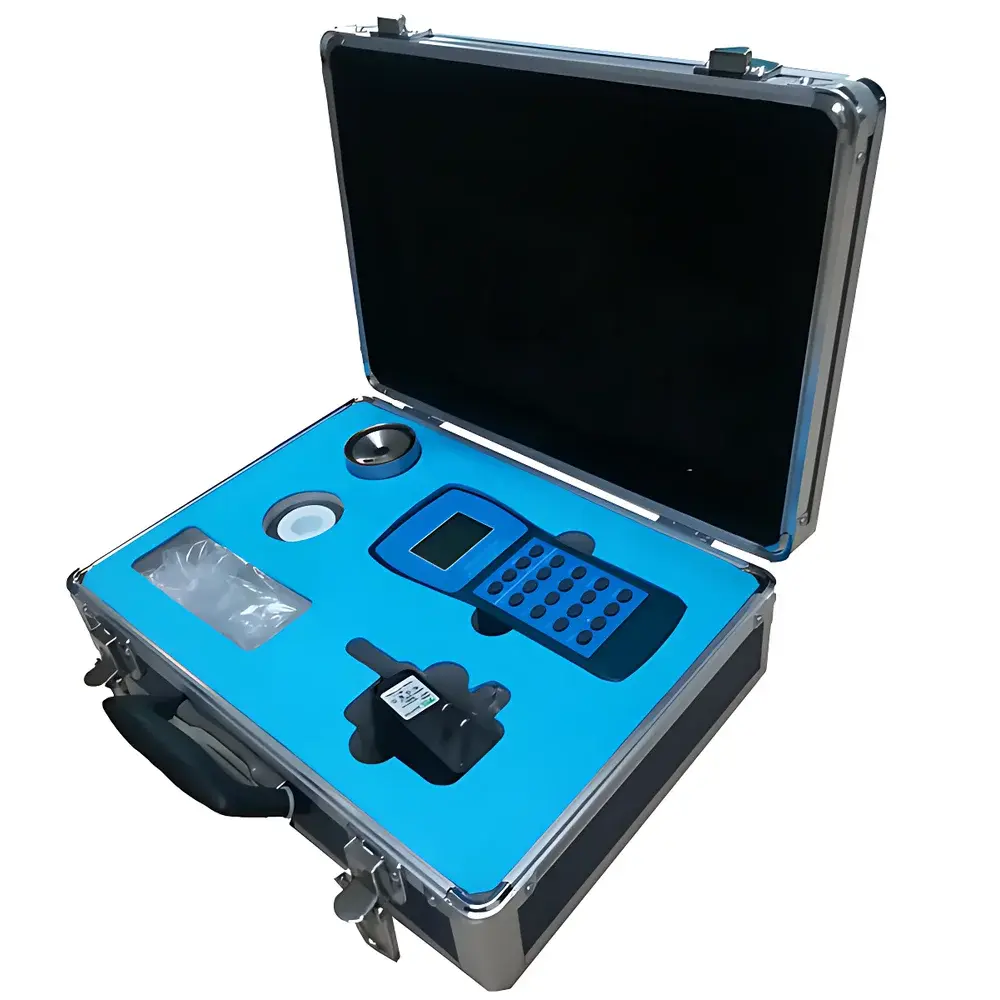
Bigdipper HBD5-MS2100 Portable Grain Water Activity Analyzer
| Brand | Bigdipper |
|---|---|
| Origin | Beijing, China |
| Manufacturer | Bigdipper Industrial Chemistry Research Institute |
| Model | HBD5-MS2100 sWA |
| Measurement Range | 0.003–0.999 a<sub>w</sub> |
| Accuracy | ±0.003 a<sub>w</sub> (at <0.1°C ambient) |
| Repeatability | ±0.015 a<sub>w</sub> (at <±0.3°C ambient) |
| Resolution | 0.001 a<sub>w</sub> |
| Sensor Type | Imported high-precision ERH sensor |
| Sample Chamber Diameter | 48 mm |
| Host Dimensions | 180 × 70 × 50 mm |
| Host Weight | 0.4 kg |
| Power Supply | Rechargeable Ni-Cd battery (2 h continuous operation, 1 week standby) or 220 V AC adapter |
| Operating Environment | 0–50°C, 0–85% RH |
| Compliance | GB/T 34790–2017 |
Overview
The Bigdipper HBD5-MS2100 Portable Grain Water Activity Analyzer is an engineered solution for rapid, field-deployable determination of water activity (aw) in bulk cereal grains and processed food commodities. It operates on the Equilibrium Relative Humidity (ERH) principle—measuring the relative humidity of the headspace above a sample at thermodynamic equilibrium, which directly corresponds to the sample’s water activity (aw = P/P0, where P is the vapor pressure above the sample and P0 is the saturation vapor pressure of pure water at the same temperature). This method is fully aligned with ISO 21807:2004, ASTM F1718–07, and—critically—the Chinese national standard GB/T 34790–2017, “Inspection of Grain and Oils—Determination of Water Activity of Grains—Instrumental Method.” Designed for grain elevators, feed mills, storage facilities, and QA/QC labs operating under time-sensitive logistics, the HBD5-MS2100 delivers traceable, repeatable aw measurements without routine calibration drift—enabling real-time decisions on storage stability, mold risk, and shelf-life compliance.
Key Features
- ERH-based measurement architecture with imported high-stability capacitive humidity sensor and integrated Pt100 temperature sensor for simultaneous thermal compensation
- No routine recalibration required—factory-trimmed sensor system maintains long-term baseline integrity under variable ambient conditions
- Compact handheld form factor (180 × 70 × 50 mm; 0.4 kg) optimized for field use, warehouse audits, and mobile inspection teams
- Integrated dual-mode capability: simultaneous aw and gravimetric moisture content estimation (0–3 kg/kg), supporting cross-validation per GB/T 5497–1985
- High-resolution display with real-time stabilization monitoring—stable reading confirmed within 5–10 minutes after chamber sealing
- Robust mechanical design: stainless-steel sample chamber (Ø48 mm), IP54-rated housing, and chemical-resistant internal surfaces for repeated exposure to grain dust, oils, and organic volatiles
Sample Compatibility & Compliance
The HBD5-MS2100 is validated for intact and milled grains—including wheat, maize, rice, soybeans, barley, and oats—as well as processed commodities such as flour, bran, feed pellets, roasted coffee beans, dried fruits, and bakery intermediates (e.g., dough pieces, fillings, and crumb samples). Its 48 mm chamber accommodates heterogeneous particulates up to 20 mm in diameter without grinding, preserving native microstructure critical for accurate ERH equilibration. The instrument meets all performance requirements specified in GB/T 34790–2017, including measurement uncertainty (<±0.003 aw), repeatability (≤±0.015 aw), and environmental operating range (0–50°C / 0–85% RH). While not FDA 21 CFR Part 11–certified out-of-the-box, its audit-ready output log (timestamped aw, temperature, and stabilization duration) supports GLP/GMP documentation workflows when paired with controlled procedural SOPs.
Software & Data Management
The HBD5-MS2100 operates as a standalone embedded system with no proprietary software dependency. All measurement data—including aw, sample temperature, stabilization time, and user-defined batch ID—are stored internally (up to 500 records) and exportable via USB to CSV format for integration into LIMS or Excel-based trending analysis. Each record includes automatic timestamping and thermal drift compensation metadata. For regulatory traceability, the device supports two-point verification using certified reference standards: saturated sodium chloride solution (aw = 0.752 at 25°C) and distilled water (aw = 0.998), both traceable to NIM (National Institute of Metrology, China) humidity standards. No firmware updates require external connectivity—ensuring data integrity and cybersecurity compliance in isolated operational environments.
Applications
- Grain storage risk assessment: Identifying aw thresholds (>0.70) associated with Aspergillus and Penicillium proliferation in silos and flat storage
- Feed formulation QC: Verifying aw consistency across batches to prevent caking, mycotoxin formation, and enzyme deactivation in premixes
- Process validation: Monitoring aw shifts during drying, tempering, roasting, and conditioning steps to optimize energy use and product uniformity
- Shelf-life modeling: Providing input parameters for predictive microbiology models (e.g., ComBase, Pathogen Modeling Program) used in HACCP plans
- Regulatory submission support: Generating auditable aw data for GB/T 34790–2017 compliance reports, export documentation, and third-party certification (e.g., ISO 22000, BRCGS)
FAQ
What is the minimum and maximum aw range supported by the HBD5-MS2100?
The instrument measures from 0.003 to 0.999 aw with resolution of 0.001 aw, covering the full spectrum relevant to dry grains (e.g., roasted coffee at ~0.25 aw) through high-moisture intermediates (e.g., wet dough at ~0.98 aw).
Does the instrument require daily calibration?
No. The sensor system is factory-characterized and exhibits negligible drift over 12 months under normal use. Two-point verification with NaCl sat. solution and distilled water is recommended before each shift or after transport-induced thermal shock.
Can the HBD5-MS2100 measure ground versus whole grains interchangeably?
Yes—though GB/T 34790–2017 specifies that whole kernels must be equilibrated for ≥15 min in sealed chamber. Grinding is not required and may accelerate equilibration but is not mandated for compliance testing.
How does temperature affect measurement accuracy?
The integrated Pt100 sensor performs real-time thermal compensation. Accuracy specification (±0.003 aw) holds within ±0.1°C ambient stability; outside this band, the device applies ISO 21807–compliant correction algorithms based on published water activity–temperature coefficients for major cereals.
Is the battery replaceable in the field?
Yes—the Ni-Cd pack is user-accessible and swappable using standard service tools. Spare batteries maintain charge for ≥1 year in storage and support ≥300 charge cycles.