
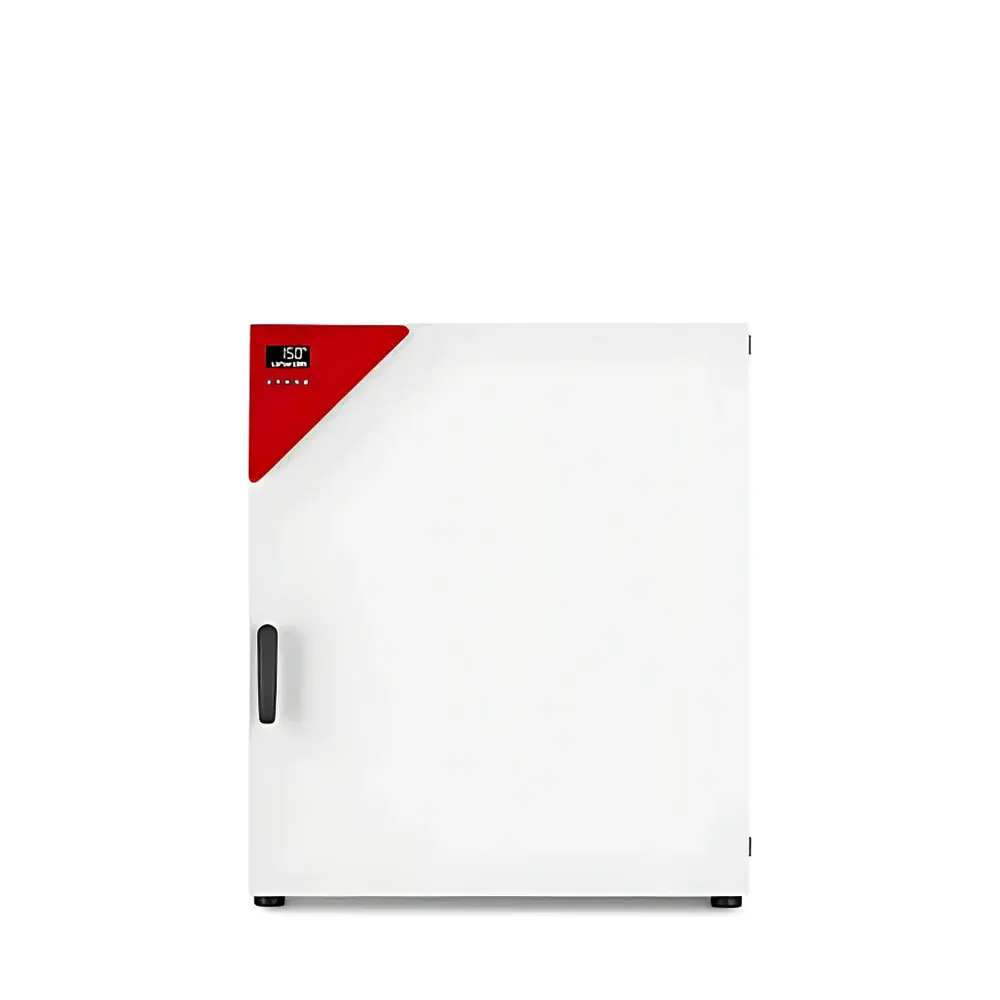
BINDER ED Series Avantgarde.Line Natural Convection Drying Oven
| Brand | BINDER |
|---|---|
| Origin | Germany |
| Model | ED Series |
| Temperature Range | Ambient + 5 °C to 300 °C |
| Temperature Uniformity (at 150 °C) | ±0.4 K to ±0.8 K |
| Internal Dimensions (W×H×D) | 960 × 1280 × 605 mm |
| External Dimensions (W×H×D) | 1165 × 1590 × 870 mm |
| Interior Volume | 743 L |
| Net Weight (empty) | 169 kg |
| Max. Load Capacity | 315 kg |
| Max. Load per Shelf | 45 kg |
| Heating Method | Natural Convection |
| Power Supply (230 V) | up to 2.25 kW |
| Power Supply (400 V) | 4.1 kW |
| Shelving | 2 standard / up to 16 stainless steel chrome-plated shelves |
| Safety | Dual-stage independent temperature safety device (DIN 12880 Class 2), optical alarm |
| Interface | USB port for data logging |
| Compliance | DIN 12880, EN 61000-6-3, EN 61000-6-4, CE |
Overview
The BINDER ED Series Avantgarde.Line Natural Convection Drying Oven is a precision-engineered laboratory drying system designed for reproducible thermal processing under controlled ambient conditions. Unlike forced-air convection ovens, the ED Series relies exclusively on natural convection—heat transfer driven solely by buoyancy-induced air movement—to achieve uniform thermal distribution across the entire chamber volume. This principle eliminates fan-induced turbulence, particle resuspension, and mechanical vibration, making it especially suitable for applications where sample integrity, low particulate exposure, or non-invasive heating is critical—such as in pharmaceutical stability testing, inert material conditioning, glassware drying, and pre-sterilization of heat-stable labware. Engineered in Tuttlingen, Germany, each unit integrates BINDER’s proprietary APT.line™ preheating chamber technology, which surrounds the inner chamber with an insulated, independently heated jacket to minimize thermal gradients and improve spatial temperature stability. The oven operates across a certified range from ambient +5 °C up to 300 °C, supporting both routine drying and validated dry-heat sterilization protocols in compliance with ISO 17025-accredited laboratories.
Key Features
- Natural convection design ensures laminar, vibration-free airflow—ideal for delicate samples, powders, and calibration standards
- APT.line™ preheating chamber technology delivers superior temperature uniformity (±0.4 K at 150 °C) and reduced recovery time after door opening (≤25 min to re-stabilize at 150 °C)
- Dual-stage independent temperature safety device (DIN 12880 Class 2) with optical alarm provides redundant overtemperature protection
- Large internal volume (743 L) with modular shelving configuration—up to 16 adjustable chrome-plated stainless steel shelves supported
- Energy-optimized thermal insulation and intelligent power management reduce energy consumption by up to 30% compared to conventional natural convection ovens
- LCD controller with intuitive menu navigation, real-time temperature display, and programmable ramp/soak profiles
- Integrated USB interface enables direct export of time-stamped temperature logs (CSV format) for audit-ready documentation
- Ergonomic door handle design and smooth-opening mechanism facilitate frequent access while maintaining structural rigidity and seal integrity
Sample Compatibility & Compliance
The ED Series accommodates a broad spectrum of sample types—including glassware, metal components, ceramic substrates, polymer films, and moisture-sensitive reference materials—without risk of mechanical disturbance or airflow-induced contamination. Its natural convection architecture avoids cross-contamination between stacked samples and supports GLP-compliant workflows where traceability and environmental consistency are mandatory. The oven meets essential regulatory requirements for laboratory equipment: DIN 12880 (safety and performance of drying and heating cabinets), EN 61000-6-3 (EMC emission limits), EN 61000-6-4 (EMC immunity), and CE marking under the EU Machinery Directive 2006/42/EC. While not intrinsically compliant with FDA 21 CFR Part 11, its USB data logging function supports integration into validated systems when paired with appropriate electronic record controls and audit trail software.
Software & Data Management
The built-in microprocessor controller records temperature values at user-defined intervals and stores them internally. Via the front-panel USB port, users can export full session logs—including timestamps, setpoints, actual chamber temperatures, and alarm events—to external storage for archiving or analysis in Excel or LIMS platforms. No proprietary software is required; exported files conform to standard CSV formatting with UTF-8 encoding. For laboratories operating under GxP frameworks, the ED Series supports manual annotation of test batches and operator IDs during setup—though full electronic signature and audit trail functionality require integration with third-party validation-ready data acquisition systems.
Applications
- Drying of filter papers, crucibles, pipettes, and volumetric glassware prior to gravimetric analysis
- Conditioning of hygroscopic reference standards and calibration weights in metrology labs
- Pre-sterilization of stainless steel instruments and autoclave accessories via dry-heat cycles (e.g., 180 °C for 3 h)
- Thermal aging studies of polymers, composites, and encapsulation materials per ASTM D3045 or ISO 2578
- Moisture loss-on-drying (LOD) determinations for APIs and excipients in accordance with USP <731>
- Stabilization of sensors, transducers, and electronic components before calibration
FAQ
What distinguishes natural convection from forced convection in drying ovens?
Natural convection relies on thermal buoyancy alone—no fans or blowers—to circulate air. This eliminates shear forces, noise, and particulate dispersion, enhancing repeatability for sensitive or static samples.
Can the ED Series be used for dry-heat sterilization?
Yes—its certified 300 °C upper limit and documented temperature uniformity support validated dry-heat sterilization cycles per ISO 15883-1 and EU Annex 1 guidelines, provided cycle development and mapping are performed per site-specific validation protocols.
Is the USB data logging function compliant with 21 CFR Part 11?
The native USB export provides raw timestamped data but lacks electronic signatures, audit trails, or role-based access control. Full Part 11 compliance requires supplemental validation of the connected host system and procedural controls.
How many shelves can be installed simultaneously in the ED 720 model?
Up to 16 chrome-plated stainless steel shelves may be installed, with load capacity distributed evenly—maximum 45 kg per shelf and 315 kg total.
Does the oven include overtemperature protection beyond the main controller?
Yes—a fully independent, hardware-based dual-stage temperature safety device (DIN 12880 Class 2) triggers optical and audible alarms and cuts power if the primary controller fails or exceeds user-defined thresholds.



