
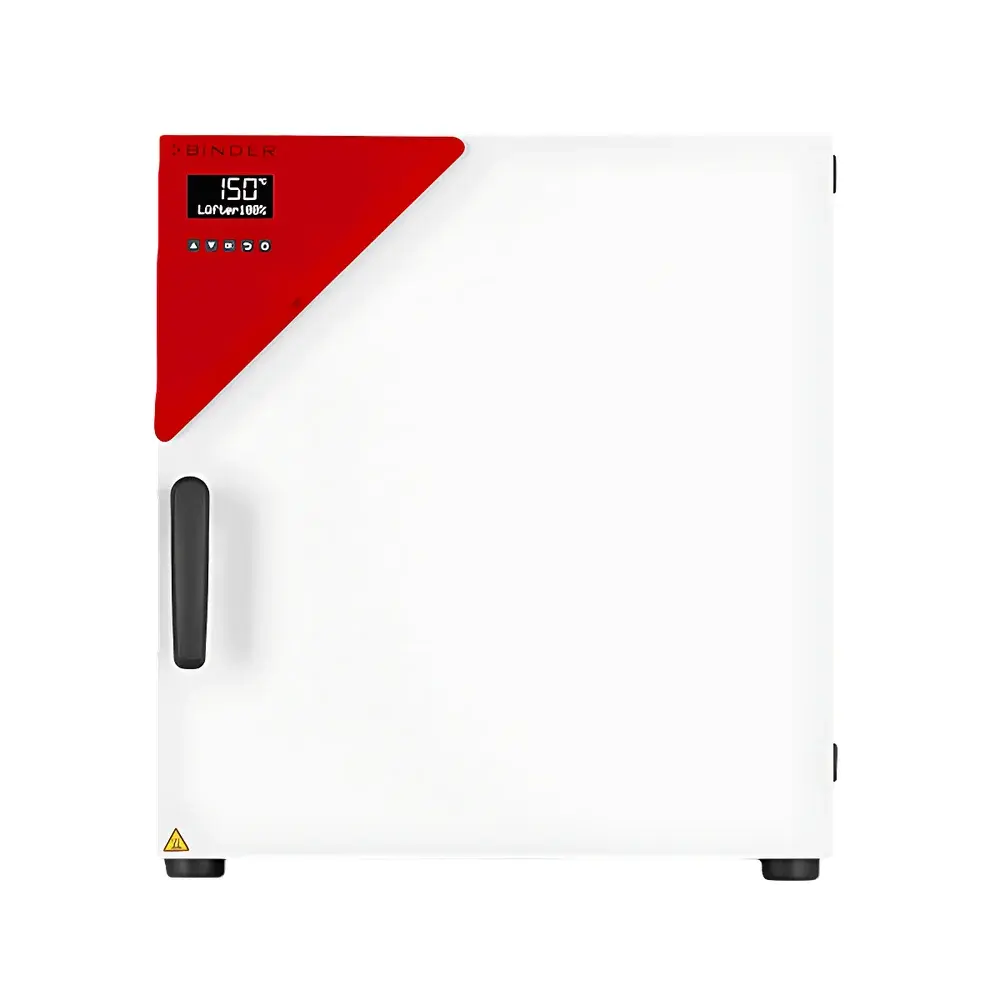
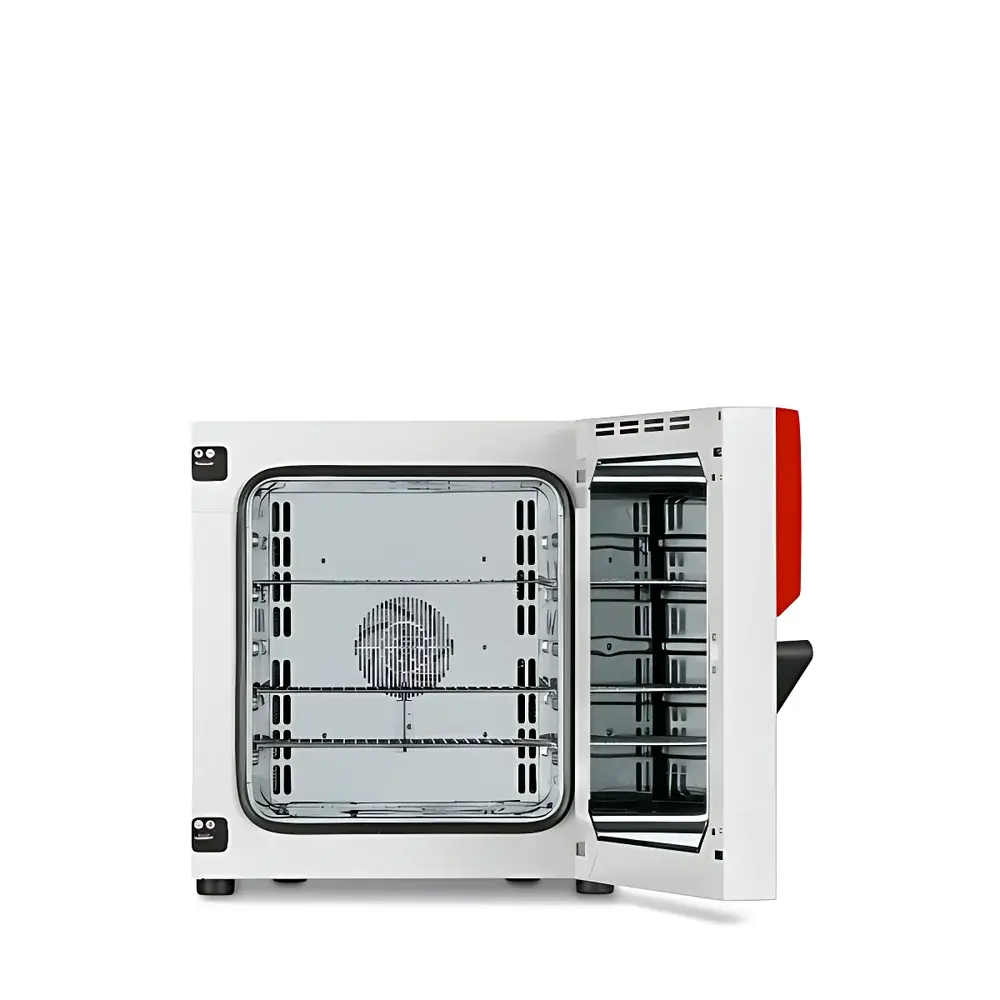
BINDER ED56 Natural Convection Drying Oven
| Brand | BINDER |
|---|---|
| Origin | Germany |
| Manufacturer | BINDER GmbH |
| Model | ED 56 |
| Instrument Type | High-Temperature Drying Oven |
| Temperature Range | Ambient +5 °C to 300 °C |
| Temperature Uniformity | ±0.4 °C at 150 °C |
| External Dimensions (W×D×H) | 560 × 625 × 565 mm |
| Internal Chamber Dimensions (W×D×H) | 360 × 420 × 380 mm |
| Chamber Material | Stainless Steel (AISI 304) |
| Heating System | APT.Line™ Preheating Chamber Technology |
| Convection Type | Natural Convection |
| Controller | LCD Digital Interface with Independent Adjustable Temperature Safety Device (Class 2, DIN 12880) |
| Shelving | Chrome-Plated Adjustable Shelves |
| Exhaust Valve | Integrated Mechanical Ventilation Control |
| Compliance | CE, DIN EN 61000-6-3, DIN EN 61000-6-2 |
Overview
The BINDER ED56 is a precision-engineered natural convection drying oven designed for reliable thermal processing in research laboratories, quality control environments, and industrial R&D settings. Built upon BINDER’s proprietary APT.Line™ preheating chamber technology, the ED56 ensures exceptional temperature stability and uniformity across its stainless steel interior—critical for applications demanding reproducible thermal treatment without forced airflow interference. Unlike fan-assisted ovens, natural convection operation eliminates turbulence-induced sample displacement or surface disturbance, making it especially suitable for drying fine powders, granular materials, filter papers, and temperature-sensitive solid samples where mechanical agitation must be avoided. The oven operates within a wide temperature range—from ambient +5 °C up to 300 °C—with documented uniformity of ±0.4 °C at 150 °C, meeting stringent requirements for method validation under GLP and ISO/IEC 17025 frameworks.
Key Features
- APT.Line™ preheating chamber technology: A thermally insulated outer jacket surrounding the main chamber minimizes heat loss and enables rapid stabilization and high repeatability across the full operating range.
- Natural convection design: Eliminates internal fans, ensuring laminar, vibration-free thermal exposure—ideal for particulate drying, gravimetric analysis, and residue determination per ASTM E121, USP <641>, and ISO 5725.
- Dual-stage independent temperature safety device (DIN 12880 Class 2): Hardware-based overtemperature protection with optical alarm, fully decoupled from the main controller for fail-safe operation.
- LCD digital controller with intuitive menu navigation: Supports setpoint programming, ramp/soak profiles, real-time deviation display, and password-protected parameter locking for audit-compliant workflows.
- Corrosion-resistant AISI 304 stainless steel chamber and chrome-plated adjustable shelving: Facilitates cleaning, prevents cross-contamination, and withstands repeated thermal cycling and mild chemical exposure.
- Integrated mechanical exhaust valve: Allows manual regulation of chamber atmosphere exchange rate to manage moisture evacuation or inert gas purging during extended drying cycles.
Sample Compatibility & Compliance
The ED56 accommodates standard laboratory ware including Petri dishes, weighing boats, crucibles, glass desiccators, and ceramic trays. Its chamber volume (~57 L) supports batch processing of multiple samples while maintaining spatial uniformity. The oven complies with European Electromagnetic Compatibility Directive 2014/30/EU (EN 61000-6-2/-3), Low Voltage Directive 2014/35/EU, and carries CE marking. It satisfies functional safety requirements outlined in DIN 12880 for laboratory ovens and supports traceable calibration per ISO/IEC 17025 when used with accredited external probes. Optional documentation packages—including Factory Acceptance Test (FAT) reports and IQ/OQ protocols—are available to support FDA 21 CFR Part 11–aligned validation in regulated pharmaceutical and medical device manufacturing environments.
Software & Data Management
While the ED56 operates via standalone hardware-based control, it features analog output (0–10 V) and digital RS485 interface (Modbus RTU) for integration into centralized lab monitoring systems (e.g., LabVantage, Siemens Desigo, or custom SCADA). Real-time temperature data can be logged externally using compliant DAQ modules. All controller operations—including setpoint changes, alarm events, and safety cutoff triggers—are timestamped and stored in non-volatile memory for ≥10,000 entries, enabling retrospective review during internal audits or regulatory inspections. Data export is supported via USB flash drive (optional accessory), generating CSV-formatted logs compatible with Excel, MATLAB, or statistical process control (SPC) platforms.
Applications
- Moisture content determination (ASTM D2298, ISO 1183)
- Drying of polymer pellets, catalysts, and ceramic precursors prior to thermal analysis (TGA/DSC)
- Pre-conditioning of filters and membranes for particulate matter analysis (EPA Method 201A)
- Stabilization of reference standards and hygroscopic reagents
- Heat treatment of metallurgical samples for microstructural homogenization
- Residue-on-ignition (ROI) assays in environmental and food testing labs
FAQ
Is the ED56 suitable for use with flammable solvents?
No. The ED56 is not explosion-proof and lacks solvent-resistant seals or intrinsically safe components. For volatile organic compounds, BINDER’s Binder BD series (with ATEX-certified variants) is recommended.
Can I validate temperature uniformity per ISO 17025?
Yes—using NIST-traceable Class A PT100 sensors and a certified multi-point mapping protocol, users can generate full-volume uniformity reports compliant with ISO/IEC 17025 clause 5.10.
What maintenance is required for long-term accuracy?
Annual verification of sensor calibration and safety device functionality is advised; chamber door gasket integrity should be inspected quarterly. No routine lubrication or fan servicing is needed due to the natural convection architecture.
Does the ED56 support remote monitoring via Ethernet or Wi-Fi?
Not natively—but third-party gateways (e.g., Moxa EDS-G205E) can bridge the RS485 Modbus interface to TCP/IP networks for integration into enterprise-wide instrumentation infrastructure.



