
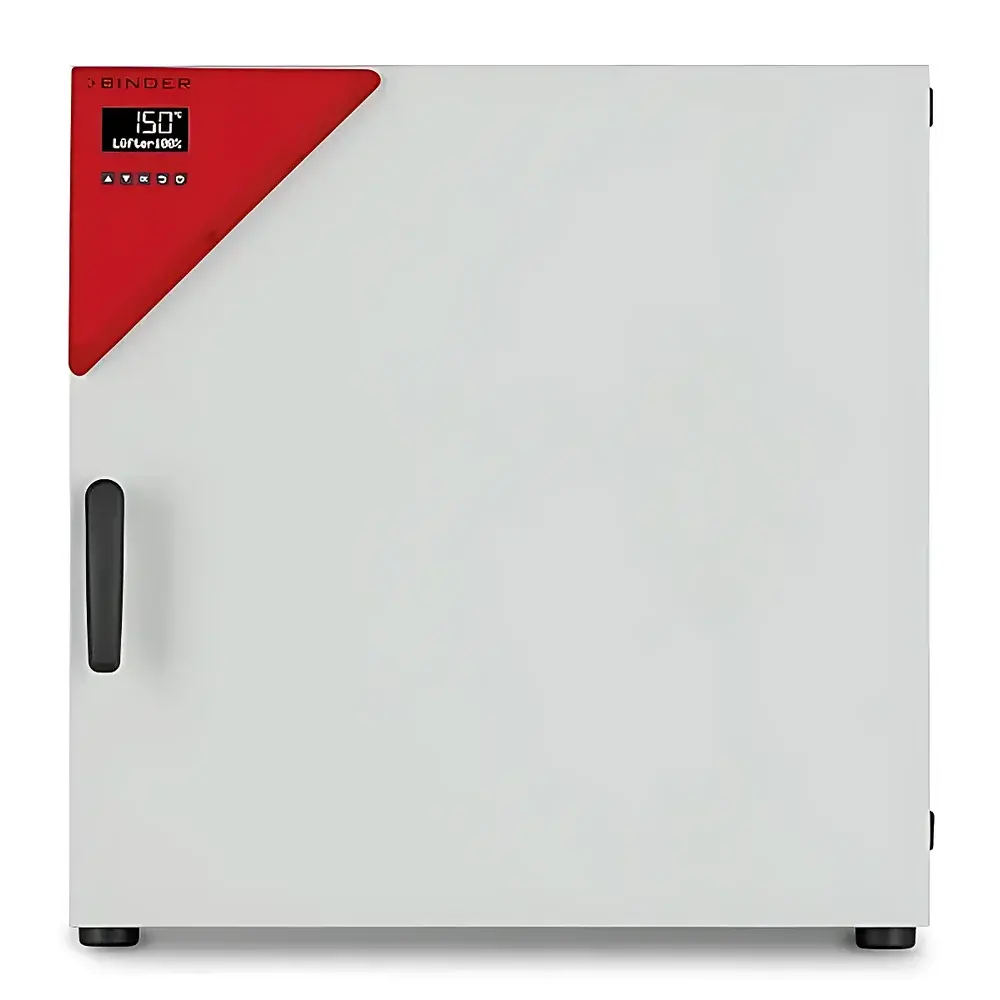
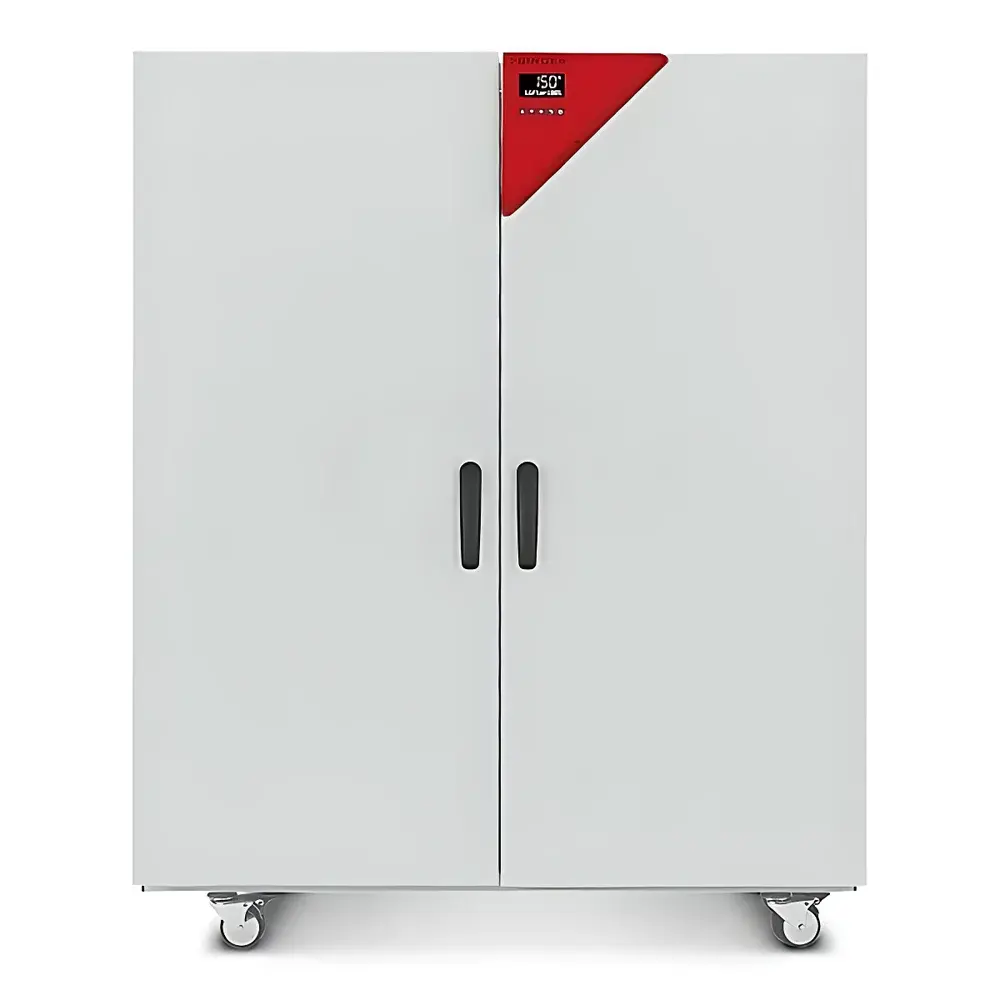
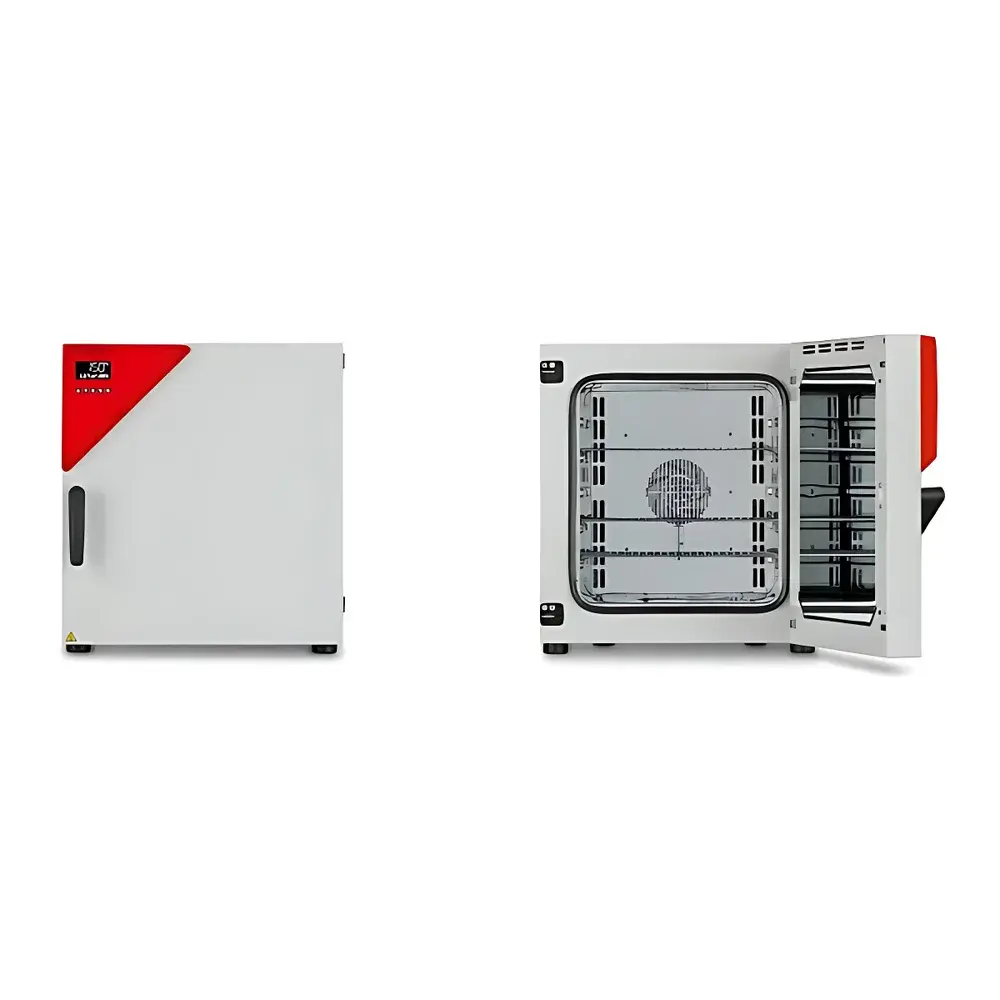
BINDER FD115 Forced Convection Drying Oven
| Brand | BINDER |
|---|---|
| Origin | Germany |
| Model | FD115 |
| Instrument Type | High-Temperature Forced-Air Oven |
| Temperature Range | Ambient +10 °C to 300 °C |
| Temperature Uniformity (at 150 °C) | ±0.3 K |
| External Dimensions (W×H×D) | 710×735×605 mm |
| Internal Chamber Dimensions (W×H×D) | 550×550×385 mm |
| Chamber Volume | 116 L |
| Chamber Material | Stainless Steel (AISI 304) |
| Heating Method | Forced Convection with APT.line™ Preheating Jacket |
| Controller | Microprocessor-Based with LCD Display |
| Safety | Independent Adjustable Temperature Safety Device Class 2 (DIN 12880), Optical Alarm |
| Data Interface | USB for Logging |
| Standard Shelves | 2 Chrome-Plated, Load Capacity per Shelf: 30 kg |
| Max. Total Load | 150 kg |
Overview
The BINDER FD115 Forced Convection Drying Oven is a precision-engineered laboratory oven designed for rapid, reproducible drying, sterilization, and heat treatment of samples under tightly controlled thermal conditions. Based on BINDER’s proprietary APT.line™ preheating jacket technology, the FD115 ensures exceptional temperature uniformity and stability across its entire 116 L stainless steel chamber—critical for applications requiring strict adherence to ISO 17025, ASTM E145, or DIN 50017 standards. Unlike natural convection ovens, the FD115 employs a high-efficiency axial fan system that delivers consistent airflow velocity and directional homogeneity, minimizing thermal gradients and reducing process time by up to 30% compared to conventional units. Its operational range extends from ambient +10 °C to 300 °C, supporting both low-temperature moisture removal and high-temperature ashing or polymer curing protocols.
Key Features
- APT.line™ preheating jacket technology for superior temperature uniformity (±0.3 K at 150 °C) and minimized overshoot during ramp-up
- Stainless steel (AISI 304) interior chamber with seamless welds and rounded corners for easy cleaning and corrosion resistance
- Microprocessor-based controller with intuitive LCD interface, real-time temperature display, and programmable ramp/soak profiles
- Dual-stage independent temperature safety device (DIN 12880 Class 2) with optical alarm—meets GLP/GMP critical parameter monitoring requirements
- Electromechanical exhaust valve for precise vapor pressure control during drying cycles
- Ergonomic, insulated door handle with positive-latching mechanism ensuring secure sealing and operator safety at elevated temperatures
- USB interface enabling direct data export of time-stamped temperature logs compliant with FDA 21 CFR Part 11 audit trail requirements
- Two chrome-plated adjustable shelves (load capacity: 30 kg each); optional shelf kits support up to five levels
Sample Compatibility & Compliance
The FD115 accommodates a broad spectrum of sample types—including glassware, metal parts, polymer substrates, pharmaceutical excipients, soil matrices, and biological culture plates—without risk of cross-contamination or thermal degradation. Its forced-air architecture ensures uniform exposure regardless of sample geometry or stacking configuration. The unit complies with IEC 61010-1 (Safety Requirements for Electrical Equipment for Measurement, Control, and Laboratory Use), EN 60529 (IP20 ingress protection), and meets essential requirements of the EU Machinery Directive 2006/42/EC. Optional validation packages support IQ/OQ/PQ documentation aligned with GMP Annex 15 and USP Analytical Instrument Qualification guidelines.
Software & Data Management
While the FD115 operates autonomously via its embedded controller, its integrated USB port enables seamless transfer of temperature history files (.csv format) to external PCs for post-process analysis. Timestamped records include setpoint, actual chamber temperature, elapsed time, and alarm events—structured to satisfy traceability mandates in regulated environments. When deployed with BINDER’s optional CellaVision® software suite (sold separately), users gain remote monitoring, multi-unit fleet management, automated report generation, and electronic signature functionality compatible with 21 CFR Part 11 Subpart B controls.
Applications
- Routine drying of filter papers, crucibles, and volumetric glassware in environmental and geochemical laboratories
- Moisture content determination per AOAC 950.46 and ASTM D2231 for polymers and composites
- Pre-sterilization conditioning of surgical instruments and packaging components prior to autoclaving
- Thermal aging studies of elastomers and adhesives per ISO 188 and ASTM D573
- Residue-on-ignition (ROI) analysis in food safety and pharmaceutical quality control labs
- Baking of thin-film coatings and ceramic precursors in materials science R&D workflows
FAQ
What is the maximum allowable load weight for the FD115?
The FD115 supports a total load of up to 150 kg, distributed across its internal chamber. Each standard shelf is rated for 30 kg; additional shelves must be installed according to BINDER’s mechanical load distribution specifications.
Does the FD115 meet GLP or GMP validation requirements?
Yes—the dual-stage temperature safety device, USB data logging capability, and DIN-compliant construction provide foundational elements for IQ/OQ execution. Full qualification requires site-specific protocol development and third-party verification.
Can the exhaust valve be automated or integrated into a building management system?
The standard electromechanical exhaust valve is manually adjustable. For automated control, BINDER offers optional analog (0–10 V) or digital (Modbus RTU) interfaces as factory-installed upgrades.
Is the chamber volume verified per ISO 27827?
Chamber volume is calculated geometrically (L × W × H) and certified in the出厂 calibration certificate. Volumetric verification per ISO 27827 is available upon request as an add-on service.
What maintenance intervals are recommended for the fan motor and heating elements?
BINDER recommends biannual inspection of fan bearings and electrical connections. Under normal usage (≤8 h/day), heating elements typically exceed 10,000 operating hours before replacement. Maintenance logs should be retained per ISO/IEC 17025 Clause 6.4.10.



