
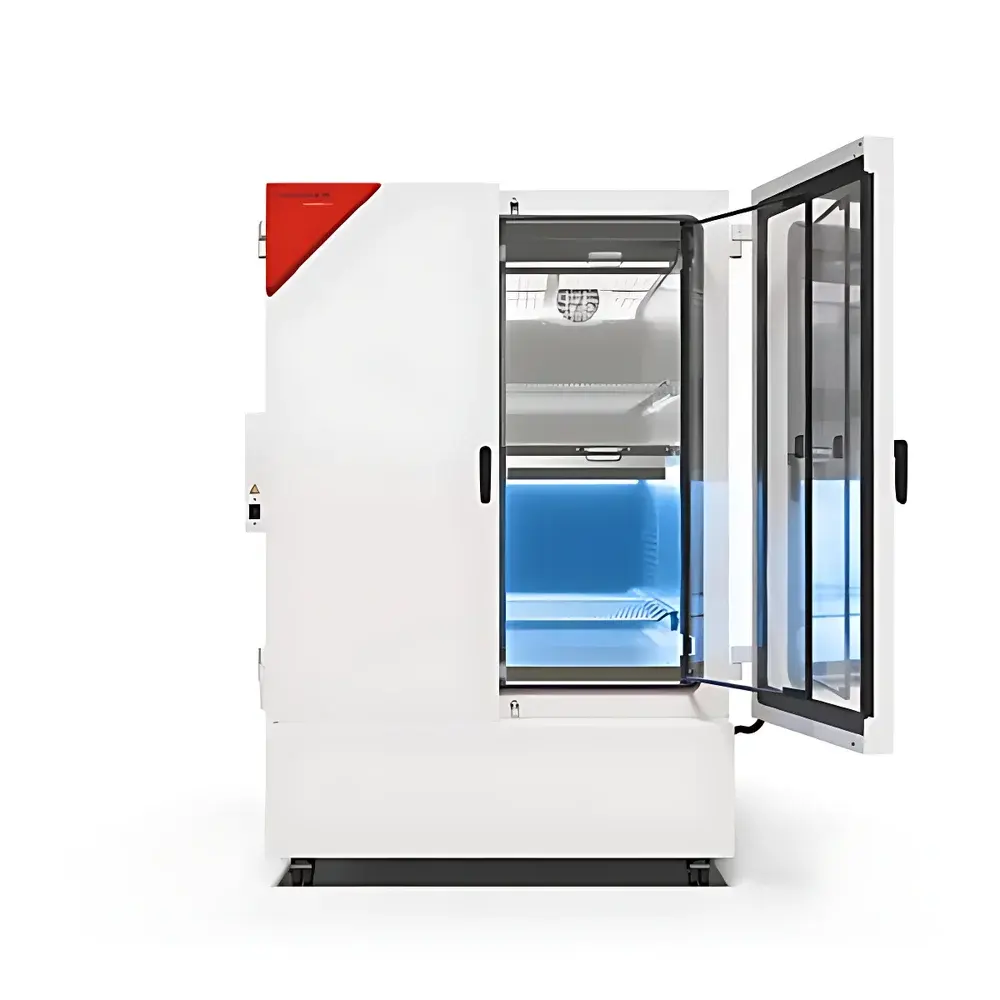
BINDER ICH-Compliant Photostability Testing Chamber with LED/Fluorescent Illumination Modules
| Brand | BINDER |
|---|---|
| Origin | Germany |
| Model Series | KB PRO / KBF / KBF PRO with ICH or ICH-LQC Illumination Modules |
| Temperature Range (No Humidity Control) | +18°C to +32°C |
| Temperature & Humidity Range (KBF Series) | +20°C to +50°C / 20–50% RH |
| Extended Temp/Humidity Range (KBF PRO Series) | +10°C to +50°C / 10–80% RH |
| Compliance | ICH Q1B Option 2 (Visible Light) and UV Supplement via Fluorescent Lamps |
| Illumination Types | LED (visible spectrum) + T8 Fluorescent (UV-A/UV-B) |
| Optional Light Dose Control (LQC) | Yes |
| Chamber Volumes | 260 L, 470 L, 720 L |
Overview
The BINDER ICH-Compliant Photostability Testing Chamber is a precision-engineered environmental simulation system designed explicitly for pharmaceutical stability testing in accordance with the International Council for Harmonisation (ICH) Q1B guideline. It implements a dual-source illumination architecture—combining high-efficiency white LEDs for visible light irradiation (meeting ICH Q1B Option 2 spectral requirements) and calibrated T8 fluorescent lamps for controlled UV-A and UV-B exposure—to replicate photolytic stress conditions mandated for drug substance and product qualification. Unlike generic climate chambers, this system integrates photometric traceability, thermal management to suppress irradiation-induced heating, and programmable irradiance profiles validated per ICH-recommended methodologies. Its modular design supports three core platform families: KB PRO (temperature-only), KBF (temperature/humidity), and KBF PRO (extended temperature/humidity range), each configurable with ICH-certified illumination modules sized for 260 L, 470 L, or 720 L working volumes.
Key Features
- ICH Q1B-compliant illumination architecture: LED arrays deliver stable, uniform visible light (320–800 nm) at defined irradiance levels; supplemental T8 fluorescent tubes provide regulated UV output (290–400 nm) for comprehensive photodegradation assessment.
- Thermally decoupled lighting system: Active cooling and optical shielding minimize sample chamber temperature rise during extended irradiation cycles—ensuring photostability results reflect photochemical degradation, not thermal artifacts.
- Two illumination module variants: Standard ICH modules (ICH-260/470, ICH-720) and Light Dose Controlled (LQC) variants (ICH-LQC-260/470, ICH-LQC-720) featuring integrated radiometers and real-time dose accumulation logging per ICH Q1B Annex 2 protocols.
- Three platform options: KB PRO series for non-humidified photostability studies (+18°C to +32°C); KBF series for combined thermo-hygrometric + light testing (+20°C to +50°C / 20–50% RH); KBF PRO series for expanded operational envelopes (+10°C to +50°C / 10–80% RH).
- German-engineered chamber construction: Double-wall insulation, stainless steel interior, and precision PID-controlled air distribution ensure spatial temperature uniformity ≤ ±0.3°C and humidity stability ≤ ±1.5% RH (KBF/KBF PRO models).
Sample Compatibility & Compliance
The chamber accommodates standard pharmaceutical packaging formats—including blister packs, vials, ampoules, and sachets—on adjustable stainless steel shelves with unobstructed light exposure geometry. All configurations comply with ICH Q1B Option 2 (visible light) and support supplemental UV exposure per Option 1 when fluorescent modules are installed. The system meets critical regulatory expectations for GLP and GMP environments: full audit trail capability (via optional software), electronic signature support aligned with FDA 21 CFR Part 11, and calibration documentation traceable to national metrology institutes (e.g., PTB, Germany). Validation packages—including IQ/OQ/PQ templates—are available to support user qualification under ISO 17025 and ASTM E2904-21 standards.
Software & Data Management
BINDER’s C-Control® software enables full parameter programming—including multi-step temperature/humidity ramps, timed illumination sequences, and LQC dose thresholds—with real-time graphing and export in CSV/PDF formats. For LQC-equipped modules, the system logs cumulative radiant exposure (J/m²) per wavelength band, automatically halting irradiation upon reaching user-defined dose endpoints. Data integrity safeguards include password-protected access levels, immutable event logs, and encrypted local storage compliant with ALCOA+ principles. Integration with LIMS and ELN systems is supported via OPC UA and RESTful API interfaces, facilitating automated reporting for regulatory submissions (e.g., CTD Module 3).
Applications
- ICH Q1B photostability testing of active pharmaceutical ingredients (APIs) and finished dosage forms under Option 1 (UV + visible) and Option 2 (visible only) conditions.
- Forced degradation studies to identify photolytic impurities and establish degradation pathways per ICH Q5C.
- Light-induced stability assessment of biologics, peptides, and photosensitive small molecules (e.g., tetracyclines, nitrofurantoin, riboflavin).
- Accelerated aging simulations incorporating photic stress for shelf-life prediction and packaging evaluation.
- Method development and validation for photostability-indicating assays in QC laboratories.
FAQ
Does this chamber meet ICH Q1B Option 2 without supplemental UV lamps?
Yes—the integrated LED array satisfies ICH Q1B Option 2 spectral and irradiance requirements for visible light testing. UV supplementation requires optional T8 fluorescent modules.
What is the difference between ICH and ICH-LQC illumination modules?
ICH-LQC modules incorporate calibrated radiometric sensors and closed-loop dose control, enabling automatic termination at target radiant exposure (e.g., 1.2 million lux·hr visible + 200 kJ/m² UV). Standard ICH modules operate at fixed irradiance without real-time dose feedback.
Can the same illumination module be used across KB PRO, KBF, and KBF PRO platforms?
Yes—ICH and ICH-LQC modules are mechanically and electrically compatible across all three platform families, provided volume matching is observed (e.g., ICH-470 for 470 L chambers).
Is humidity control required for ICH Q1B testing?
No—ICH Q1B does not mandate humidity control; however, concurrent humidity exposure may be scientifically justified for products sensitive to hydrolytic-photolytic synergy, in which case KBF or KBF PRO models are recommended.
How is temperature uniformity maintained during prolonged illumination cycles?
The chamber employs a dedicated air-cooling circuit for the lamp housing, thermally isolating radiant heat from the test compartment, and uses BINDER’s patented APT.line™ preheating technology to sustain spatial uniformity within ±0.3°C—even at maximum irradiance load.
Related Products



