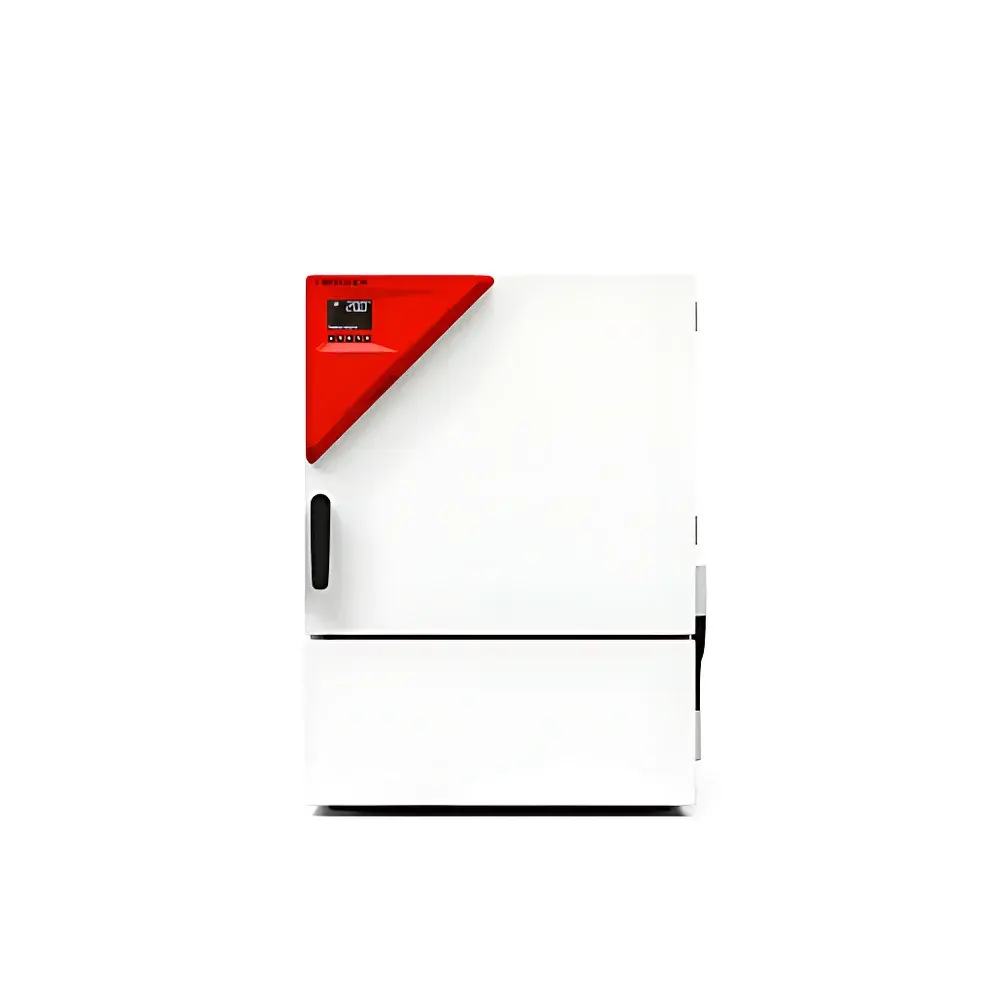
BINDER KB Series Low Temperature Incubators
| Brand | BINDER |
|---|---|
| Origin | Germany |
| Model | KB Series |
| Temperature Range | 0 °C to +70 °C |
| Temperature Uniformity at 37 °C | ±0.2 K |
| Temperature Fluctuation at 37 °C | ±0.1 K (KB 130 and larger) |
| Recovery Time after 30-sec Door Opening at 37 °C | 3 min |
| Internal Volume | 63 L to 1070 L |
| Power Consumption | 0.9 kW to 1.5 kW |
| Refrigerant | R-600a |
Overview
The BINDER KB Series Low Temperature Incubators are precision-engineered environmental chambers designed for demanding life science applications requiring stable, reproducible temperature control between 0 °C and +70 °C. Built in Germany to stringent DIN EN ISO 9001 standards, each unit employs BINDER’s proprietary APT.line™ preheating technology—where heating elements are integrated into the chamber walls rather than placed directly inside the working space—to ensure exceptional thermal uniformity (±0.2 K at 37 °C) and minimal vertical/horizontal gradients across the entire usable volume. The system utilizes a variable-frequency compressor with natural refrigerant R-600a, delivering up to 40% lower energy consumption compared to prior-generation models without compromising cooling capacity or stability. All internal surfaces—including floor, walls, ceiling, and door liner—are constructed from electropolished stainless steel (AISI 304), ensuring corrosion resistance, ease of decontamination, and compliance with GLP and GMP hygiene requirements. The KB Series is not a general-purpose warming cabinet; it is a validated, laboratory-grade incubation platform engineered for long-term microbial culture, enzyme activity studies, low-temperature cell line maintenance, and stability testing under regulated conditions.
Key Features
- APT.line™ convection-free preheating architecture eliminates thermal stratification and ensures ±0.2 K uniformity at 37 °C—even at full load and across all volumes (63 L to 1070 L)
- Variable-frequency refrigeration system with R-600a refrigerant enables precise sub-ambient cooling, rapid recovery (<3 min after 30-second door opening at 37 °C), and 40% reduced power draw versus legacy models
- Dual-stage independent temperature safety system compliant with DIN 12880 Class 3.3, featuring optical and acoustic alarms plus automatic shutdown upon deviation beyond user-defined thresholds
- Stainless steel interior (AISI 304), metal-oxide-coated safety glass inner door, and HIT-insulated double-wall housing provide mechanical robustness, thermal inertia, and condensation-free operation
- Integrated dry heat sterilization program (up to 180 °C) for routine chamber decontamination—validated per ISO 14644-1 cleanroom protocols and compatible with microbiological QC workflows
- Programmable dual-setpoint functionality allows unattended weekend operation: users can define primary incubation temperature (e.g., 30 °C) and secondary hold temperature (e.g., 4 °C) with time-based transitions
- Standard USB and optional Ethernet interface support audit-trail-capable data logging (CSV export), remote monitoring via BINDER LabExchange software, and integration into LIMS environments
Sample Compatibility & Compliance
The KB Series accommodates a broad range of sample formats—from Petri dishes and multiwell plates to flasks, roller bottles, and custom bioreactor vessels—thanks to standardized shelf spacing, high weight capacity per shelf (25–40 kg), and large-diameter access ports sealed with silicone plugs. All models meet IEC 61010-1 safety requirements for laboratory equipment and are CE-marked for use in EU member states. The stainless steel construction and absence of organic insulation materials satisfy USP analytical instrument qualification criteria for non-shedding, non-reactive surfaces. Temperature mapping validation reports (IQ/OQ/PQ templates available) align with FDA 21 CFR Part 11 expectations for electronic records and signatures when used with BINDER’s certified software package. Units are routinely deployed in ISO/IEC 17025-accredited testing laboratories and comply with ASTM E171 and ISO 2859-1 sampling plans for environmental chamber verification.
Software & Data Management
BINDER’s proprietary LabExchange software provides full local and networked control of temperature setpoints, sterilization cycles, alarm thresholds, and data export parameters. Measurement values are logged internally at user-configurable intervals (1 sec to 60 min) and stored in open-format CSV files accessible via USB mass storage mode—eliminating vendor lock-in and enabling direct import into MATLAB, Python pandas, or statistical process control (SPC) platforms. Ethernet-enabled models support SNMP v3 and Modbus TCP for integration into building management systems (BMS) or centralized lab infrastructure dashboards. Audit trails record operator ID, timestamp, parameter changes, and alarm events with immutable timestamps—fully traceable for GLP/GMP audits. Firmware updates are delivered via signed binary packages verified through SHA-256 checksums and require explicit administrator authentication.
Applications
- Long-term cultivation of psychrophilic and mesophilic microorganisms (e.g., Pseudomonas fluorescens, Bacillus subtilis) under tightly controlled thermal conditions
- Enzyme kinetics assays requiring stable sub-37 °C incubation to minimize denaturation and preserve catalytic integrity
- Stability testing of pharmaceutical intermediates and biologics per ICH Q1A(R2) guidelines at defined temperature-humidity profiles
- Cell line banking and low-temperature passaging of sensitive primary cultures (e.g., neural stem cells, chondrocytes)
- Environmental simulation for material degradation studies (e.g., polymer aging, adhesive performance at cold storage temperatures)
- Reference standard storage and calibration verification for thermocouple and RTD probe systems in metrology labs
FAQ
What is the maximum allowable ambient temperature for continuous operation?
The KB Series is rated for continuous operation at ambient temperatures up to 30 °C (86 °F) with ≤60% relative humidity, as specified in the Declaration of Conformity.
Can the dry heat sterilization cycle be validated for sterility assurance level (SAL) of 10⁻⁶?
Yes—when performed according to BINDER’s validated protocol (180 °C for 90 minutes), the cycle achieves SAL ≥10⁻⁶ for common vegetative bacteria and spores; IQ/OQ documentation kits are available upon request.
Is remote firmware update supported over Ethernet?
Firmware updates must be initiated locally via USB; however, configuration changes, real-time monitoring, and historical data retrieval are fully supported over Ethernet.
Are shelf positions adjustable without tools?
All stainless steel shelves feature tool-free height adjustment using precision-machined notched rails—no screws or fasteners required.
Does the unit support external sensor input for chamber temperature redundancy?
No—the KB Series relies on its factory-calibrated Pt100 sensor array; external probe inputs are not provided, but third-party data loggers may be connected via the standard 6-mm access port.