
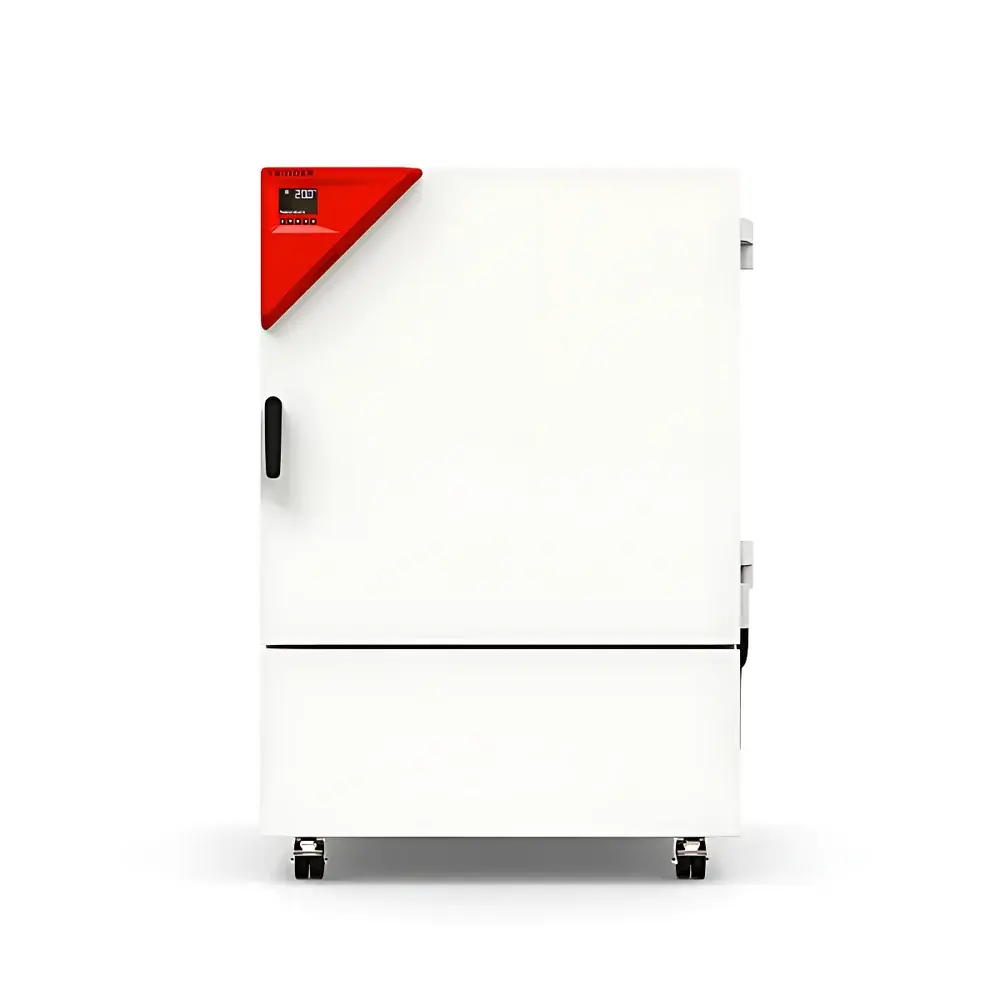
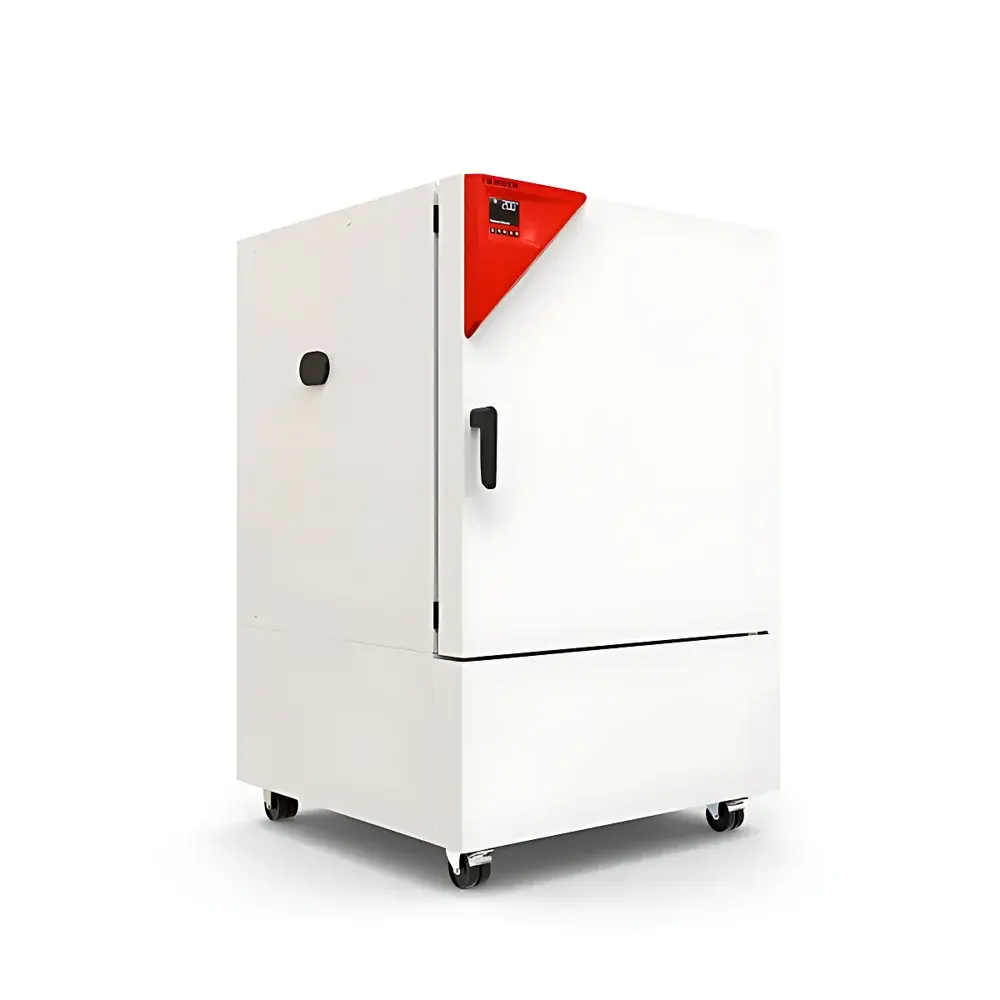
BINDER KB260 Low Temperature Incubator
| Brand | BINDER |
|---|---|
| Origin | Germany |
| Manufacturer | BINDER GmbH |
| Type | Imported |
| Model | KB 260 |
| Cooling Method | Compressor-based refrigeration |
| Heating Method | Water-jacketed heating |
| Temperature Range | 0 °C to +70 °C |
| Temperature Fluctuation | ±0.1 °C |
| Temperature Uniformity | ±0.2 °C at 37 °C |
| Chamber Volume | 127 L |
| External Dimensions (W × H × D) | 900 mm × 1005 mm × 710 mm |
| Refrigerant | R-600a |
| Safety Class | DIN 12880 Class 3.3 |
| Data Interfaces | Ethernet, USB |
| Internal Data Logger | Yes (open-format CSV export via USB) |
| Door Heating | Yes |
| Insulation Technology | HIT (High Integrity Thermal) double-wall insulation |
| Interior Material | Stainless steel (AISI 304) |
| Inner Door | Tempered safety glass with metal oxide coating |
| Shelving | 2 adjustable stainless steel shelves |
| Access Port | Large-diameter port with silicone plug |
| Mobility | Floor-standing unit with dual swivel casters (front casters with locking brakes) |
Overview
The BINDER KB260 Low Temperature Incubator is a precision-engineered, floor-standing environmental chamber designed for demanding microbiological, cell culture, and stability testing applications requiring stable sub-ambient to moderate elevated temperatures. Operating on the principle of active dual-mode thermal regulation—compressor-driven refrigeration combined with water-jacketed heating—the KB260 delivers exceptional thermal stability across its full operational range of 0 °C to +70 °C. Its core architecture integrates HIT (High Integrity Thermal) double-wall insulation, a fully welded AISI 304 stainless steel interior, and an optically coated safety glass inner door to minimize thermal bridging, condensation, and contamination risk. Unlike conventional air-jacketed incubators, the KB260’s water-jacketed heating system ensures uniform heat distribution and superior recovery after door openings—critical for long-term, unattended experiments. The inclusion of an integrated dry-heat decontamination cycle (up to 180 °C) enables routine sterilization without external autoclaving, supporting GLP-compliant laboratory workflows.
Key Features
- Compressor-based refrigeration with inverter-driven control and eco-friendly R-600a refrigerant, reducing energy consumption by up to 40% versus prior-generation models
- Water-jacketed heating system delivering high thermal mass and ±0.1 °C temperature fluctuation (at setpoint), with ±0.2 °C uniformity at 37 °C
- DIN 12880 Class 3.3 independent temperature safety device featuring dual optical and acoustic alarm outputs
- HIT double-wall insulation and heated door seal to prevent condensation and maintain internal humidity stability
- Stainless steel (AISI 304) interior with seamless welds, corrosion-resistant surfaces, and easy-clean geometry
- Two height-adjustable stainless steel shelves; large-diameter access port with silicone gasket for sensor or tubing integration
- Onboard data logger with time-stamped, open-format CSV export via USB; real-time monitoring and historical traceability
- Ethernet interface enabling remote status monitoring, firmware updates, and integration into centralized lab infrastructure (e.g., LIMS)
- Self-diagnostic system performing automated functional checks upon startup and during operation
Sample Compatibility & Compliance
The KB260 accommodates standard microbiological vessels—including Petri dishes, flasks, multiwell plates, and roller bottles—within its 127 L chamber. Its stainless steel interior and dry-heat decontamination capability support ISO 14644-1 Class 5 cleanroom-compatible use when installed in controlled environments. The incubator conforms to key international standards including DIN 12880 (incubators for laboratory use), IEC 61000-6-3 (EMC emissions), and IEC 61000-6-2 (EMC immunity). Its independent safety circuit meets DIN 12880 Class 3.3 requirements for critical life science applications. For regulated environments, the USB data logger supports audit-ready record retention, while Ethernet connectivity facilitates alignment with FDA 21 CFR Part 11 principles when paired with validated third-party software platforms. The absence of fan-forced airflow minimizes shear stress on sensitive cultures and eliminates particle resuspension—making it suitable for low-turbulence applications aligned with USP and ISO 13408-1 guidance.
Software & Data Management
The KB260 operates via an intuitive, menu-driven touchscreen interface supporting multistep program scheduling—including weekend or overnight temperature profiles with automatic ramping and hold functions. All operational parameters—including setpoints, alarms, and safety thresholds—are configurable and password-protected. Internal logging records temperature values at user-defined intervals (1–60 min), storing up to 30 days of continuous data. Export is performed via USB stick in plain-text CSV format, enabling direct import into Excel, MATLAB, or LIMS systems without proprietary software dependencies. Ethernet connectivity allows integration into enterprise-level monitoring networks using standard TCP/IP protocols; optional BINDER CLEANSOFT™ or third-party SCADA systems can be deployed for centralized alarm management and trend analysis. Audit trails—including operator ID, timestamp, and parameter change history—are retained in non-volatile memory and accessible via diagnostic mode.
Applications
The KB260 serves as a primary incubation platform for psychrophilic and mesophilic microorganism cultivation (e.g., Pseudomonas fluorescens, Lactobacillus spp.), cold-adapted enzyme production, low-temperature fermentation process development, and stability studies per ICH Q1A(R3). Its precise sub-ambient control supports mycological work, cryopreservation intermediate storage, and quality control testing of temperature-sensitive biologics. The dry-heat cycle validates sterility assurance for reusable components in QC labs operating under GMP Annex 1 guidelines. Academic researchers utilize the KB260 for circadian rhythm studies in model organisms requiring tightly controlled diurnal thermal profiles. Its robust mechanical design and extended service life make it suitable for core facility deployment across university, pharmaceutical, and contract research organizations.
FAQ
What is the maximum temperature deviation observed during door opening events?
At 37 °C, the KB260 recovers to within ±0.2 °C of setpoint within ≤12 minutes after a 30-second door opening—verified per DIN 12880 test protocol.
Can the dry-heat decontamination cycle be validated for sterility assurance?
Yes; the 180 °C cycle achieves >log6 microbial reduction for common bioindicators (e.g., Geobacillus stearothermophilus) when performed per BINDER’s validated SOPs and supported by thermocouple mapping.
Is remote firmware update supported over Ethernet?
Yes; authenticated firmware updates may be initiated via Ethernet using BINDER’s secure update protocol—no physical access required.
Does the KB260 meet requirements for 21 CFR Part 11 compliance?
The hardware supports Part 11 principles (audit trail, electronic signature readiness, data integrity); full compliance requires site-specific validation of associated software and procedural controls.
What maintenance intervals are recommended for the compressor system?
BINDER recommends annual preventive maintenance by certified technicians, including refrigerant pressure verification, condenser coil inspection, and safety circuit calibration.



