
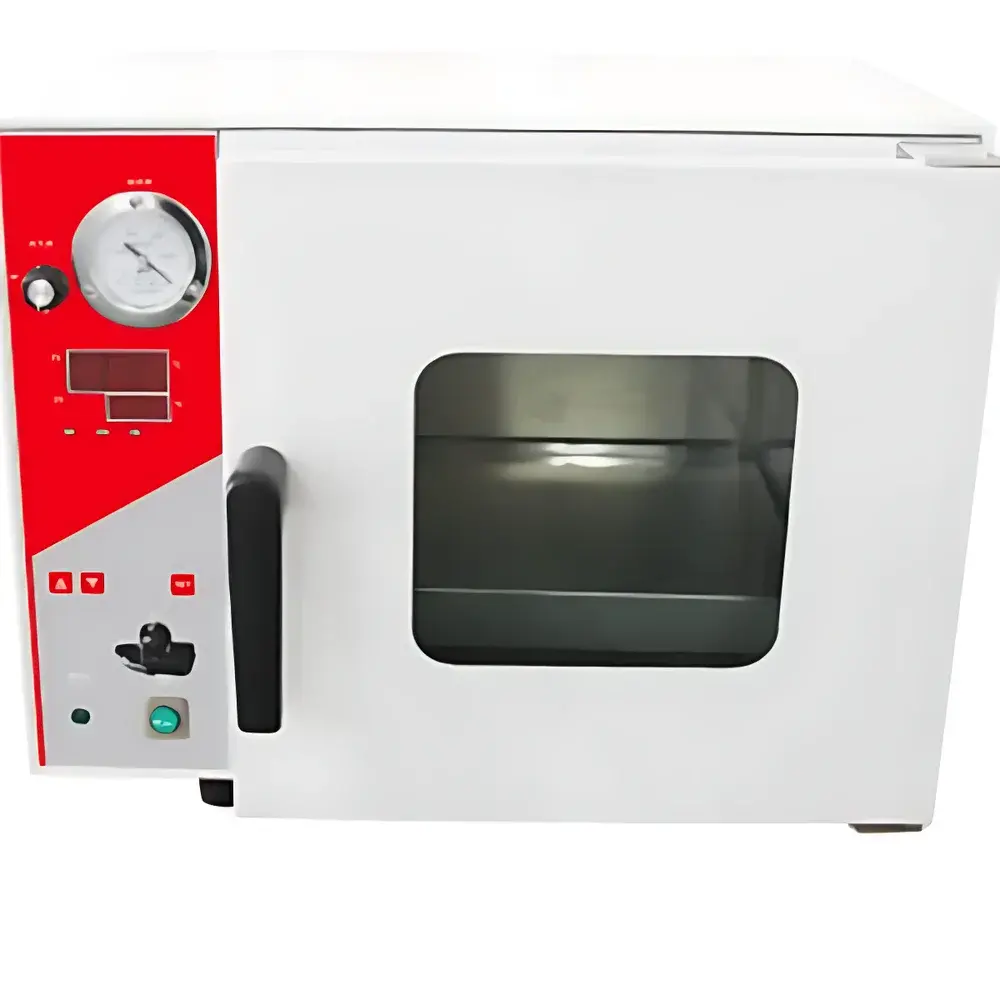
BOXUN DZF-6020MBE & DZF-6050MBE Microprocessor-Controlled Vacuum Drying Ovens
| Brand | BOXUN |
|---|---|
| Origin | Shanghai, China |
| Model | DZF-6020MBE, DZF-6050MBE |
| Instrument Type | Vacuum Oven |
| Temperature Range | +5°C to 250°C |
| Temperature Uniformity | ±1°C |
| Vacuum Level | 133 Pa |
| Internal Chamber Dimensions (DZF-6020MBE) | 300 × 296 × 275 mm |
| Internal Chamber Dimensions (DZF-6050MBE) | 415 × 370 × 344 mm |
| External Dimensions (DZF-6020MBE) | 590 × 430 × 475 mm |
| External Dimensions (DZF-6050MBE) | 710 × 505 × 550 mm |
| Chamber Volume | 30 L (DZF-6020MBE), 50 L (DZF-6050MBE) |
| Temperature Resolution | 0.1°C |
| Heating Method | Forced-Air Convection with Vacuum Compatibility |
| Chamber Material | Stainless Steel (SUS304) |
| Power Supply | AC 220 V ±10%, 50 Hz ±2% |
| Input Power | 900 W (DZF-6020MBE), 1300 W (DZF-6050MBE) |
| Timer Range | 0–999 minutes |
| Standard Shelves | 2 pcs |
| Operating Ambient Temperature | 5–40°C |
Overview
The BOXUN DZF-6020MBE and DZF-6050MBE are microprocessor-controlled vacuum drying ovens engineered for precise, low-temperature dehydration of thermally sensitive, oxidation-prone, or compositionally complex samples. Unlike conventional forced-air ovens, these units operate under reduced pressure—down to 133 Pa—to lower the boiling point of solvents and moisture, enabling efficient drying below degradation thresholds. This principle is grounded in the Clausius–Clapeyron relationship, where vapor pressure depression under vacuum facilitates gentle solvent removal without thermal stress. Designed for routine use in GLP-compliant laboratories, they serve as critical tools in pharmaceutical stability testing, polymer formulation, lyophilization pre-drying, catalyst activation, and analytical sample preparation where residual solvent content must be minimized per ICH Q5C or USP guidelines.
Key Features
- Microprocessor-based PID temperature control system with real-time digital display (dual LED screens), offering 0.1°C resolution and programmable setpoint retention across power interruptions.
- Stainless steel (SUS304) interior chamber with seamless, radius-corner construction—optimized for cleaning validation and minimizing particle entrapment per ISO 14644-1 Class 8 cleanroom maintenance protocols.
- Reinforced dual-pane tempered glass door with integrated silicone gasket, rated for sustained operation at ≤133 Pa vacuum; door-tightness is user-adjustable to ensure long-term seal integrity.
- Forced-air convection heating system fully functional under vacuum conditions—engineered to maintain uniform temperature distribution (±1°C) across the entire working volume, validated per ASTM E2297-21 Annex A1 for vacuum oven performance verification.
- Programmable timer (0–999 min) with auto-shutdown and over-temperature cut-off (±5°C above setpoint), supporting unattended operation during extended drying cycles.
- Electrostatically coated cold-rolled steel exterior with ergonomic curved profile—designed for durability, ease of surface decontamination, and compatibility with laboratory furniture integration standards (EN 14727).
Sample Compatibility & Compliance
These ovens accommodate a broad range of sample formats—including Petri dishes, weighing boats, glass vials, ceramic crucibles, and custom fixtures—without compromising vacuum integrity. The stainless steel chamber resists corrosion from organic solvents (e.g., acetone, ethanol, ethyl acetate) and mild aqueous solutions, supporting reuse in multi-batch workflows. Units comply with electrical safety requirements per IEC 61010-1:2010 and electromagnetic compatibility per EN 61326-1:2013. While not intrinsically rated for hazardous location use, their design aligns with general laboratory risk assessments under ISO/IEC 17025:2017 clause 5.4.1 for equipment suitability verification. Vacuum performance meets typical requirements for ASTM D2243 (plastic film drying) and ISO 11357-4 (thermal analysis sample conditioning).
Software & Data Management
The embedded microcontroller supports manual parameter entry only—no external software interface or data export capability is included. However, all operational parameters (set temperature, elapsed time, vacuum status indicator) are continuously displayed and retained in non-volatile memory. In the event of power failure, the system automatically restores prior settings upon restart—a feature aligned with FDA 21 CFR Part 11 §11.10(a) expectations for basic audit trail functionality in non-GMP but regulated environments (e.g., academic research labs conducting NIH-funded studies). For full electronic record compliance, integration with third-party environmental monitoring systems (via optional analog output modules, sold separately) is feasible through standard 4–20 mA or 0–5 V signal interfaces.
Applications
- Pre-drying of HPLC vials and GC sample tubes to eliminate trace moisture prior to headspace analysis.
- Dehydration of enzyme powders, probiotics, and vaccine adjuvants where thermal denaturation must be avoided.
- Removal of residual solvents from synthesized MOFs (metal–organic frameworks) and nanomaterial dispersions.
- Conditioning of reference standards per USP “Water Determination” methodology prior to Karl Fischer titration.
- Accelerated aging studies of packaging materials under controlled humidity and temperature gradients.
- Post-cleaning drying of precision optical components and MEMS devices requiring particulate-free, low-outgassing environments.
FAQ
What vacuum level can the DZF-6020MBE and DZF-6050MBE achieve?
Both models are rated for a minimum ultimate vacuum of 133 Pa (1 Torr) when paired with a compatible two-stage rotary vane pump meeting ISO 8573-1 Class 4 purity requirements.
Is the chamber volume usable at full vacuum?
Yes—the stated internal volumes (30 L and 50 L) reflect net free space available for sample placement under operating vacuum conditions; no volumetric reduction occurs due to structural deformation.
Can these ovens be used for sterilization or depyrogenation?
No—they are not designed or validated for microbial kill or endotoxin destruction; autoclave or dry-heat tunnel systems meeting ISO 17665 or USP are required for such applications.
Does the unit include a vacuum pump?
No—vacuum pumps are supplied separately; we recommend selecting a pump with ≥4 L/min free air displacement and oil mist filtration for optimal longevity and chamber cleanliness.
How is temperature uniformity verified across the chamber?
Uniformity is confirmed via nine-point mapping per ASTM E2297-21 using calibrated PT100 probes; test reports are available upon request for IQ/OQ documentation support.



