
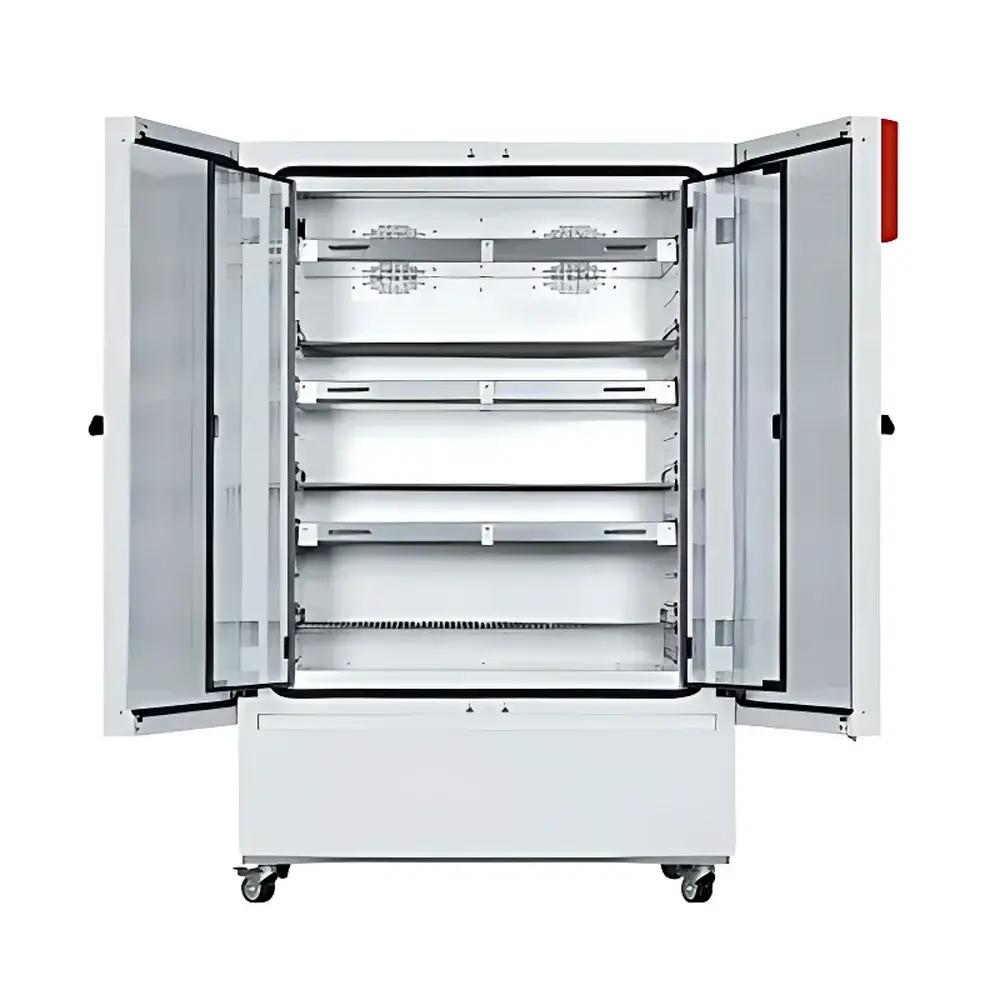
BINDER KBW & KBWF Series Plant Growth Chambers
| Brand | BINDER |
|---|---|
| Origin | Germany |
| Model Series | KBW, KBWF |
| Temperature Range | 0–70 °C (dry, dark) / 10–60 °C (humid, lit) |
| Humidity Range | 10–80 % RH (dry, dark) / 10–75 % RH (humid, lit) |
Overview
The BINDER KBW and KBWF Series Plant Growth Chambers are precision-engineered environmental simulation systems designed for reproducible, long-term cultivation of plants, algae, fungi, and model organisms under tightly controlled climatic conditions. Based on BINDER’s proprietary APT.Line® preheating technology—where the inner chamber walls are actively heated to eliminate thermal gradients—the KBW/KBWF platforms deliver exceptional spatial temperature uniformity (±0.3 °C at 25 °C, per DIN 12880) and temporal stability (±0.1 °C over 24 h). The KBW series focuses on high-fidelity photoperiodic simulation using daylight-spectrum fluorescent lighting, while the KBWF extends functionality with integrated humidification and dehumidification subsystems, enabling full tri-variable control (temperature, relative humidity, and photosynthetically active radiation). These chambers comply with ISO 17025-accredited calibration practices and support GLP-compliant experimental workflows in academic, pharmaceutical, and agro-biotech laboratories.
Key Features
- APT.Line® inner chamber preheating architecture ensures minimal thermal stratification and rapid recovery after door opening (≤15 min to re-stabilize at 25 °C/60 % RH).
- MCS microprocessor controller with intuitive touch interface, supporting up to 25 independent multi-step programs (each with up to 100 segments), programmable day/night cycles, ramp/halt/soak functions, and user-defined alarm thresholds.
- Modular light system: Each adjustable light box houses five T5 fluorescent lamps (6500 K, 36 W each); intensity and spectral balance optimized for photomorphogenesis and photosynthetic efficiency (PAR range: 400–700 nm).
- Capacitive humidity sensing with factory-traceable calibration; closed-loop electronic humidification (steam generator) and refrigerative dehumidification ensure stable RH control without desiccant replacement or sensor drift.
- Dual safety architecture: Primary PID-controlled regulation plus an independent mechanical safety thermostat (DIN 12880 Class 3.1) with visual LED indicator and audible alarm for over-temperature events.
- RS422 serial interface compatible with BINDER’s APT-COM® software suite for remote monitoring, data logging (timestamped, CSV-exportable), audit trail generation, and 21 CFR Part 11–compliant user access control (optional license).
Sample Compatibility & Compliance
The KBW/KBWF chambers accommodate standard plant growth vessels—including Petri dishes, Magenta boxes, growth trays (up to 500 mm × 350 mm footprint), and hydroponic racks—within their stainless-steel interior (AISI 304) and tempered glass inner door. Internal dimensions (KBWF 720 model example): 690 W × 590 D × 1,120 H mm; usable volume: 420 L. All models meet IEC 61000-6-3 (EMC emissions) and IEC 61000-6-2 (immunity) standards. Humidity and temperature performance is validated per VDI/VDE 3511 Sheet 4.4 and referenced in BINDER’s ISO/IEC 17025 test certificate (included with shipment). The system supports compliance with OECD Test Guidelines 208 (terrestrial plant toxicity), ASTM E1980 (light exposure protocols), and EU Directive 2004/10/EC on Good Laboratory Practice.
Software & Data Management
APT-COM® Professional software enables centralized management of multiple BINDER units across a LAN. It provides real-time visualization of all process parameters (T, RH, light status, alarm states), configurable trend graphs, automated report generation (PDF/CSV), and secure user role assignment (administrator, operator, viewer). Audit trails record all parameter changes, program uploads, and manual interventions with timestamps and operator IDs—fully traceable for FDA 21 CFR Part 11 and EU Annex 11 validation requirements. Raw data files are stored in non-proprietary formats to ensure long-term archival integrity and third-party analysis compatibility (e.g., R, Python, MATLAB).
Applications
- Controlled-environment phenotyping of crop mutants under defined photoperiods and drought stress (e.g., Arabidopsis thaliana, Oryza sativa).
- Regulatory stability testing of botanical extracts and cosmeceuticals per ICH Q1A(R3) guidelines.
- Insect rearing (Drosophila, Tribolium) with synchronized circadian entrainment via programmable light/dark transitions.
- Pre-germination conditioning of seeds under variable moisture and thermal regimes.
- Long-term culture of mosses, lichens, and bryophytes requiring low-light, high-humidity niches.
- Validation of packaging material permeability under accelerated aging conditions (ASTM F1249).
FAQ
What is the difference between KBW and KBWF models?
The KBW series offers precise temperature and light control only; the KBWF adds fully integrated, feedback-regulated humidity control—enabling simultaneous, independent modulation of all three critical growth variables.
Can the chamber operate at 4 °C with 95% RH?
No. Due to condensation risk and physical limitations of the steam-based humidification system, the minimum operating temperature with active humidity control is 10 °C. Below this, only dry operation (0–70 °C) is supported.
Is UV-B irradiation supported?
Standard configurations use daylight-spectrum fluorescent tubes (UV-A present, UV-B negligible). Custom UV-B modules (e.g., Philips TL 20W/01) can be integrated upon request, subject to chamber-specific safety interlocks and irradiance mapping.
How often does the humidity sensor require recalibration?
The capacitive sensor is maintenance-free and factory-calibrated for the lifetime of the unit under normal operating conditions; no field recalibration is specified by BINDER.
Does the system support Ethernet or only RS422?
RS422 is standard; optional Ethernet gateway modules (e.g., BINDER LAN Adapter) enable TCP/IP connectivity and integration into building management systems (BMS) or LIMS platforms.



