
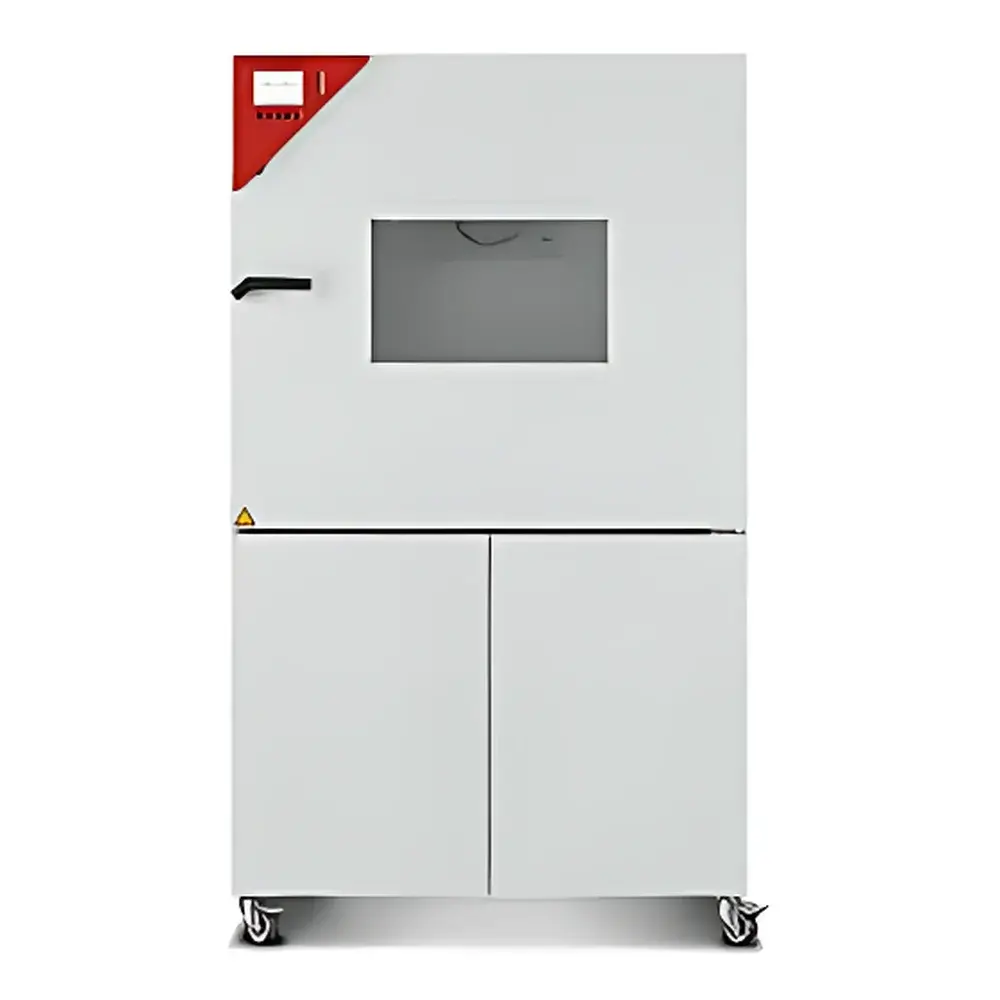
BINDER MKT Series High-Low Temperature Environmental Test Chambers
| Brand | BINDER |
|---|---|
| Origin | Germany |
| Model | MKT |
| Temperature Range | -70 °C to +180 °C |
| Compliance | DIN 12880 Class 2 Temperature Safety Device, IEC 60068, MIL-STD-810 |
| Humidity Control | Capacitive Hygrometer + Steam Humidification (MKT models) |
| Refrigerant | R-452A |
| Controller | MCS Touchscreen with Real-Time Clock, Ramp Function, Internal Data Logger |
| Interface | Ethernet, USB, 230 V Socket on Right Side |
| Safety | Optical & Acoustic Fault Diagnostics, Heated Viewing Window with LED Lighting, Silicone-Sealed Access Ports (50 mm for MKT 115/240 |
| Castors | 4, 2 with Brakes |
| Internal Volume | 115 L / 228 L / 734 L (MKT 115 / MKT 240 / MKT 720) |
| Net Weight | 305 kg / 380 kg / 610 kg |
Overview
The BINDER MKT Series High-Low Temperature Environmental Test Chambers are precision-engineered environmental simulation systems designed for rigorous thermal stress testing of materials, components, and finished products under dynamically controlled conditions. Based on the fundamental principles of convective heat transfer and thermodynamic equilibrium, these chambers deliver exceptional temperature uniformity and stability across their full operating range of –70 °C to +180 °C. The proprietary APT.line™ preheating chamber technology ensures rapid, homogeneous temperature distribution while minimizing thermal gradients—critical for compliance with standardized test protocols such as DIN EN 60068-2-1 (cold), DIN EN 60068-2-2 (dry heat), and MIL-STD-810H Method 502.5. Unlike conventional chambers relying solely on forced-air circulation, the MKT series integrates a dual-zone thermal architecture: the outer jacket maintains precise ambient insulation, while the inner chamber wall is actively preheated to eliminate condensation during low-temperature ramp-downs—a key requirement for testing hygroscopic or coating-sensitive specimens. All units are manufactured in Tuttlingen, Germany, and conform to CE, UL/cULus, and RoHS directives.
Key Features
- Class 2 independent temperature safety device per DIN 12880, featuring optical alarm activation and redundant sensor monitoring
- Capacitive humidity sensor combined with steam-based humidification system (optional on MKT models) for high-fidelity climate simulation
- MCS touchscreen controller with real-time clock, programmable ramp rates, hold steps, and user-defined profiles (up to 99 segments)
- Integrated internal data logger storing temperature (and humidity, if equipped) at configurable intervals; data exportable via USB in CSV format
- Heated, double-glazed viewing window with LED illumination for continuous visual inspection without thermal interruption
- Silicone-sealed access ports (50 mm diameter on MKT 115/240; dual 80 mm ports on MKT 720) enabling external cabling, sensor feedthroughs, or pneumatic connections
- Four heavy-duty castors (two with mechanical brakes) for stable repositioning in laboratory or production environments
- Ethernet interface supporting remote monitoring, alarm forwarding, and integration into centralized facility management systems (e.g., LabVantage, Siemens Desigo)
Sample Compatibility & Compliance
The MKT series accommodates a broad spectrum of sample geometries—from small electronic assemblies and polymer films to automotive subcomponents and pharmaceutical packaging. Internal dimensions (e.g., 600 × 480 × 400 mm for MKT 115) allow flexible fixture mounting, while the heated door prevents frost formation during extended low-temperature operation. All models comply with ISO/IEC 17025 calibration traceability requirements when paired with BINDER’s certified reference sensors. For regulated industries, the MCS controller supports audit-trail-enabled operation per FDA 21 CFR Part 11 (when used with validated software configuration), and test records meet GLP/GMP documentation standards. The R-452A refrigerant meets current EU F-Gas Regulation (EU) No 517/2014 phase-down criteria and offers significantly lower global warming potential (GWP = 2140) versus legacy R-404A.
Software & Data Management
The MCS controller firmware includes built-in time-split functionality, enabling simultaneous execution of multiple test programs across different chamber zones (where applicable). Real-time graphing displays current setpoints, measured values, and deviation tolerances directly on the 7-inch color LCD. Logged data is timestamped with millisecond resolution and retains integrity even during power interruption due to non-volatile memory storage. Exported CSV files are compatible with statistical process control (SPC) platforms including JMP, Minitab, and Python-based analysis workflows. Optional BINDER WebControl software enables secure HTTPS-based remote access, email/SMS alerting on alarm events, and automated report generation compliant with ISO 17025 clause 7.8.2.
Applications
These chambers serve critical roles in quality assurance and R&D across aerospace (thermal cycling of avionics housings), automotive (material aging under desert/Arctic profiles), electronics (solder joint reliability per JEDEC JESD22-A104), and medical device manufacturing (sterile barrier system validation per ISO 11607-2). They are routinely deployed for accelerated life testing, cold-start simulations, and qualification of adhesives and sealants under dynamic humidity-temperature coupling—particularly relevant for battery module encapsulation and EV thermal interface materials.
FAQ
What safety certifications do MKT chambers carry?
All MKT models are CE-marked, UL/cULus listed (File E195570), and comply with EN 61000-6-2/6-4 for electromagnetic compatibility.
Can the MKT series perform humidity-controlled thermal cycling?
Yes—when configured with the optional steam humidification system and capacitive hygrometer, MKT chambers support combined temperature/humidity profiles per IEC 60068-2-30 (damp heat cyclic).
Is remote diagnostics supported?
Yes—via integrated Ethernet port and BINDER WebControl, users can monitor chamber status, download logs, and receive real-time notifications without local physical access.
How is temperature uniformity validated?
BINDER provides factory-verified uniformity reports per DIN EN 60068-3-5, typically ±0.5 °C at 100 °C and ±1.0 °C at –40 °C across the working volume.
What maintenance intervals are recommended?
Compressor oil and filter replacement every 24 months; annual calibration verification of temperature/humidity sensors using NIST-traceable references.



