
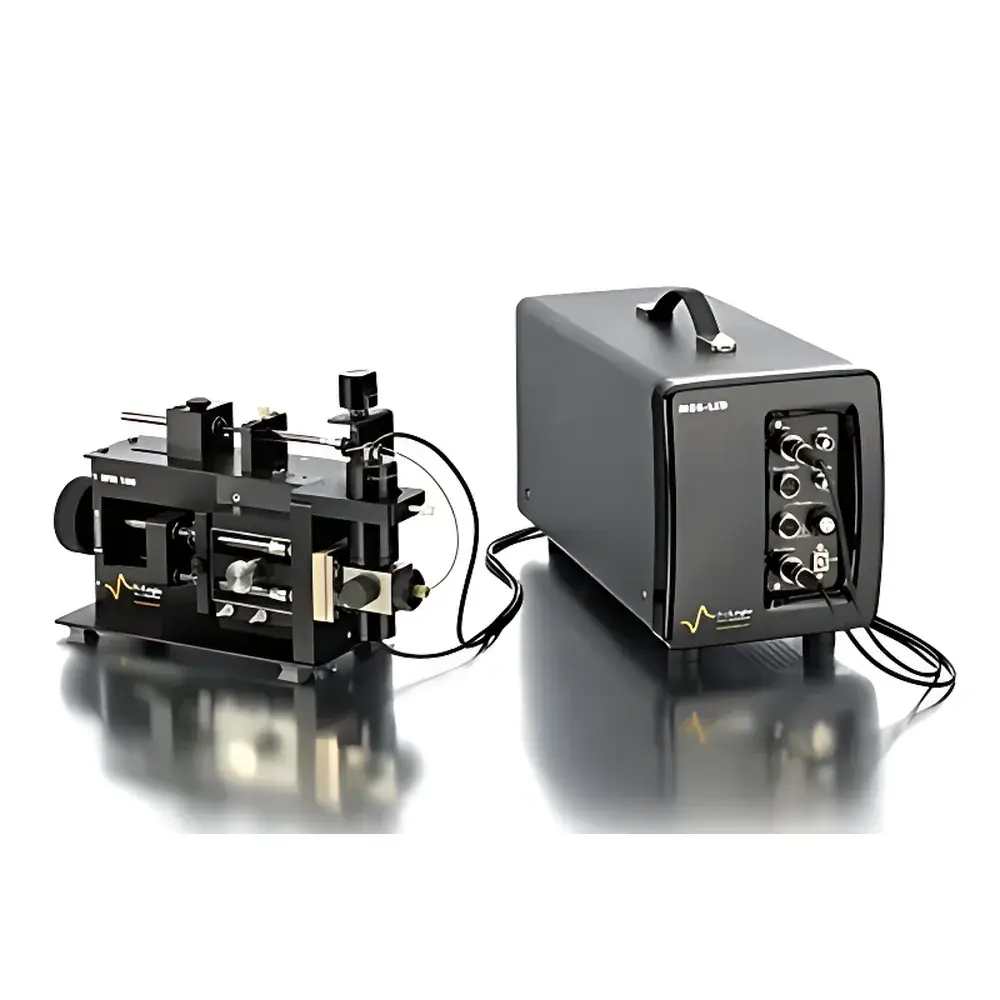
Bio-Logic SFM-100+MOS-LED Stopped-Flow Spectrophotometer for Rapid Kinetic Analysis
| Brand | Bio-Logic |
|---|---|
| Origin | France |
| Manufacturer Status | Authorized Distributor |
| Origin Category | Imported |
| Model | SFM-100+MOS-LED |
| Instrument Architecture | Single-beam |
| Detector Type | Photodiode Array (PDA) |
| Wavelength Range | 180–820 nm |
| Wavelength Accuracy | ±0.1 nm |
| Spectral Bandwidth | 0–16 nm (adjustable) |
| Stray Light | ≤2 ppm |
| Dead Time | 5 ms (motor-driven), 8 ms (manual) |
| Sample Consumption per Experiment | 30 µL |
| Mixing Chamber Dead Volume | 20 µL |
| Mixing Ratio | Variable |
| Control Interface | USB |
| Detection Modes | Standard Absorbance (default), optional Fluorescence and Dual-Absorbance modes |
| Software | Spec-Lab v5.x |
Overview
The Bio-Logic SFM-100+MOS-LED is a high-performance, single-beam stopped-flow spectrophotometer engineered for quantitative analysis of rapid chemical and biochemical reaction kinetics on the millisecond timescale. It operates on the fundamental principle of rapid mixing followed by time-resolved optical detection—enabling real-time monitoring of transient species formation, conformational changes, ligand binding, enzyme catalysis, and protein folding/unfolding events. The instrument integrates a motorized optical stop-flow unit (MOS-LED) with a high-sensitivity photodiode array detector, delivering sub-millisecond temporal resolution and spectral acquisition across the deep UV to visible range (180–820 nm). Its compact, modular architecture and low sample consumption (30 µL per experiment) make it especially suitable for laboratories working with scarce or expensive biomolecules—including purified enzymes, nucleic acids, and membrane proteins—while maintaining rigorous experimental reproducibility under controlled temperature and flow conditions.
Key Features
- Motor-driven stopped-flow module (MOS-LED) enabling precise dead-time control down to 5 ms, with manual override capability (8 ms dead time)
- Photodiode array (PDA) detector providing full-spectrum acquisition (180–820 nm) in a single shot, eliminating wavelength scanning delays
- Adjustable spectral bandwidth (0–16 nm) optimized for signal-to-noise ratio versus spectral resolution trade-offs
- Wavelength accuracy of ±0.1 nm ensures traceable calibration compliance with ISO/IEC 17025 and ASTM E275 for spectrophotometric validation
- Stray light level ≤2 ppm minimizes baseline distortion in absorbance measurements below 200 nm—critical for aromatic amino acid and nucleotide quantification
- Low dead volume (20 µL) and variable mixing ratio support stoichiometric flexibility across diverse reaction systems
- USB-based communication protocol compatible with Windows OS and supports audit-trail-enabled data logging per FDA 21 CFR Part 11 requirements when used with validated Spec-Lab configurations
Sample Compatibility & Compliance
The SFM-100+MOS-LED accommodates aqueous and organic solvent-based reaction mixtures, including buffered solutions, glycerol-containing viscosities, and detergent-stabilized membrane protein preparations. Its quartz flow cell and PTFE fluidic path resist corrosion and adsorption, ensuring compatibility with acidic, basic, and chaotropic reagents. The system meets essential performance criteria outlined in ISO 9001-certified manufacturing practices and supports GLP/GMP-aligned workflows through Spec-Lab’s timestamped, user-identifiable data export and metadata tagging. All optical components are CE-marked and conform to IEC 61000-4 electromagnetic compatibility standards.
Software & Data Management
Spec-Lab v5.x provides intuitive instrument control, kinetic trace acquisition, spectral deconvolution, and global fitting capabilities using nonlinear regression algorithms (e.g., Marquardt-Levenberg). Raw data files (.spc) retain full metadata—including mixing parameters, temperature logs, lamp intensity history, and user annotations—for retrospective analysis and regulatory submission. Export formats include ASCII, CSV, and HDF5, facilitating integration with MATLAB, Python (SciPy/NumPy), and commercial kinetic modeling platforms such as DynaFit or KinTek Explorer. Audit trail functionality records all parameter modifications, file saves, and software version changes—essential for laboratory accreditation under ISO/IEC 17025 and pharmaceutical QC environments.
Applications
- Enzyme kinetics (pre-steady-state burst analysis, kcat/KM determination)
- Hemoglobin and myoglobin ligand-binding dynamics (O2, CO, NO)
- Protein folding intermediates detected via tryptophan fluorescence or tyrosine absorbance shifts
- Nucleic acid hybridization and G-quadruplex formation kinetics
- Photoinduced electron transfer reactions in synthetic photocatalysts
- Teaching laboratories: hands-on instruction in transient kinetics, detector physics, and Beer–Lambert law applications
FAQ
What is the minimum measurable dead time, and how is it achieved?
The instrument achieves a motor-driven dead time of 5 ms using synchronized syringe displacement and pneumatic valve actuation; this value is verified using standard azide–nitrite or cytochrome c oxidation test reactions.
Can the SFM-100+MOS-LED perform fluorescence measurements?
Yes—when equipped with the optional fluorescence detection module, it enables time-resolved emission spectroscopy (TRES) with excitation at fixed wavelengths (e.g., 280 nm or 295 nm) and emission collection across 300–600 nm.
Is temperature control integrated into the system?
The base SFM-100 does not include built-in thermostating; however, it is fully compatible with external Peltier-controlled mixing blocks and flow cells (e.g., Bio-Logic TCB-100) for experiments between 4 °C and 45 °C.
How is calibration traceability maintained for wavelength and absorbance?
Wavelength calibration uses holmium oxide and didymium filters certified to NIST SRM 2034 and SRM 2035; absorbance linearity is verified using neutral density filters traceable to NIST SRM 930e.
Does Spec-Lab support automated method sequencing for unattended operation?
Yes—batch mode allows pre-programmed sequences of up to 99 experiments with variable mixing ratios, delay times, and acquisition durations, enabling overnight kinetic screening studies.





