
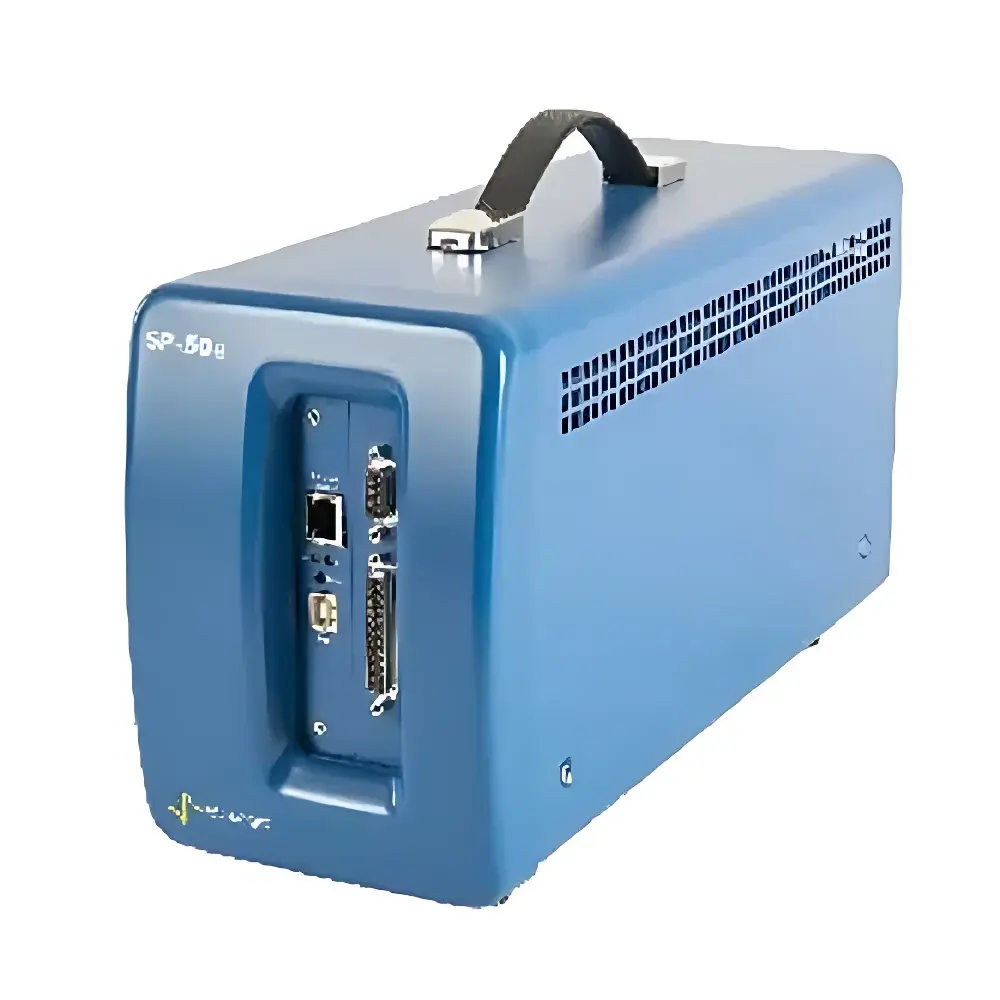
Bio-Logic SP-50e Single-Channel Portable Potentiostat/Galvanostat
| Brand | Bio-Logic |
|---|---|
| Origin | France |
| Model | SP-50e |
| Instrument Type | Portable Electrochemical Workstation |
| Channel Count | Single-Channel |
| Current Range | ±1 A |
| Current Accuracy | ±20 nA (on 10 μA range) |
| Potential Accuracy | <5 mV (on ±2.5 V range) |
| Potentiostatic Range | ±10 V |
| EIS Frequency Range | 10 μHz to 1 MHz |
| Current Resolution | 760 pA |
| Voltage Resolution | Adjustable from 300 μV down to 5 μV |
| Data Acquisition Rate | 200,000 points/s |
Overview
The Bio-Logic SP-50e is a compact, single-channel potentiostat/galvanostat engineered for high-fidelity electrochemical research in academic laboratories, industrial R&D centers, and field-deployable testing environments. Operating on the principle of controlled-potential (potentiostatic) and controlled-current (galvanostatic) electrochemical measurement, the SP-50e delivers laboratory-grade performance in a portable form factor. Its architecture supports classical DC techniques—including cyclic voltammetry (CV), chronoamperometry (CA), chronopotentiometry (CP), and linear sweep voltammetry (LSV)—as well as advanced frequency-domain characterization via electrochemical impedance spectroscopy (EIS). The instrument’s analog front-end features low-noise design, real-time digital signal processing, and hardware-synchronized data acquisition, enabling robust signal integrity even under low-current or high-impedance conditions typical of sensor interfaces, corrosion monitoring, and battery electrode characterization.
Key Features
- True single-channel architecture with full potentiostatic, galvanostatic, and zero-resistance ammeter (ZRA) modes
- Wide dynamic current range from ±10 µA to ±1 A, with programmable gain stages and auto-ranging capability
- High-resolution potential control: 300 µV base resolution, dynamically adjustable down to 5 µV for ultra-sensitive measurements
- Ultra-low current detection limit supported by ±20 nA accuracy on the 10 µA range, critical for microelectrode and biosensor applications
- Extended EIS frequency coverage from 10 µHz to 1 MHz—enabling both slow interfacial relaxation studies and fast double-layer charging analysis
- Real-time data acquisition at up to 200,000 points per second, with onboard buffering and timestamp synchronization
- Integrated thermal management and electromagnetic shielding compliant with IEC 61326-1 for EMC in shared lab environments
Sample Compatibility & Compliance
The SP-50e interfaces seamlessly with standard three-electrode electrochemical cells (working, counter, reference), rotating disk electrodes (RDE), and custom microfluidic or thin-film test fixtures. It supports common reference electrodes (Ag/AgCl, SCE, Hg/Hg₂SO₄) and is compatible with aqueous, non-aqueous, and ionic liquid electrolytes. From a regulatory standpoint, the instrument meets essential requirements of IEC 61010-1 (safety) and IEC 61326-1 (EMC). While not certified for GMP production environments, its software architecture supports audit-trail-enabled operation when used with EC-Lab® v12+ under GLP-compliant workflows. All firmware and calibration data are traceable to internal NIST-traceable references, and the device complies with RoHS and REACH directives.
Software & Data Management
Controlled exclusively via Bio-Logic’s EC-Lab® software (Windows-based, v12.0 or later), the SP-50e provides intuitive method scripting, real-time visualization, and post-experiment analysis modules—including equivalent circuit fitting (EIS), derivative analysis (CV), and diffusion-controlled current modeling. EC-Lab® implements role-based user access, electronic signatures, and full audit trail logging per FDA 21 CFR Part 11 guidelines when configured with network authentication and centralized database storage. Raw data are saved in open-format .mpt files (ASCII-based, tab-delimited), ensuring long-term readability and third-party compatibility with Python (pympt), MATLAB, or OriginLab. Firmware updates are delivered through secure HTTPS channels and validated via SHA-256 checksums.
Applications
- Battery material screening: half-cell and full-cell cycling, differential capacity analysis (dQ/dV), and SEI growth kinetics via low-frequency EIS
- Corrosion science: Tafel extrapolation, polarization resistance (Rp), and electrochemical noise analysis (ENA) on coated metals and alloys
- Electrochemical biosensors: amperometric detection of glucose, dopamine, or H₂O₂ with sub-nA resolution and rapid response validation
- Fuel cell catalyst evaluation: oxygen reduction reaction (ORR) activity mapping, accelerated stress testing (AST), and mass transport analysis
- Photoelectrochemistry: time-resolved photocurrent transients synchronized with external light sources (via TTL input)
- Academic teaching labs: modular experiment templates aligned with ASTM G59 (DC polarization), ASTM G106 (EIS), and ISO 16773-2 (corrosion monitoring)
FAQ
Is the SP-50e suitable for battery cycling tests requiring long-term stability?
Yes—the instrument supports continuous operation for >72 hours with active thermal regulation and drift-compensated potential control. Its ±10 V compliance voltage accommodates most Li-ion, Na-ion, and solid-state battery configurations.
Can multiple SP-50e units be synchronized for multi-electrode array studies?
No—each SP-50e operates as an independent channel. For true multi-channel synchronization, Bio-Logic recommends the VSP-300 or MCS series platforms.
Does EC-Lab® support automated method sequencing across different scan rates or potentials?
Yes—using the “Method Sequence” module, users can define cascaded experiments (e.g., CV at 10 mV/s → EIS at OCP → CA at −0.5 V) with conditional triggers and file naming rules.
What calibration standards are required for routine maintenance?
Bio-Logic provides factory-calibrated dummy cells (DC-10k, DC-1M) and recommends annual verification using traceable resistors and voltage references per ISO/IEC 17025 guidelines.
Is USB isolation available to prevent ground loops in shielded Faraday cages?
Yes—the SP-50e includes opto-isolated USB 2.0 communication, rated to 1 kV RMS, minimizing interference during low-noise measurements.
Related Products





