
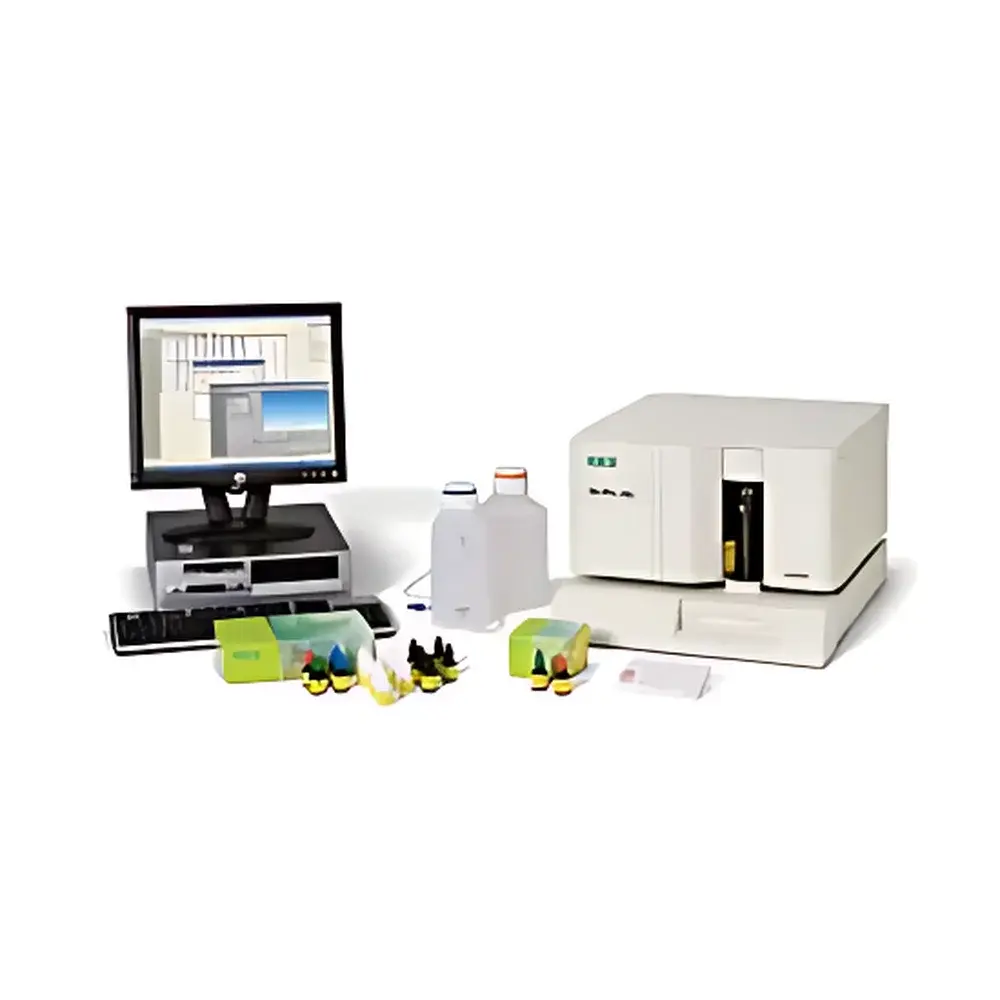
Bio-Rad Bio-Plex 200 Suspension Array System
| Brand | Bio-Rad |
|---|---|
| Origin | USA |
| Model | Bio-Plex 200 |
| Configuration | Complete system with dual-laser detection, magnetic bead handling, and integrated fluidics |
| Detection Principle | xMAP® (x-MAP) technology based on fluorescently encoded microspheres |
| Multiplex Capacity | Up to 500 analytes per well |
| Sample Format | 96-well or 384-well microplate |
| Detection Lasers | 532 nm (reporter) and 635 nm (classification) |
| Sensitivity | Sub-picogram/mL range for cytokines (typical) |
| Compliance | Designed for GLP/GMP environments |
Overview
The Bio-Rad Bio-Plex 200 Suspension Array System is a dual-laser, flow-based multiplex immunoassay platform engineered for high-sensitivity, quantitative analysis of up to 500 distinct biomolecules in a single microliter-scale sample. Built upon Luminex xMAP® technology, the system utilizes spectrally distinct fluorescent microspheres—each uniquely coded by internal dye ratios—to serve as solid-phase carriers for capture reagents. During assay execution, analyte binding is detected via phycoerythrin-conjugated reporter antibodies, while classification lasers (532 nm and 635 nm) simultaneously resolve bead identity and quantify reporter fluorescence intensity. This orthogonal optical architecture enables true parallel detection without cross-reactivity or spectral overlap compensation artifacts. The Bio-Plex 200 integrates fluidic handling, temperature-controlled incubation, magnetic bead separation, and real-time signal acquisition into a single benchtop instrument, supporting both research-grade discovery and regulated QC/QA applications requiring traceable calibration and audit-ready data lineage.
Key Features
- Dual-laser optical detection engine optimized for xMAP microsphere decoding and reporter quantification with <1% coefficient of variation (CV) for intra-assay precision
- Integrated magnetic separation module enabling robust wash steps for both polystyrene and magnetic bead-based assays
- Automated plate handling with barcode scanning and positional tracking for full sample traceability
- Onboard temperature control (4–45°C) for precise incubation across antibody binding, enzymatic, and hybridization steps
- Validation-ready architecture compliant with ISO/IEC 17025 and ASTM E2500-18 guidelines for analytical instrument qualification
- Modular design supporting future upgrades including enhanced throughput modules and expanded reagent compatibility
Sample Compatibility & Compliance
The Bio-Plex 200 accepts native biological matrices—including serum, plasma, cell culture supernatants, cerebrospinal fluid (CSF), and tissue lysates—without mandatory pre-purification, provided samples meet defined particulate and viscosity thresholds (<10 cP). Assay kits are validated per CLSI EP17-A2 for limit of detection (LoD) and EP05-A3 for precision profiling. Instrument operation adheres to FDA 21 CFR Part 11 requirements when deployed with Bio-Plex Manager™ software configured for electronic signatures, audit trails, and role-based access control. All system performance verification (SPV) protocols—including photometric linearity, bead classification fidelity, and fluidic accuracy—are documented per IQ/OQ/PQ frameworks aligned with GAMP 5 principles.
Software & Data Management
Bio-Plex Manager™ software v6.2+ serves as the unified interface for instrument control, assay protocol definition, real-time monitoring, and statistical analysis. It provides built-in curve-fitting algorithms (5-parameter logistic, spline, and weighted linear regression), batch processing for multi-plate studies, and automated outlier detection using Grubbs’ test. Raw data files (.xpt) are stored in vendor-neutral formats compatible with third-party platforms such as GraphPad Prism and R/Bioconductor. Audit trail logs record all user actions—including parameter edits, result exports, and calibration events—with immutable timestamps and operator IDs. Data export options include CSV, XML, and SDTM-compliant structures for regulatory submissions.
Applications
- Immunoprofiling of cytokine, chemokine, and growth factor panels in translational oncology and autoimmune disease studies
- Pharmacodynamic biomarker monitoring in clinical trial biospecimens under ICH-GCP standards
- Host-cell protein (HCP) residual detection during bioprocess development and lot release testing
- High-throughput screening of monoclonal antibody affinity and epitope binning using competitive binding assays
- Nucleic acid-based detection of miRNA, SNP genotyping, and viral load quantification via hybridization-coupled xMAP chemistries
- Cell signaling pathway analysis through phospho-protein multiplexing in stimulated primary cell models
FAQ
What validation documentation is included with the Bio-Plex 200 system?
Each shipment includes a Factory Acceptance Test (FAT) report, Certificate of Conformance, and a complete set of SPV protocols covering optical alignment, fluidic delivery accuracy, temperature uniformity, and bead classification reproducibility.
Can the Bio-Plex 200 be integrated into an automated laboratory workflow?
Yes—the system features RS-232, Ethernet, and USB interfaces compatible with LIS/LIMS middleware and robotic deck controllers meeting ANSI SLAS-4 standards.
Is xMAP assay development supported in-house or only through certified partners?
Bio-Rad offers custom assay development services through its Global Assay Development Center (GADC), and provides open-access reagent kits (e.g., Bio-Plex Pro™ Coupling Kits) for end-user conjugation of proprietary capture molecules.
How does the Bio-Plex 200 ensure long-term data integrity across software updates?
All historical .xpt files remain fully readable in current and future versions of Bio-Plex Manager™; version migration paths and backward compatibility matrices are published in the Software Lifecycle Policy document (Ref: BIO-RAD-SW-LCP-2023).



