
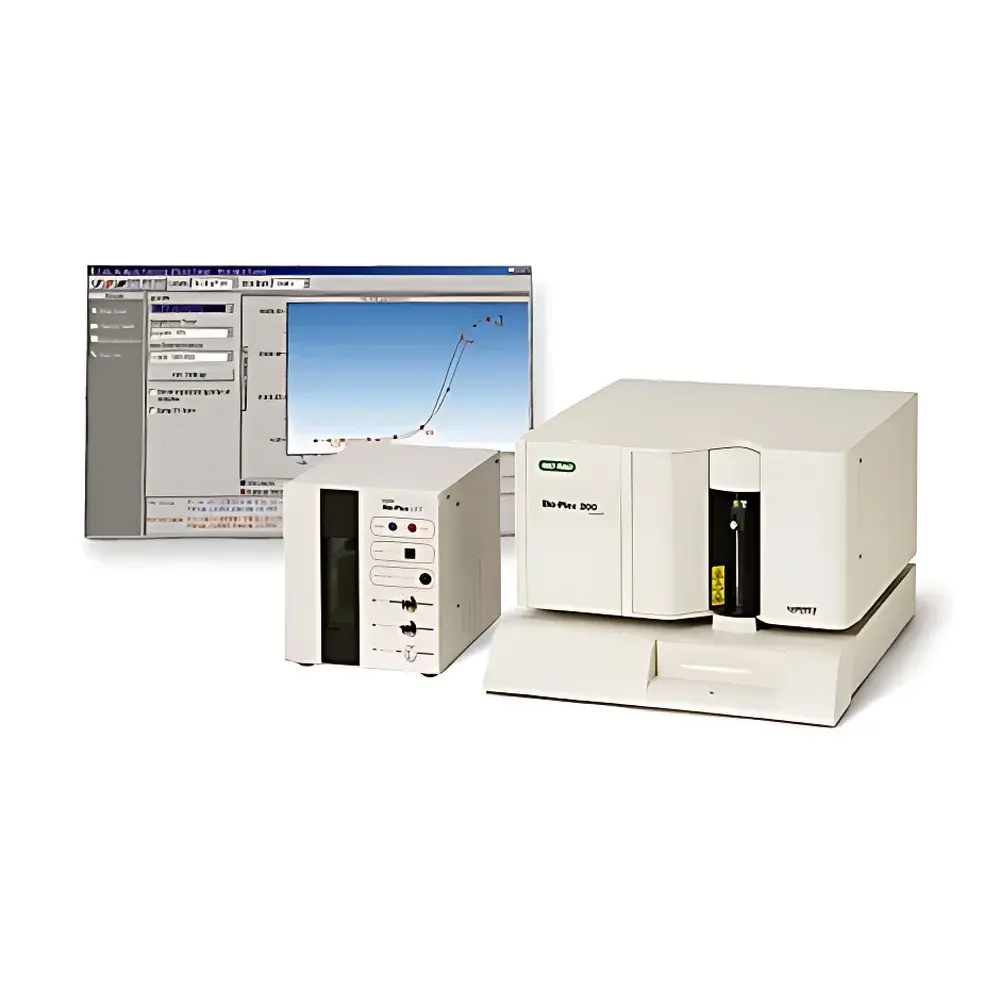
Bio-Rad Bio-Plex 200 Suspension Array System with High Throughput Fluidics (HTF)
| Brand | Bio-Rad |
|---|---|
| Origin | USA |
| Model | Bio-Plex 200 (with HTF) |
| Regulatory Classification | Imported Instrument for In Vitro Diagnostic Use |
| Platform Technology | xMAP® Luminex-based Bead-Based Suspension Array |
| Detection Method | Dual-Laser Flow Cytometric Analysis (532 nm excitation / 635 nm classification + 532 nm excitation / 585 nm emission) |
| Sample Format | 96-well or 384-well microplate |
| Multiplex Capacity | Up to 500-plex per well |
| Sensitivity | Sub-picogram/mL range (varies by analyte and assay configuration) |
| Dynamic Range | ≥3–4 logs |
| Throughput | Up to 96 samples per run (standard plate) |
Overview
The Bio-Rad Bio-Plex 200 Suspension Array System with High Throughput Fluidics (HTF) is a fully integrated, dual-laser flow cytometry platform engineered for quantitative, multiplexed biomolecular detection in biological fluids. Leveraging Luminex’s xMAP® technology, the system utilizes spectrally distinct fluorescently dyed microspheres (beads), each conjugated to a unique capture molecule—antibody, antigen, oligonucleotide, or receptor—to enable simultaneous quantification of up to 500 analytes within a single 25–50 µL sample volume. The core measurement principle relies on hydrodynamic focusing and time-resolved dual-laser interrogation: a 532 nm classification laser identifies bead identity via internal dye ratio, while a second 532 nm excitation laser quantifies reporter fluorescence (e.g., PE-conjugated detection antibodies) at 585 nm emission. This architecture delivers high specificity, low cross-talk, and robust signal-to-noise performance essential for complex matrices such as serum, plasma, CSF, cell lysates, and tissue supernatants. Designed for research-use-only (RUO) and IVD development workflows, the Bio-Plex 200 HTF meets foundational requirements for assay validation under CLIA, ISO 15189, and FDA-aligned analytical method validation guidelines—including precision, linearity, limit of detection (LOD), and inter-assay reproducibility.
Key Features
- Dual-laser optical engine with real-time bead classification and reporter signal acquisition, ensuring high-fidelity multiplex discrimination
- Integrated High Throughput Fluidics (HTF) module enabling automated reagent dispensing, magnetic bead washing, aspiration, and plate handling for up to 4 standard 96-well plates without manual intervention
- Validated hardware architecture compliant with ISO/IEC 17025 calibration traceability; includes built-in optical alignment verification and daily QC check routines
- On-board temperature-controlled incubation (ambient to 45°C) and shaking for optimized binding kinetics during assay incubation steps
- Modular design supporting seamless integration with third-party liquid handlers and LIS/HIS systems via ASTM E1384-compliant data export protocols
- Comprehensive validation toolkit: included MCV (Multiplex Calibration Verification) microplates and proprietary calibration standards for longitudinal instrument performance monitoring
Sample Compatibility & Compliance
The Bio-Plex 200 HTF accommodates diverse biological sample types—including human and animal sera, EDTA-plasma, urine, bronchoalveolar lavage fluid, cerebrospinal fluid, and clarified cell culture supernatants—without requiring pre-fractionation or enrichment. All assays are developed and verified in accordance with Good Laboratory Practice (GLP) principles. While the system itself is not CE-IVD marked or FDA 510(k)-cleared out-of-the-box, it serves as a validated platform for developing and transferring IVD assays compliant with ISO 13485, USP , and ICH Q2(R2) analytical procedure validation standards. Data integrity is maintained through audit-trail-enabled software operation aligned with FDA 21 CFR Part 11 requirements when used with Bio-Plex Manager v6.2 or later.
Software & Data Management
Bio-Plex Manager Software (v6.x) provides unified control of instrument operation, assay protocol execution, raw data acquisition, and advanced statistical analysis—including standard curve fitting (5PL, 4PL), outlier detection, inter-plate normalization, and batch correction algorithms. Raw .bpk files are stored with embedded metadata (operator ID, timestamp, instrument serial, calibration status). Export formats include CSV, XML, and SDTM-compliant datasets for direct ingestion into SAS, R, or Python-based bioinformatics pipelines. The software supports role-based user access control, electronic signatures, and full audit trail logging—meeting ALCOA+ (Attributable, Legible, Contemporaneous, Original, Accurate, Complete, Consistent, Enduring, Available) data governance criteria.
Applications
- Immunoprofiling: Quantitative cytokine, chemokine, growth factor, and phosphorylated signaling protein panels in disease progression studies
- Autoimmune & Infectious Disease Serology: Multiplexed autoantibody or pathogen-specific IgG/IgM profiling with improved diagnostic specificity vs. ELISA
- Vaccinology: Assessment of functional antibody titers and T-cell cytokine signatures post-immunization
- Oncology Biomarker Discovery: Simultaneous measurement of soluble checkpoint inhibitors (e.g., PD-L1, CTLA-4), exosomal proteins, and tumor-derived miRNAs
- Toxicology & Pharmacodynamics: Monitoring drug-induced cytokine release syndrome (CRS) markers or target engagement biomarkers in preclinical and clinical trials
- Translational Research: Bridging discovery proteomics with targeted, high-sensitivity validation using physiologically relevant sample volumes
FAQ
What regulatory status does the Bio-Plex 200 HTF hold for clinical diagnostics?
The system is classified as a research-use-only (RUO) instrument. It may be used in clinical laboratory settings under CLIA regulations when employed with analyte-specific reagents (ASRs) or laboratory-developed tests (LDTs) that undergo internal validation.
Can the Bio-Plex 200 HTF be operated without the HTF module?
Yes—the base Bio-Plex 200 system functions independently; HTF is an optional automation upgrade that enhances walk-away time and reduces hands-on variability in multi-plate workflows.
Is xMAP assay compatibility limited to Bio-Rad kits?
No—xMAP technology is open-platform. Third-party xMAP-certified beads and assays from Luminex, R&D Systems, MilliporeSigma, and others are fully supported with appropriate instrument configuration and spectral calibration.
How is instrument performance monitored over time?
Via the included MCV plates and Bio-Plex Validation Kit, which provide reference standards for optical alignment, laser stability, fluidic consistency, and bead classification accuracy—tracked in Bio-Plex Manager’s QC dashboard.
Does Bio-Plex Manager support integration with enterprise LIMS?
Yes—through configurable ODBC drivers and delimited text exports (CSV/XML), enabling bidirectional data exchange with major LIMS platforms including LabWare, Thermo Fisher SampleManager, and STARLIMS.





