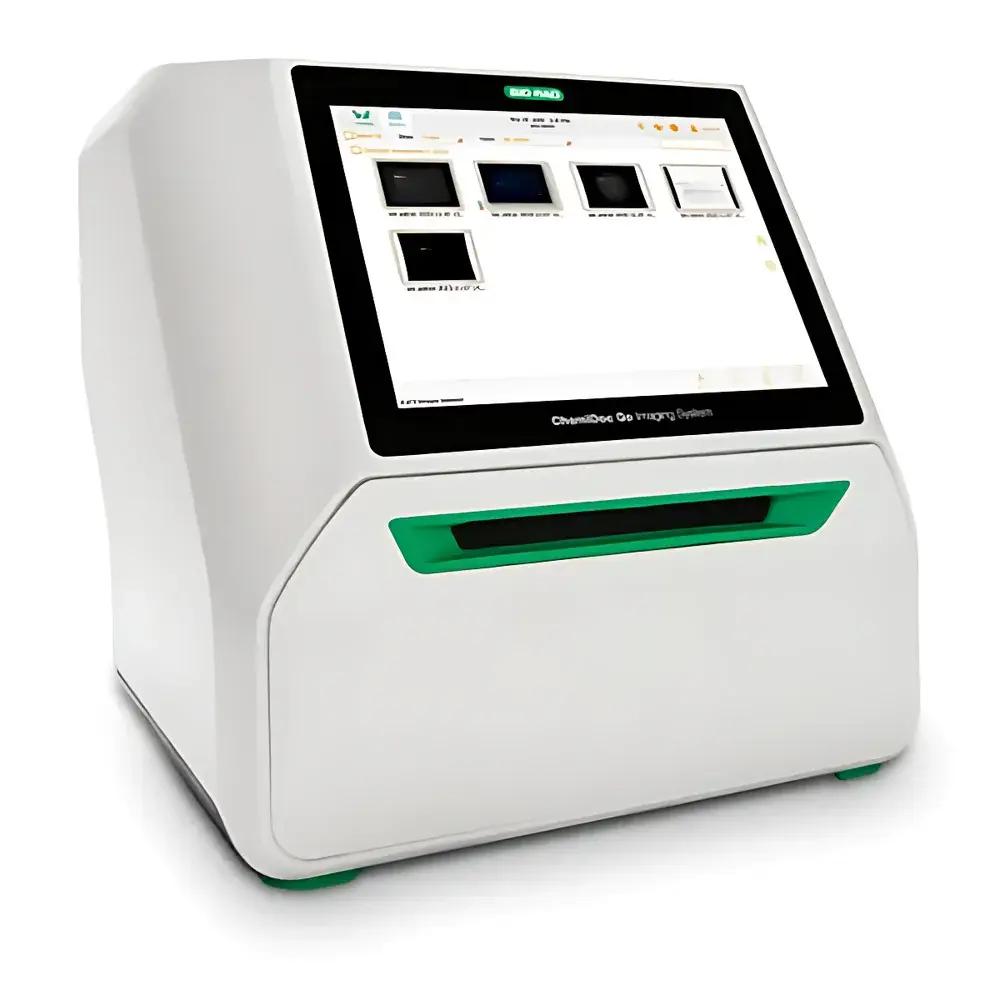
Bio-Rad ChemiDoc Go Fluorescence and Chemiluminescence Imaging System
| Brand | Bio-Rad |
|---|---|
| Origin | USA |
| Model | ChemiDoc Go |
| Instrument Type | Chemiluminescence Gel Imaging System |
| CCD Resolution | 20 MP (physical pixels) |
| Bit Depth | 16-bit |
| Dynamic Range | 0–4.8 OD |
| Signal-to-Noise Ratio | ≥56 dB |
| Lens | Fixed-focus f/0.95 lens |
| Excitation Sources | Transmitted UV (302 nm), Transmitted Blue Light (470 nm, optional), Transmitted White Light (optional), Reflected UV (365 nm), Reflected Green Light (530 nm) |
| Emission Filters | 520/26 nm BP, 590/110 nm BP, 695 nm LP |
| Dual-Channel Fluorescence | StarBright 520 nm & 700 nm channels |
| Regulatory Status | For research use only (RUO), not for clinical diagnostic use |
Overview
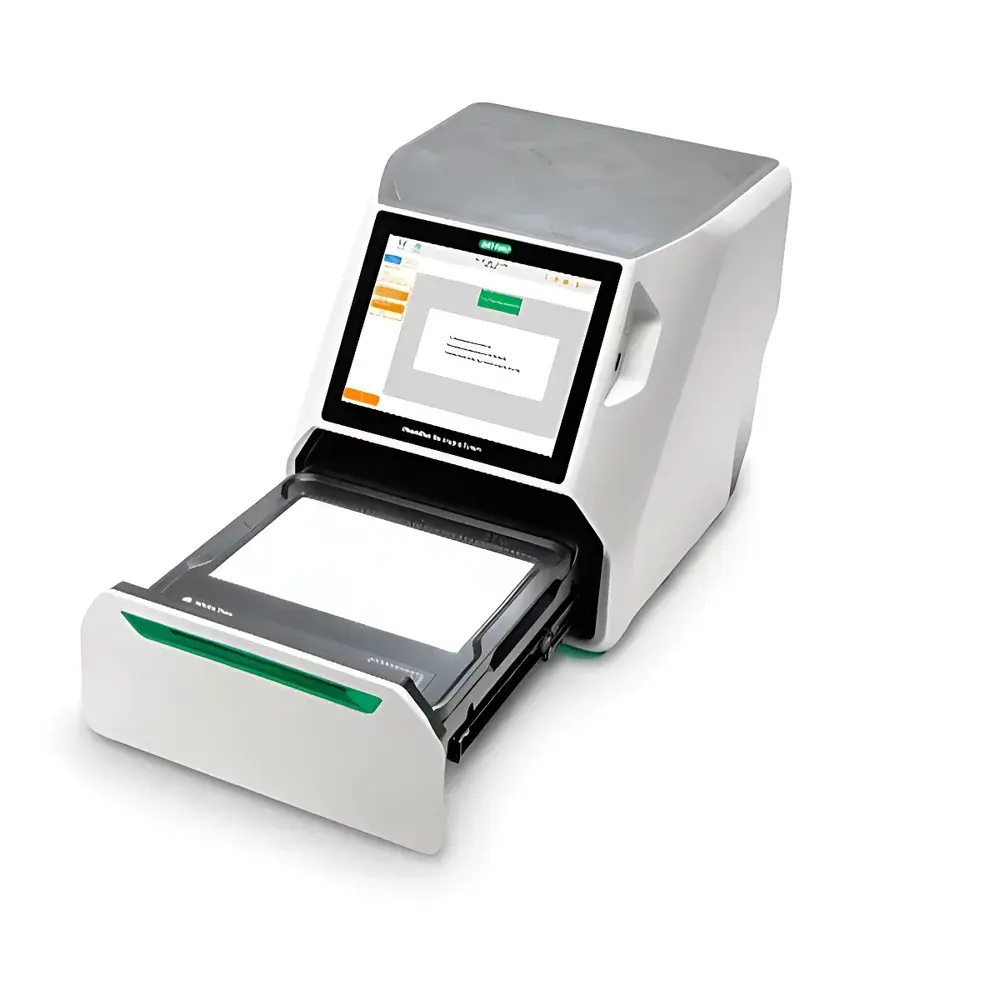
The Bio-Rad ChemiDoc Go Fluorescence and Chemiluminescence Imaging System is a compact, high-performance benchtop imager engineered for quantitative molecular biology applications in academic, pharmaceutical, and biotechnology laboratories. Built upon a cooled, scientific-grade 20-megapixel CCD sensor with 16-bit digitization and an ultra-fast f/0.95 fixed-focus lens, the system delivers exceptional sensitivity and spatial resolution for both chemiluminescent and multi-modal fluorescence detection. Its optical architecture leverages optimized light path design and low-noise electronics to achieve a dynamic range of 0–4.8 optical density (OD) and a signal-to-noise ratio exceeding 56 dB—enabling reliable quantification across wide-intensity gradients, from faint chemiluminescent signals to saturated protein bands. Unlike modular or legacy gel documentation platforms, the ChemiDoc Go integrates hardware, illumination, and software into a single streamlined unit designed for rapid setup, minimal footprint (<30 cm depth), and consistent reproducibility under GLP-aligned laboratory workflows.
Key Features
- Cooled 20-megapixel CCD sensor with true physical pixel resolution—no interpolation—ensuring accurate band sizing and intensity linearity.
- f/0.95 fixed-focus lens optimized for maximum photon capture across UV, visible, and near-infrared emission spectra.
- Dual-channel StarBright fluorescence imaging at 520 nm and 700 nm—compatible with common fluorescent dyes including SYBR Safe, SYPRO Ruby, Alexa Fluor 488, and IRDye 680/800 derivatives.
- Integrated multi-spectral excitation: transmitted UV (302 nm), reflected UV (365 nm), reflected green (530 nm), plus optional transmitted blue (470 nm) and white light modules for versatile sample visualization.
- Standard emission filter set includes 520/26 nm bandpass (BP), 590/110 nm BP, and 695 nm longpass (LP) filters—supporting simultaneous dual-band acquisition without manual filter wheel intervention.
- Automated exposure optimization and background subtraction algorithms reduce user-dependent variability and support ISO/IEC 17025-compliant documentation practices.
Sample Compatibility & Compliance
The ChemiDoc Go supports a broad spectrum of electrophoretic and blotting formats, including agarose and polyacrylamide gels (up to 20 × 20 cm), nitrocellulose and PVDF membranes, and Stain-Free gels. It accommodates standard molecular weight markers, chemiluminescent substrates (e.g., Luminol-based reagents), and fluorescently labeled antibodies or nucleic acid probes. All firmware and acquisition software are validated for compliance with Good Laboratory Practice (GLP) documentation requirements, including timestamped image metadata, user audit trails, and non-editable raw file storage (TIFF format). The system is classified as a Research Use Only (RUO) instrument per FDA 21 CFR §809.3 and carries no CE-IVD or IVD marking. It is not intended for clinical diagnosis, patient management, or regulatory submission without additional validation per ISO 13485 or CLIA guidelines.
Software & Data Management
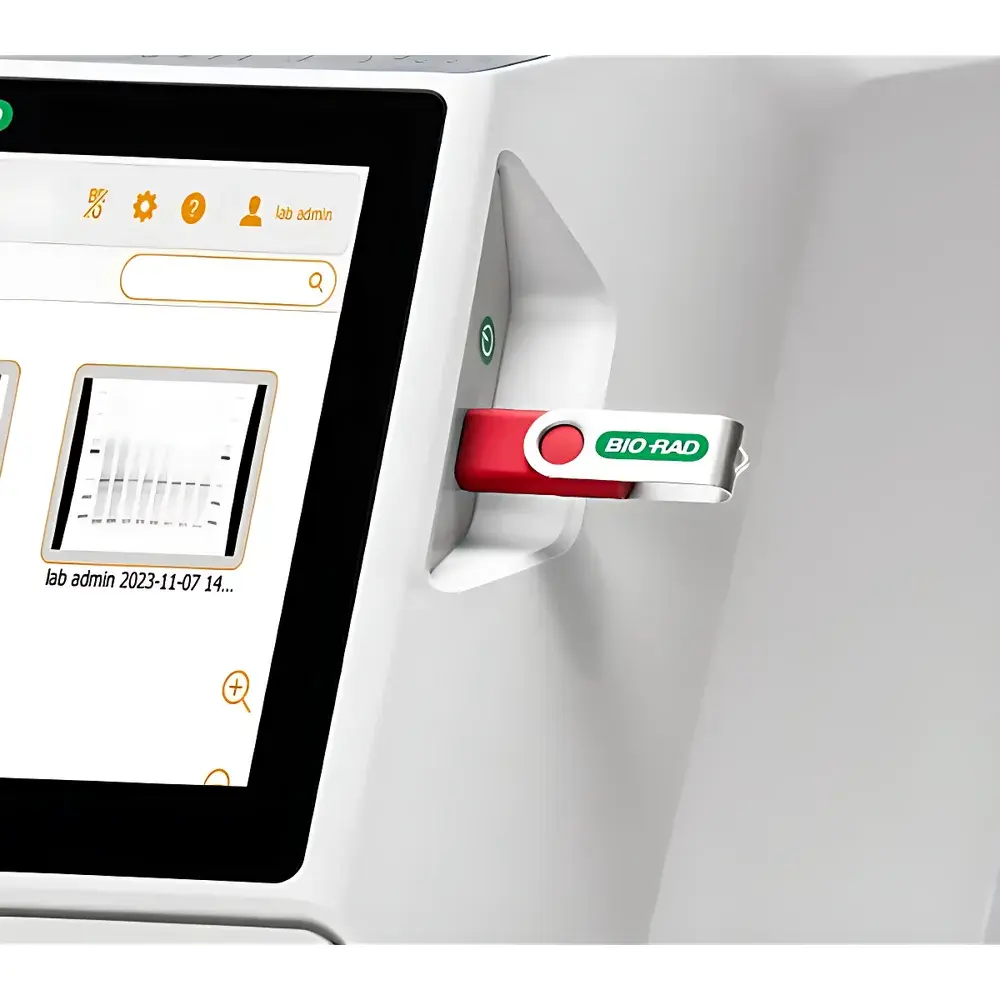
Bio-Rad Image Lab Touch Software v7.x provides intuitive, touch-optimized control for acquisition, analysis, and reporting. Key capabilities include one-click auto-exposure, lane and band detection with integrated molecular weight calibration, densitometric quantification with background correction models (rolling ball, local averaging), and side-by-side comparative analysis across multiple images. Raw data files retain full 16-bit intensity values and embedded EXIF metadata—including exposure time, lens aperture, filter position, and lamp status—for traceability. Export options include TIFF (lossless), PNG, PDF, and Excel-compatible CSV reports. The software supports 21 CFR Part 11-compliant configurations when deployed on networked Windows environments with domain authentication, electronic signatures, and audit log retention—meeting QA/QC requirements in regulated GMP and biopharma settings.
Applications
- Quantitative analysis of Western blots via enhanced chemiluminescence (ECL) and multiplex fluorescence detection.
- Nucleic acid gel documentation for PCR product verification, restriction digest analysis, and CRISPR editing efficiency assessment.
- Protein gel imaging using Coomassie, silver stain, or SYPRO Ruby with automated band intensity normalization.
- Stain-Free total protein normalization workflows for improved blot loading control accuracy.
- Validation of antibody specificity and cross-reactivity through dual-channel fluorescent immunodetection.
- Support for publication-ready figure generation compliant with journal standards (e.g., Nature Methods, JBC, PLOS ONE).
FAQ
Is the ChemiDoc Go compatible with third-party fluorescent dyes beyond Bio-Rad’s StarBright series?
Yes—the system’s excitation sources and filter set support common commercial dyes such as Alexa Fluor, DyLight, CyDye, and IRDye families. Spectral overlap should be verified using the provided filter transmission curves and dye excitation/emission profiles.
Can the ChemiDoc Go perform time-lapse chemiluminescence imaging?
No—it is designed for endpoint acquisition only and does not support programmable sequential exposures or kinetic imaging modes.
Does the system require routine calibration or alignment?
No—optical alignment is factory-fixed and sealed; only periodic cleaning of the glass platen and lens cover is recommended per Bio-Rad’s maintenance schedule.
What file formats are generated during acquisition?
Primary output is uncompressed 16-bit TIFF with embedded metadata; secondary exports include PNG, JPEG, PDF, and CSV for quantification tables.
Is remote operation supported?
Yes—Image Lab Touch supports secure remote desktop access via IT-managed RDP or VNC protocols, enabling off-site instrument monitoring and data review within institutional firewall policies.
Related Products