
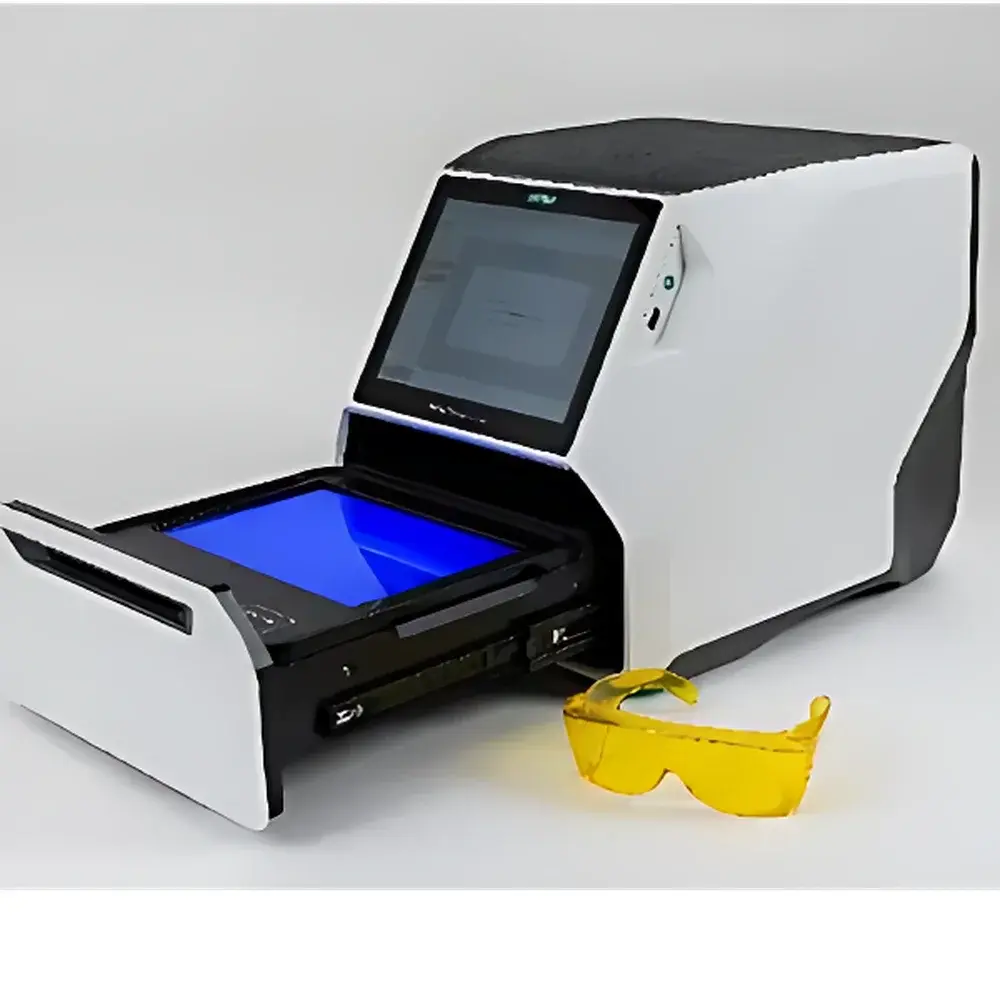
Bio-Rad GelDoc Go Blue Light-Safe Gel Imaging System
| Brand | Bio-Rad |
|---|---|
| Origin | Singapore |
| Model | GelDoc Go |
| Imaging Sensor | 6.3 MP monochrome CCD |
| Light Sources | Dual-mode transilluminator (UV 302 nm + blue light 470 nm) |
| Safety Features | Integrated blue-light–optimized optics, included amber safety goggles |
| Imaging Modes | UV transillumination, blue-light transillumination, white-light reflection |
| Fluorescence Compatibility | SYBR Safe, SYBR Gold, Ethidium Bromide (EtBr), GelRed, GelGreen, and other nucleic acid dyes |
| Software | Image Lab Touch™ (touchscreen interface, one-touch capture, auto-exposure, ROI analysis, molecular weight estimation, lane/band quantification) |
| Regulatory Compliance | CE, FCC, RoHS compliant |
| Intended Use | Benchtop gel documentation, nucleic acid and protein gel imaging, blue-light–mediated excision, academic and QC laboratory applications |
Overview
The Bio-Rad GelDoc Go Blue Light-Safe Gel Imaging System is a compact, integrated benchtop platform engineered for high-fidelity documentation and precise excision of nucleic acid and protein gels in research, teaching, and quality control laboratories. Unlike conventional UV-based systems, the GelDoc Go implements a dual-wavelength transillumination architecture—combining standard 302 nm UV excitation with a high-intensity 470 nm blue LED light source—enabling safe, real-time visualization and physical excision of DNA/RNA bands without UV exposure hazards. The system operates on the principle of fluorescence excitation and emission detection: nucleic acid dyes (e.g., SYBR Safe, GelRed) absorb blue light and emit visible green or orange fluorescence, which is captured by a cooled 6.3 megapixel monochrome CCD sensor optimized for low-noise, high-dynamic-range imaging. Its optical path includes fixed-focus lensing, precision bandpass filters, and automated exposure control—ensuring reproducible signal intensity across repeated acquisitions. Designed for GLP-aligned workflows, the GelDoc Go supports audit-ready image metadata logging (timestamp, exposure time, light mode, gain settings) and integrates seamlessly into regulated environments where operator safety and data traceability are critical.
Key Features
- Dual-mode transilluminator: Independently switchable 302 nm UV and 470 nm blue LED light sources—no mechanical filter wheel required; each mode optimized for dye-specific quantum yield and photostability.
- Blue-light–safe excision workflow: Eliminates need for UV shielding barriers during gel cutting; amber-tinted safety goggles provided ensure optimal band contrast under blue illumination while blocking residual UV leakage.
- QuickSight one-touch imaging: Proprietary auto-exposure algorithm dynamically adjusts integration time and analog gain to maximize signal-to-noise ratio—no manual optimization needed for standard ethidium bromide or SYBR-stained gels.
- Image Lab Touch™ software: Intuitive touchscreen interface with preconfigured acquisition protocols, region-of-interest (ROI) quantification, background subtraction, molecular weight calibration using ladder standards, and export of TIFF/PDF/CSV files compliant with lab notebook requirements.
- Robust mechanical design: All-metal chassis, sealed optical chamber, and vibration-dampened stage minimize environmental interference; footprint under 30 cm × 35 cm suits space-constrained fume hoods or shared instrumentation benches.
Sample Compatibility & Compliance
The GelDoc Go accommodates standard mini-gels (up to 10 × 10 cm) and wide-format gels (up to 15 × 20 cm) in common formats including agarose, polyacrylamide (PAGE), SDS-PAGE, and native PAGE. It supports both nucleic acid stains (SYBR Safe, GelRed, EtBr, SYBR Gold) and protein-compatible dyes (Coomassie Brilliant Blue, Deep Purple, Silver Stain). All optical components meet ISO 13485–aligned manufacturing controls. The system is CE-marked per Directive 2014/30/EU (EMC) and 2014/35/EU (LVD), complies with IEC 61000-6-3 for radiated emissions, and adheres to RoHS 2011/65/EU restrictions on hazardous substances. Blue-light operation conforms to IEC 62471 Photobiological Safety classification (Risk Group 1 – exempt from hazard labeling under normal use conditions).
Software & Data Management
Image Lab Touch™ provides FDA 21 CFR Part 11–ready functionality via optional password-protected user roles, electronic signatures, and immutable audit trails that record every acquisition parameter, annotation, and export action. Raw images are saved in lossless 16-bit TIFF format with embedded EXIF metadata (light mode, exposure duration, sensor temperature, lens aperture). Batch processing supports lane profiling, relative quantification against internal standards, and automatic band matching across multiple gels. Export options include publication-ready PNG/JPEG, annotated PDF reports, and tabular CSV outputs compatible with statistical packages (R, GraphPad Prism, Python pandas). Data integrity is preserved through SHA-256 checksum generation upon file save.
Applications
- PCR product verification and cloning validation in molecular biology labs.
- Quality assessment of plasmid preps, restriction digests, and CRISPR editing outcomes.
- Protein expression profiling and purity evaluation in recombinant protein workflows.
- Teaching laboratory instruction—enabling student-led gel documentation without UV safety training overhead.
- QC release testing of nucleic acid therapeutics, where blue-light imaging reduces photodegradation of sensitive RNA samples compared to UV exposure.
FAQ
Does the GelDoc Go require UV protective shielding during blue-light operation?
No—blue-light transillumination at 470 nm eliminates the need for UV-blocking shields or dedicated darkrooms. Amber safety goggles are provided to enhance contrast and block any incidental UV emission from the dual-source module.
Can I quantify bands from both UV and blue-light images in the same session?
Yes—Image Lab Touch™ maintains separate calibration curves and exposure histories for each light mode; quantification parameters (e.g., background subtraction method, gamma correction) are stored per acquisition protocol.
Is the system compatible with third-party staining reagents?
Yes—the optical filter set and sensitivity profile support all commercially available nucleic acid and protein fluorescent dyes validated for 302 nm UV or 470 nm blue excitation, including those listed in Bio-Rad Technical Bulletin 6424.
What is the minimum detectable DNA mass under blue-light imaging?
Using SYBR Safe stain and standard 1% TAE agarose gels, the system reliably detects ≥0.5 ng of dsDNA per band (100 bp–1 kb range), consistent with published performance benchmarks for blue-light–optimized CCD platforms.
How is firmware updated and validated?
Firmware updates are delivered via USB drive with version-signed binaries; each release includes a validation report documenting regression testing against ISO/IEC 17025–aligned test cases for image uniformity, linearity, and dynamic range.




