
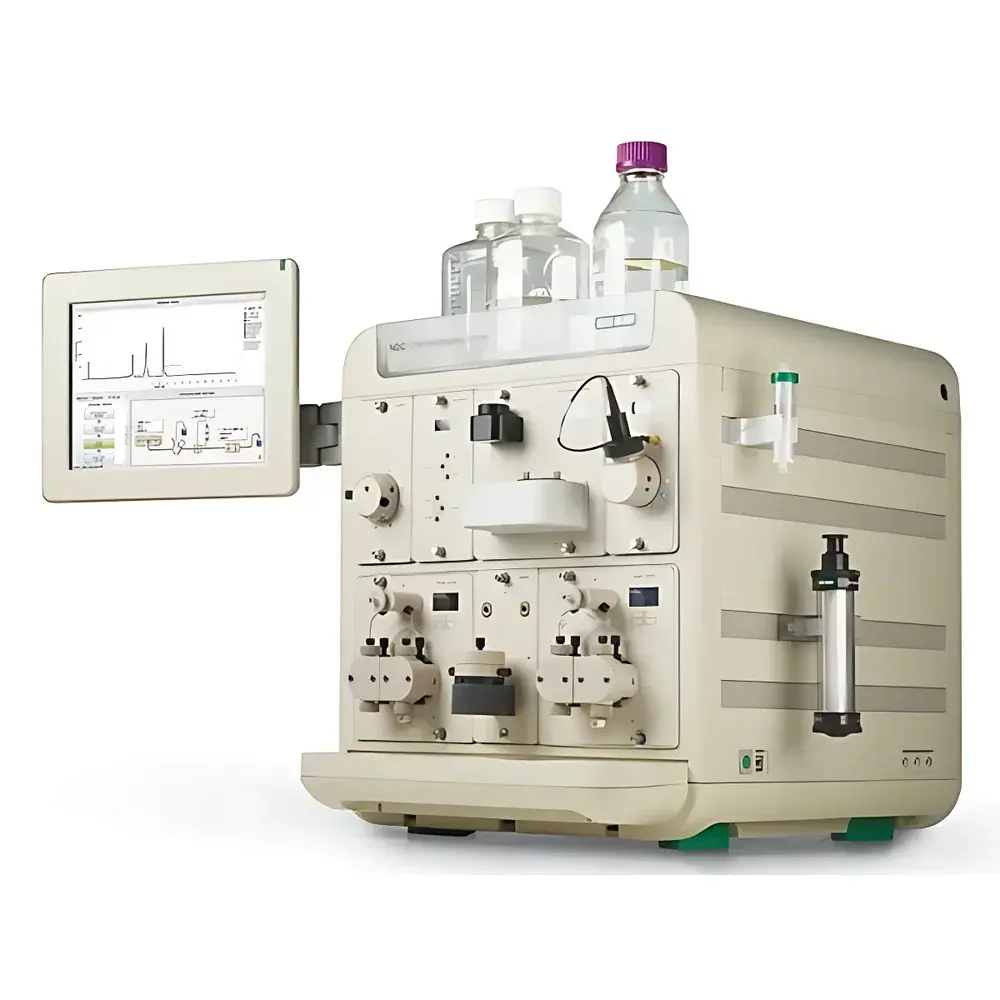
Bio-Rad NGC Scout Medium-Pressure Chromatography System
| Brand | Bio-Rad |
|---|---|
| Origin | USA |
| Model | Scout |
| Flow Rate Options | 10 mL/min (max. 3650 psi) or 100 mL/min (max. 1450 psi) |
| Buffer Blending | On-line gradient mixing with auto-buffer preparation valve system (2× flow boost: up to 20 mL/min for F10, 200 mL/min for F100) |
| UV Detection | Optional single-wavelength detector (255 nm / 280 nm) or full-spectrum diode array detector (190–800 nm, 4-channel simultaneous acquisition) |
| Software | ChromLab™ with integrated touchscreen interface |
| Sample Handling | Integrated autosampler valve |
| Fraction Collection | Optional BioFrac™ square-format fraction collector |
| Compliance | Designed for GLP/GMP-aligned workflows |
Overview
The Bio-Rad NGC Scout Medium-Pressure Chromatography System is an automated, modular liquid chromatography platform engineered for high-fidelity purification of proteins, antibodies, viral vectors, and other biomolecules across research, process development, and pilot-scale applications. Built on a true plug-and-play architecture, the NGC Scout implements low-dispersion, high-pressure liquid chromatography (HPLC) principles—specifically optimized for medium-pressure operation (up to 3650 psi)—to deliver robust separation performance with reproducible retention times and peak resolution. Its core design integrates precision dual-piston solvent delivery, real-time UV/Vis absorbance monitoring, and intelligent valve routing to support complex multi-step purification protocols—including ion exchange, size exclusion, hydrophobic interaction, and affinity chromatography—without manual intervention. Unlike fixed-configuration systems, the Scout serves as a scalable foundation: users may begin with a basic configuration and incrementally integrate additional modules (e.g., buffer blending valves, column switchers, or fraction collectors) as experimental complexity or throughput requirements evolve.
Key Features
- Modular hardware architecture enabling field-upgradable configurations—from benchtop analytical setups to pilot-scale preparative runs.
- Dual-flow-rate pump options: F10 (0–10 mL/min, 0–3650 psi) for high-resolution analytical and small-scale prep; F100 (0–100 mL/min, 0–1450 psi) for accelerated method scouting and mid-scale purification.
- On-line buffer blending with auto-preparation valve system—supports dynamic pH and conductivity gradients while doubling effective flow capacity (20 mL/min for F10, 200 mL/min for F100) without external dilution loops.
- UV detection flexibility: choice of fixed-wavelength detector (255 nm and 280 nm channels standard) or full-spectrum diode array detector (DAD) with 190–800 nm spectral range and simultaneous 4-wavelength quantitation for multi-analyte tracking.
- Integrated touchscreen interface running ChromLab™ software—enabling method creation, real-time chromatogram visualization, parameter adjustment, and post-run analysis directly at the instrument.
- Expandable valve ecosystem: optional sample selection valves (up to 12 positions), column switching valves (dual-column or multi-column configurations), outlet divert valves, and automated fraction collection interfaces.
Sample Compatibility & Compliance
The NGC Scout accommodates a broad range of sample matrices—including clarified lysates, cell culture supernatants, plasma fractions, and purified protein solutions—with compatibility across standard analytical (4.6 mm ID) to preparative (16–26 mm ID) column formats. All fluidic pathways employ biocompatible materials (e.g., PEEK, stainless steel with electropolished finish, and inert ceramic components) to minimize adsorption and ensure consistent recovery of sensitive biomolecules. The system meets key regulatory expectations for laboratory instrumentation: ChromLab™ software supports configurable audit trails, user access levels, electronic signatures, and data integrity controls aligned with FDA 21 CFR Part 11 and EU Annex 11 requirements. When deployed in validated environments, the NGC Scout supports GLP and GMP documentation workflows—including IQ/OQ protocols, calibration traceability, and raw data archiving in vendor-supported formats (e.g., .ngc, .csv, .pdf).
Software & Data Management
ChromLab™ is a purpose-built chromatography control and analysis suite developed exclusively for NGC platforms. It provides intuitive drag-and-drop method building, real-time overlay of multiple chromatograms, baseline correction algorithms, peak integration with customizable thresholds, and export-ready reporting templates. All method parameters—including gradient profiles, flow rates, UV wavelength settings, and fraction collection logic—are stored as encrypted, version-controlled files. Raw data are saved in native binary format with embedded metadata (instrument ID, operator, timestamp, environmental logs), ensuring full traceability. ChromLab™ also supports LIMS integration via OPC UA and exports compliant CSV/PDF outputs for regulatory submissions. Optional ChromLab™ Connect enables remote monitoring and secure cloud-based method sharing across distributed labs.
Applications
The NGC Scout is routinely deployed in academic and industrial laboratories for: (1) rapid purification of recombinant monoclonal antibodies (mAbs) from transient transfection harvests; (2) parallel screening of purification resins and binding/elution conditions during downstream process development; (3) isolation of extracellular vesicles and AAV serotypes using size-exclusion and ion-exchange gradients; (4) polishing steps in biosimilar manufacturing requiring high-resolution separation of charge variants; and (5) high-yield capture of His-tagged proteins under native or denaturing conditions. Its pressure and flow versatility allows seamless transition from early-stage purity assessment (µg–mg scale) to late-stage material generation (10–100 mg per run), reducing technology transfer bottlenecks.
FAQ
What is the maximum operating pressure for the NGC Scout F10 configuration?
The F10 pump module supports pressures up to 3650 psi (25 MPa), suitable for high-resolution separations on rigid, sub-2-µm particle resins.
Can ChromLab™ software be used to control third-party detectors or fraction collectors?
Yes—ChromLab™ includes open API support and hardware abstraction layers compatible with select third-party devices that adhere to standard TTL, RS-232, or Ethernet-based command protocols.
Is method validation support available for GMP environments?
Bio-Rad provides IQ/OQ documentation packages, installation qualification templates, and on-site validation assistance through certified field service engineers.
Does the Scout support pH gradient formation?
Yes—when equipped with the optional buffer blending valve and two or more reservoirs containing differing pH buffers, the system generates precise, reproducible pH gradients via active mixing.
How is data integrity maintained during long-duration purification runs?
ChromLab™ performs automatic checksum verification of raw data files, writes redundant backups to internal storage and optional network drives, and logs all operator actions with timestamps and user IDs in immutable audit trails.




