
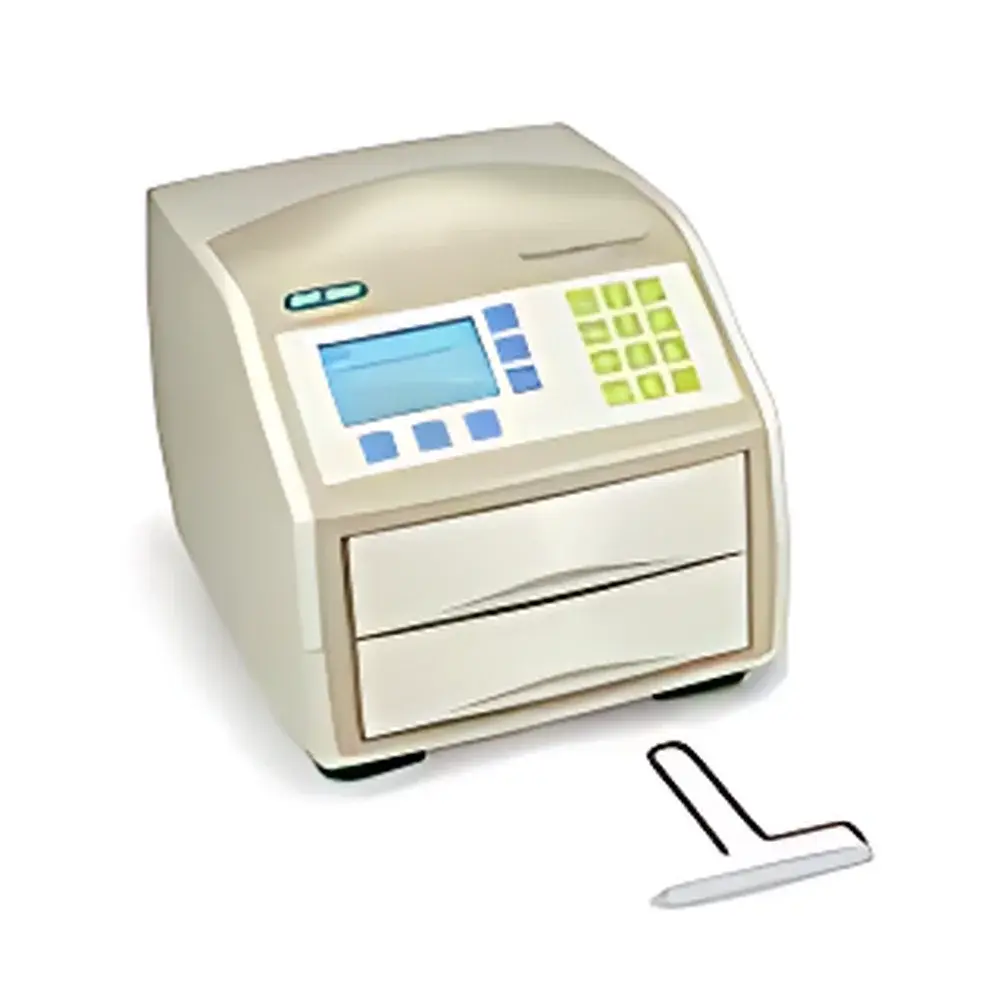
Bio-Rad Trans-Blot Turbo Western Blotting System
| Brand | Bio-Rad |
|---|---|
| Origin | Singapore |
| Model | Trans-Blot Turbo |
| Automation Level | Fully Automated Western Blot Transfer System |
| Throughput | 4 mini gels or 2 midi gels per run |
| Dual Cassette Design | Yes |
| Transfer Time | ≤3 min (2 TGX Mini Gels), ≤7 min (4 standard mini gels or 2 midi gels) |
| Power Supply | Integrated constant voltage/current/power regulator |
| User Interface | Backlit LCD touchscreen with programmable protocol storage (25 protocols) |
| Electrode Architecture | 6-spring-loaded parallel plate electrodes |
| Pre-formulated Kits | Compatible with Turbo Transfer Packs (buffer-free, membrane-ready) |
| Compatibility | Works with standard PVDF/nitrocellulose membranes, conventional electrophoresis buffers (e.g., Tris-Glycine, CAPS), and legacy gel formats |
Overview
The Bio-Rad Trans-Blot Turbo Western Blotting System is an engineered electrophoretic transfer platform designed for high-efficiency, reproducible protein transfer from polyacrylamide gels to solid supports under controlled electric field conditions. Based on constant-power electrophoretic blotting principles, the system applies optimized voltage, current, and power profiles to minimize thermal denaturation while maximizing directional protein migration across the gel–membrane interface. Its architecture integrates real-time thermal management, uniform electrode contact force distribution, and programmable energy delivery—enabling consistent transfer performance across diverse gel thicknesses (0.75–1.5 mm), acrylamide concentrations (8–20%), and protein molecular weights (10–250 kDa). Unlike traditional wet or semi-dry systems requiring manual buffer preparation and timing calibration, the Trans-Blot Turbo eliminates inter-operator variability through factory-validated transfer kinetics and pre-optimized power algorithms.
Key Features
- Dual independent cassette design permits simultaneous execution of two distinct transfer protocols—ideal for comparative optimization studies or parallel sample processing without cross-contamination risk.
- Six-point spring-loaded parallel plate electrodes ensure uniform mechanical pressure (≥2.5 psi) and homogeneous electric field distribution across the entire gel surface, mitigating edge effects and band distortion.
- Integrated constant-power regulation dynamically adjusts voltage and current output in real time to maintain preset wattage (up to 2.5 W per cassette), preventing overheating during rapid transfers and preserving epitope integrity.
- Backlit LCD touchscreen interface supports intuitive navigation, on-device protocol editing, and secure storage of up to 25 user-defined methods—including temperature-compensated settings for ambient lab conditions ranging from 15–30°C.
- Pre-formulated Turbo Transfer Packs eliminate manual buffer preparation; each pack contains pre-measured reagents, methanol-free transfer matrix, and activated membranes—reducing hands-on time by >70% versus conventional protocols.
Sample Compatibility & Compliance
The Trans-Blot Turbo maintains full compatibility with standard SDS-PAGE and native PAGE gels (mini: 8.6 × 6.8 cm; midi: 13.5 × 10.5 cm), including gradient, Tris-Tricine, and Bis-Tris formulations. It accepts both nitrocellulose and PVDF membranes (0.2–0.45 µm pore size) without adapter modification. The system meets ISO 9001-certified manufacturing standards at Bio-Rad’s Singapore facility and complies with IEC 61010-1 safety requirements for laboratory electrical equipment. While not a regulated medical device, its operational repeatability and audit-ready protocol logging support GLP-aligned workflows where traceability of transfer parameters (power, duration, temperature) is required for method validation documentation.
Software & Data Management
No external software installation is required—the instrument operates as a standalone unit with embedded firmware (v3.2+). All executed runs are timestamped and logged internally with metadata including protocol name, start/stop time, average power, peak current, and thermal sensor readings. Logs can be exported via USB flash drive in CSV format for integration into LIMS or electronic lab notebooks (ELN). Though not FDA 21 CFR Part 11 compliant out-of-the-box, the system supports institutional SOPs requiring operator authentication (via password-protected method editing) and version-controlled protocol archiving when paired with networked data repositories.
Applications
This system serves core applications in antibody validation, post-translational modification analysis (e.g., phosphorylation, ubiquitination), and quantitative western blotting when coupled with chemiluminescent or fluorescent detection. Its speed and reproducibility make it suitable for high-throughput screening labs validating CRISPR knockouts or siRNA knockdown efficiency. The dual-cassette capability enables side-by-side comparison of transfer efficiency across different membranes, buffer systems, or activation methods—supporting method development per USP guidelines for analytical procedure validation. Academic and industrial users routinely deploy it in QC release testing for recombinant proteins and biosimilars where transfer consistency directly impacts densitometric quantitation accuracy.
FAQ
Can the Trans-Blot Turbo be used with homemade transfer buffers?
Yes—while optimized for Turbo Transfer Packs, the system accepts custom Tris-glycine-methanol or CAPS-based buffers. Users must manually enter conductivity and viscosity assumptions into the power algorithm via advanced settings.
Is cooling required during operation?
No active cooling is needed; the integrated heat-dissipating chassis and pulsed power delivery prevent gel temperature rise beyond 28°C even during 7-minute transfers.
Does it support overnight low-current transfer protocols?
Not natively—the minimum programmable duration is 1 minute, and the system is engineered for rapid transfer only. For extended protocols, conventional semi-dry or tank systems remain appropriate.
How is electrode cleanliness maintained between runs?
Electrodes are stainless steel and corrosion-resistant; wiping with deionized water and lint-free cloth after each use prevents salt residue buildup. Bio-Rad recommends quarterly inspection for pitting or warping.
What is the expected lifetime of the power supply module?
Rated for ≥10,000 operating hours under normal lab conditions (25°C, 50% RH), with mean time between failures (MTBF) exceeding 5 years at typical academic usage frequency (5–10 runs/week).




