
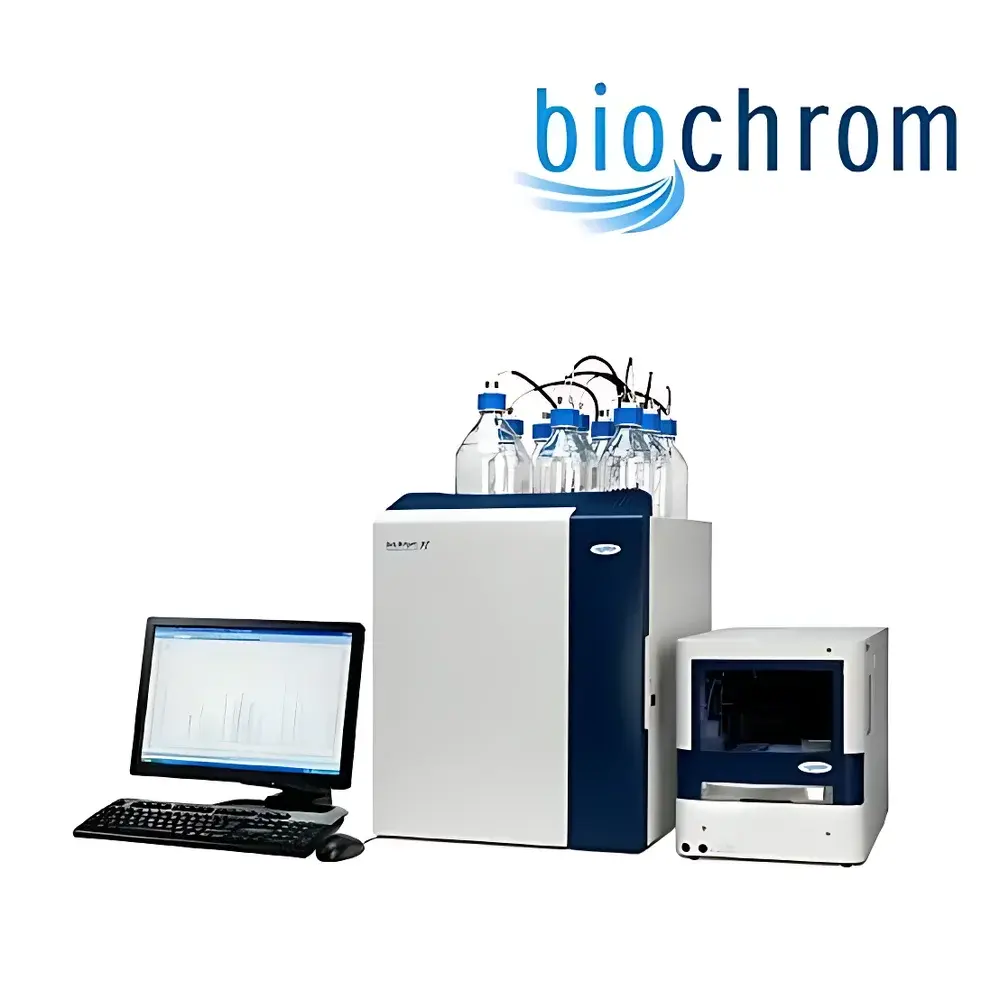
Biochrom 30+ Fully Automated Amino Acid Analyzer
| Brand | Biochrom |
|---|---|
| Origin | United Kingdom |
| Manufacturer Type | Authorized Distributor |
| Origin Category | Imported |
| Model | Biochrom 30+ |
| Price Range | USD 92,000 – 132,000 (based on exchange rate and configuration) |
| Instrument Type | Post-Column Derivatization System |
| Pump Flow Rate | 0–130 mL/hr |
| Maximum Pump Pressure | 45 MPa |
| Autosampler Injection Volume | 1–5000 µL |
| Autosampler Temperature Control | 4 °C to ambient, continuously adjustable |
| Post-Column Reactor Temperature Range | 40–145 °C |
| Detection Wavelengths | 570 nm and 440 nm (dual-wavelength, self-calibrating, parallel signal output with summation capability) |
| Flow Cell Volume | 8 µL |
Overview
The Biochrom 30+ Fully Automated Amino Acid Analyzer is a high-precision, regulatory-compliant chromatographic system engineered for quantitative analysis of free and hydrolyzed amino acids in complex biological, pharmaceutical, food, and feed matrices. Based on cation-exchange liquid chromatography with post-column ninhydrin derivatization, the instrument separates amino acids using precisely controlled pH and ionic strength gradients across a 20 cm PEEK-lined analytical column. Separated analytes undergo thermally accelerated reaction with ninhydrin in a dedicated reactor (40–145 °C), generating chromophores detectable at two fixed wavelengths—570 nm (primary for α-amino acids) and 440 nm (for imino acids such as proline)—without wavelength calibration drift. Dual-wavelength photometric detection enables simultaneous quantification and spectral verification, ensuring robust identification and minimizing interference from matrix components. Designed and manufactured in the UK by Biochrom Ltd.—a pioneer in amino acid analytics since 1970—the Biochrom 30+ remains the only amino acid analyzer globally cleared by the U.S. Food and Drug Administration (FDA) under 21 CFR Part 820, and is validated for GLP/GMP environments requiring audit-trail compliance.
Key Features
- Ceramic high-pressure pump delivering stable flow up to 45 MPa, enabling reproducible gradient formation and extended column lifetime
- Integrated buffer pre-heating module to minimize thermal lag and improve retention time stability during temperature-programmed separations
- Entire fluidic path constructed from biocompatible, chemically inert PEEK tubing and fittings—resistant to strong acids, bases, and organic solvents used in eluent preparation
- 20 cm long cation-exchange analytical column optimized for resolution of all 41 standard amino acids, including cystine, taurine, and hydroxyproline, under single-run conditions
- Graphical user interface (GUI) with intuitive method editor, real-time chromatogram overlay, and customizable report templates compliant with ISO/IEC 17025 documentation requirements
- Optional multilingual software package—including fully localized Chinese-language operation—supports bilingual method development and cross-regional laboratory collaboration
Sample Compatibility & Compliance
The Biochrom 30+ accommodates diverse sample types following standardized hydrolysis or derivatization protocols: protein hydrolysates (6M HCl, 110 °C, 22–24 hr), enzymatic digests, cell culture supernatants, plasma/serum extracts, and fortified food matrices. It meets stringent international regulatory frameworks, including FDA 21 CFR Part 11 (electronic records/signatures), ISO 9001:2015, ISO 13485:2016, and ISO/IEC 17025:2017. The system supports full traceability through automated audit trails, user-access logging, and electronic signature workflows. It is referenced in over 15 national and pharmacopoeial standards—including USP , EP 2.2.56, Chinese Pharmacopoeia Vol. IV (2020), GB/T 5009.124–2016, GB/T 18246–2019, and AOAC Official Methods 994.12 and 982.30—ensuring data acceptance in regulatory submissions across EMA, NMPA, PMDA, and Health Canada jurisdictions.
Software & Data Management
Chromatographic control, data acquisition, and quantitative reporting are managed via Biochrom’s proprietary ChromaStar™ software suite. The platform provides real-time peak integration using adaptive baseline algorithms, automatic retention time alignment across batches, and built-in calibration curve generation with forced zero-intercept and weighting options (1/x, 1/x²). Raw data files (.raw) are stored in vendor-neutral format with embedded metadata (instrument ID, operator, method version, environmental logs). Export modules support CSV, PDF, and XML formats compatible with LIMS integration (e.g., LabWare, Thermo Fisher SampleManager). All software updates undergo formal validation per GAMP 5 guidelines, and electronic signatures comply with FDA 21 CFR Part 11 Annex 11 requirements for computerized systems in regulated laboratories.
Applications
- Food & Nutrition: Quantitative profiling of essential amino acids in infant formula, dairy products, plant-based proteins, sports nutrition supplements, and fortified cereals per Codex Alimentarius and GB/T 18246–2019
- Animal Feed & Agriculture: Compliance testing for lysine, methionine, and threonine in compound feeds, pet food, and aquaculture diets according to EU Regulation (EC) No 1831/2003 and GB/T 15399–94
- Pharmaceuticals & Biologics: Release testing of amino acid composition in parenteral nutrition formulations, peptide APIs, and microbial fermentation broths per USP and ICH Q5C
- Clinical & Research: Metabolomic studies of plasma amino acid patterns in inborn errors of metabolism, nutritional assessment in chronic disease, and biomarker validation per CLSI C37-A guidelines
FAQ
Is the Biochrom 30+ compliant with FDA 21 CFR Part 11?
Yes—the system includes full electronic signature functionality, audit trail generation, user role management, and data integrity controls validated per FDA guidance and Annex 11.
What sample preparation methods are recommended for protein hydrolysates?
Standard 6 M HCl hydrolysis at 110 °C for 22–24 hours under vacuum or nitrogen atmosphere is recommended; optional oxidation with performic acid prior to hydrolysis enables cysteic acid and methionine sulfone quantification.
Can the instrument analyze non-standard amino acids such as D-amino acids or phosphoamino acids?
Yes—with method optimization, including alternate derivatization reagents (e.g., OPA/FMOC) and column chemistry adjustments, the platform supports chiral separation and modified residue detection.
What maintenance intervals are required for the ceramic pump and post-column reactor?
Pump seals require replacement every 12 months under continuous operation; reactor tubing is rated for >5,000 injections at 130 °C and should be inspected quarterly for carbon buildup.
Does the system support remote diagnostics and service dispatch?
Yes—integrated Ethernet connectivity enables secure remote access by authorized Biochrom-certified engineers for firmware updates, error log analysis, and preventive maintenance scheduling.



