
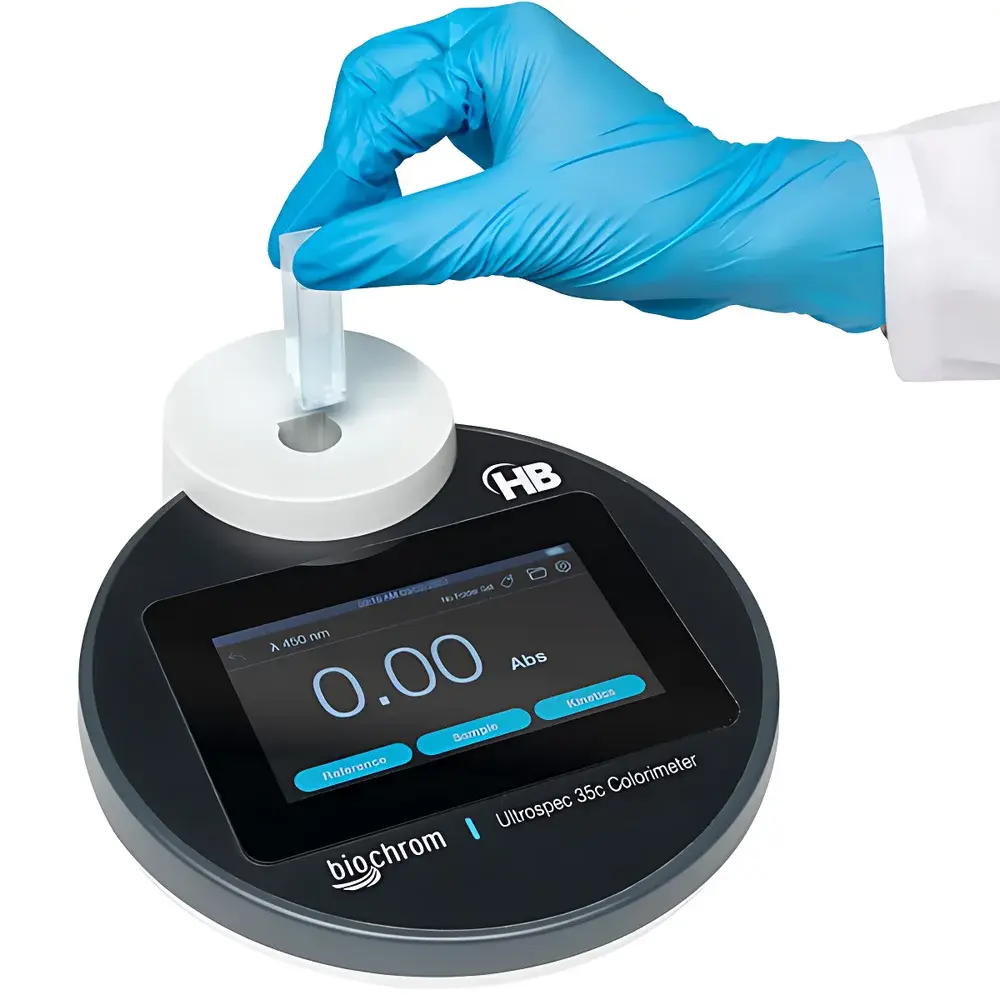
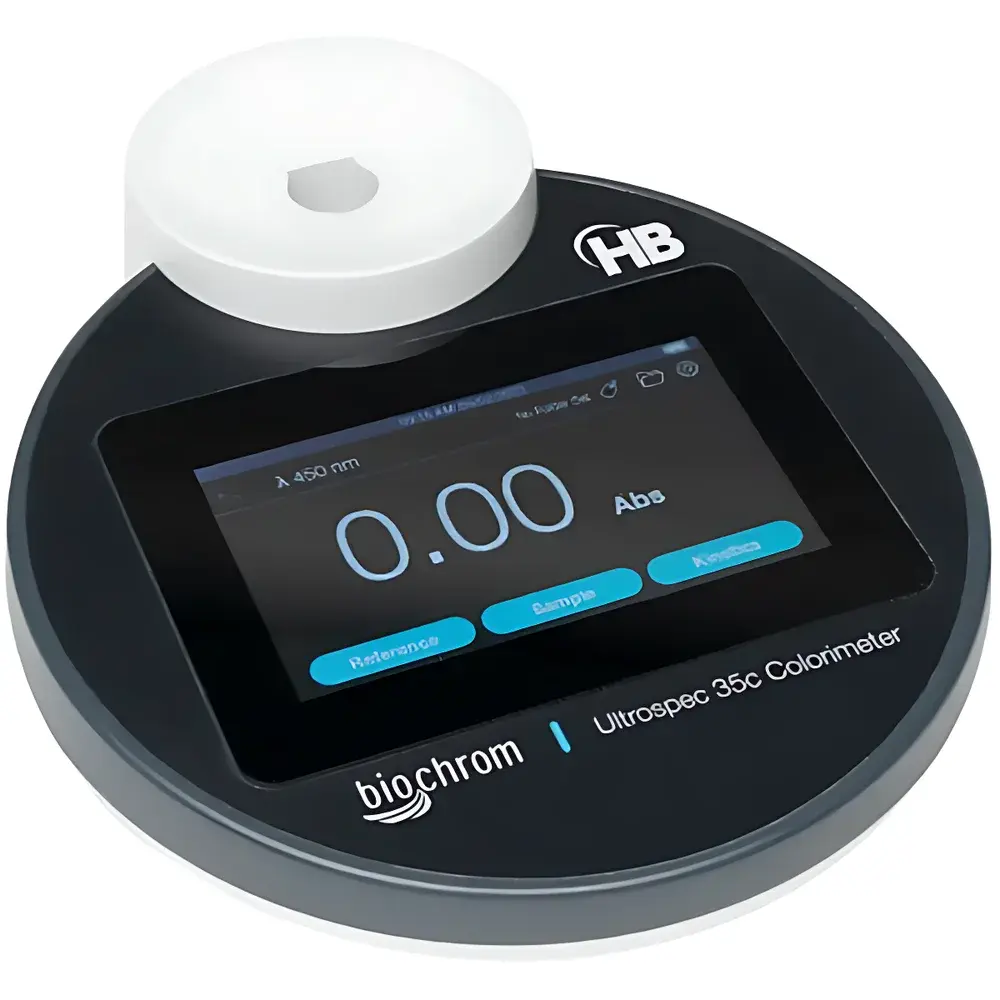
Biochrom Ultrospec 35c Portable Spectrophotometer
| Brand | Biochrom |
|---|---|
| Origin | United Kingdom |
| Model | Ultrospec 35c |
| Wavelength Options | 450, 500, 520, 540, 600, 640 nm |
| Display | 4.3-inch color touchscreen |
| Data Export | CSV format to USB drive |
| Power Options | Internal rechargeable battery or AC adapter |
| Sample Format | Cuvette- or test-tube-based liquid samples |
| Measurement Modes | Absorbance and Transmittance |
| Kinetics Capability | Basic time-resolved absorbance monitoring |
| Compliance | Designed for GLP-supporting workflows in academic, industrial, and field laboratories |
Overview
The Biochrom Ultrospec 35c Portable Spectrophotometer is a compact, LED-based single-beam spectrophotometer engineered for quantitative absorbance and transmittance measurements at discrete, user-selectable wavelengths. Unlike scanning instruments, the Ultrospec 35c employs high-stability light-emitting diodes (LEDs) centered at six fixed wavelengths—450 nm, 500 nm, 520 nm, 540 nm, 600 nm, and 640 nm—optimized for common colorimetric assays including Bradford, Lowry, BCA, NAD(P)H detection, and turbidity-based cell density estimation. Its optical architecture follows Beer–Lambert law principles, delivering reproducible photometric data across sample matrices encountered in life science research, quality control testing, environmental monitoring, and educational laboratories. The instrument’s portability, combined with its dual-power operation (rechargeable internal battery or AC mains), enables deployment in resource-limited settings, mobile labs, cleanrooms, or outdoor sampling locations without compromising measurement integrity.
Key Features
- Compact, handheld-ready form factor with integrated ergonomic grip and low footprint—designed for benchtop, field, or transport use.
- Six pre-calibrated LED sources ensure wavelength accuracy and long-term photometric stability without lamp replacement or warm-up delays.
- 4.3-inch capacitive color touchscreen interface supports intuitive navigation, real-time graphing of kinetic traces, and on-device parameter configuration—including blank subtraction, measurement units (A or %T), and averaging cycles.
- Onboard data storage with direct export to USB flash drives in standard CSV format—compatible with Excel, GraphPad Prism, and LIMS integration via post-acquisition import.
- Robust mechanical design featuring chemical-resistant housing and simplified optical path—minimizing alignment drift and enabling rapid decontamination between samples using ethanol or mild detergent wipes.
- Flexible sample handling accommodates standard 10-mm pathlength cuvettes (square or rectangular) and 12–16 mm diameter test tubes—eliminating the need for adapter accessories in routine assays.
Sample Compatibility & Compliance
The Ultrospec 35c is validated for aqueous and mildly organic solvent-based solutions commonly used in protein, nucleic acid, and enzyme activity assays. It supports sample volumes as low as 0.5 mL in standard cuvettes and up to 3 mL in test tubes. While not a regulatory-grade instrument per se, its design aligns with foundational requirements of Good Laboratory Practice (GLP) and ISO/IEC 17025:2017 for non-automated photometric analysis. Traceable calibration is supported via optional NIST-traceable neutral density filters or certified reference standards. The device does not incorporate electronic audit trails or user access controls required under FDA 21 CFR Part 11; however, exported CSV files retain timestamped metadata (date, time, wavelength, operator ID if entered), supporting manual auditability in regulated environments where supplementary documentation protocols are applied.
Software & Data Management
No proprietary desktop software is required for basic operation—the Ultrospec 35c functions autonomously via its embedded firmware and touchscreen UI. All measurement sessions are stored internally and exported in plain-text CSV format, preserving column headers (e.g., “Time (s)”, “Absorbance”, “Wavelength (nm)”) for seamless compatibility with third-party analysis platforms. Users may define custom assay templates (e.g., “Protein A @ 595 nm”) with preset wavelength, blank type, and unit selection—enhancing workflow consistency across multiple operators. For institutions requiring centralized data archiving, the CSV output integrates directly into laboratory information management systems (LIMS) or electronic lab notebooks (ELN) through standard ingestion pipelines.
Applications
- Quantitative determination of biomolecule concentration (e.g., proteins, DNA, RNA) using established colorimetric or UV-absorbance methods.
- Enzyme kinetics monitoring—such as NADH oxidation at 340 nm (using external filter adaptation) or alkaline phosphatase activity via p-nitrophenol release at 405 nm (with appropriate wavelength substitution).
- Water quality assessment—including nitrate, phosphate, and iron content via standardized APHA or ISO colorimetric protocols.
- Educational demonstrations of spectroscopic principles, Beer–Lambert law validation, and assay optimization in undergraduate chemistry and molecular biology curricula.
- Field-deployable QC checks for reagent lot verification, buffer pH indicator response, or microbial growth tracking in bioprocessing support roles.
FAQ
Is the Ultrospec 35c compliant with FDA 21 CFR Part 11?
No—the instrument lacks electronic signature capability, role-based access control, and automated audit trail generation required for Part 11 compliance. However, CSV exports support manual traceability when paired with procedural documentation.
Can I perform multi-wavelength scans or spectral acquisition with this device?
No—it is a fixed-wavelength photometer, not a scanning spectrophotometer. Spectral resolution is limited to the six discrete LED peaks specified.
What cuvette types are compatible?
Standard 10-mm pathlength square or rectangular quartz, glass, or disposable plastic cuvettes; also accepts round 12–16 mm test tubes with optional tube holder accessory (sold separately).
Does the instrument require annual recalibration?
Biochrom recommends verification against reference standards every 6–12 months depending on usage frequency and environmental conditions. LED stability minimizes drift, but optical path cleanliness remains critical.
Is Bluetooth or Wi-Fi connectivity available?
No—data transfer is exclusively via USB 2.0 port. Wireless functionality is omitted to maintain electromagnetic compatibility in sensitive lab environments and extend battery life.




