
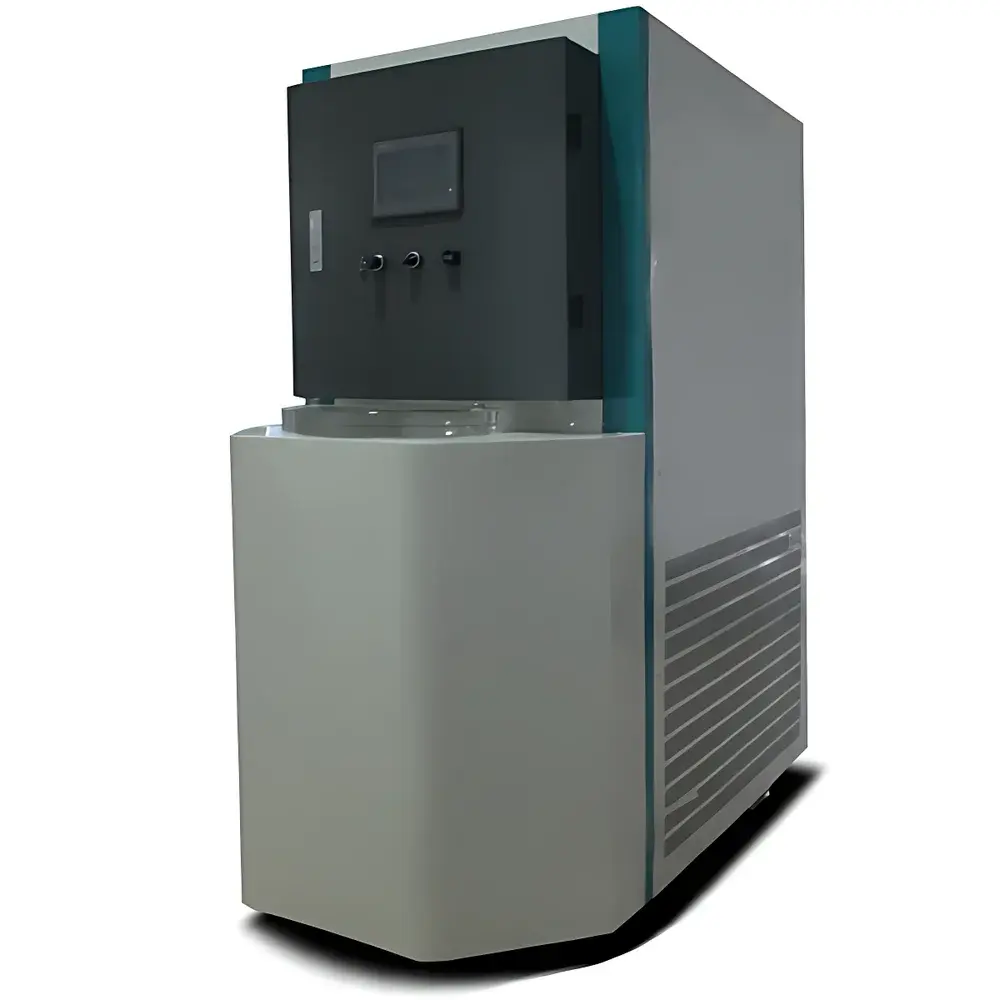
BIOCOOL BIOCOOL-ES Series “IceCore” Pilot-Scale Freeze Dryer
| Brand | BIOCOOL |
|---|---|
| Origin | Beijing, China |
| Manufacturer Type | Authorized Distributor |
| Country of Origin | China |
| Model | BIOCOOL-ES |
| Instrument Type | Stoppering Freeze Dryer |
| Application Scope | Pilot-Scale |
| Lyophilization Area | 1 m² |
| Ultimate Vacuum | ≤1 Pa |
| Condensate Capacity (24 h) | 15 L |
| Cold Trap Temperature | < −110 °C (enhanced mode down to −165 °C) |
| Dimensions (W×D×H) | 760 × 1440 × 1900 mm |
Overview
The BIOCOOL BIOCOOL-ES Series “IceCore” Pilot-Scale Freeze Dryer is engineered for precise, reproducible lyophilization of thermally sensitive biopharmaceuticals, diagnostic reagents, and advanced functional materials where critical thermal transition temperatures—such as eutectic temperature (Te), melting point (Tm), collapse temperature (Tc), and glass transition temperature (Tg’)—fall significantly below conventional system capabilities. Operating on the fundamental principles of sublimation under high vacuum and controlled heat transfer via shelf-mounted conduction, the IceCore platform integrates deep-cold condensation, ultra-low shelf pre-freezing, and dynamic vacuum regulation to maintain product integrity across demanding freeze-drying cycles. Designed explicitly for pilot-scale process development and small-batch GMP-compliant manufacturing, it bridges the gap between laboratory feasibility studies and commercial-scale production—enabling robust工艺 transfer while preserving structural fidelity of proteins, mRNA-lipid nanoparticles, sterile enzyme formulations, and amorphous inorganic matrices.
Key Features
- Ultra-low temperature capability: Shelf pre-freezing down to < −80 °C; cold trap operational range extended to < −110 °C (with enhanced mode reaching −165 °C) for efficient water vapor capture during low-Tg' drying.
- High-integrity vacuum architecture: Dual-stage vacuum system with international-brand rotary vane pump and oil-free backing; ultimate chamber vacuum ≤1 Pa, maintained with leak-tight stainless-steel construction and double O-ring sealed door.
- Intelligent process control: Industrial-grade PLC coupled with 10.1″ HMI touchscreen interface; supports fully programmable cycles—including freezing, primary drying (sublimation), secondary drying (desorption), defrosting, stoppering, and inert gas backfilling.
- Advanced thermal management: Fuzzy PID-controlled shelf heating with real-time thermal loop monitoring; uniform ±0.5 °C shelf temperature distribution across full 1 m² lyophilization area.
- Automated endpoint detection: Integrated升华 end判定 algorithm based on pressure rise test (PRT) and tunable diode laser-assisted moisture sensing; independent freeze-dry endpoint verification during desorption phase via residual moisture correlation.
- Safety-critical engineering: Comprehensive protection suite including overcurrent, compressor high/low pressure cutoff, shelf overtemperature lockout, vacuum interlock on drain valve actuation, and nitrogen purge validation prior to chamber opening.
Sample Compatibility & Compliance
The BIOCOOL-ES accommodates standard 2R–20R serum vials, trays, and custom containers up to 1 m² footprint. Its design supports lyophilization of aqueous, viscous, and low-eutectic formulations—including monoclonal antibodies, viral vectors, lyophilized PCR master mixes, and nanostructured ceramics. System architecture complies with ISO 22042:2019 (freeze dryer performance qualification), adheres to core elements of FDA 21 CFR Part 11 (audit trail, electronic signature readiness, data integrity controls), and supports GLP/GMP documentation workflows through configurable metadata tagging and ALCOA+ compliant data export. Optional IQ/OQ documentation packages are available upon request.
Software & Data Management
The embedded control software provides native support for ≥2000 user-defined or factory-stored lyo protocols, with versioned recipe management and parameter locking for SOP enforcement. Data acquisition occurs at 50 ms intervals for shelf temperature, product thermocouple signals (optional), chamber pressure, and condenser temperature. Storage options include internal flash memory (retention ≥3 months), USB 3.0 external media, and secure TCP/IP-based PC database logging with SQLite or SQL Server compatibility. Remote supervision is enabled via encrypted Ethernet/WiFi link (up to 1.5 km line-of-sight), supporting live dashboard viewing, alarm push notifications, and secure web-based historical curve replay. Calibration logs for temperature sensors and vacuum transducers are automatically timestamped and retained with traceable NIST-traceable reference values.
Applications
- Biopharmaceutical process development: Optimization of cycle parameters for mAb, ADC, and bispecific formats requiring Tg’ < −40 °C.
- Vaccine stabilization: Lyophilization of live-attenuated and mRNA-LNP vaccines under nitrogen blanket to minimize oxidative degradation.
- Diagnostics & IVD: Stabilization of lyophilized ELISA reagents, lateral flow assay components, and CRISPR-Cas detection kits.
- Materials science: Drying of aerogels, MOFs, and conductive polymer dispersions without pore collapse or crystallinity loss.
- Academic & CRO research: Reproducible scale-up from 50 mL vial batches to 1 m² tray loads with full data continuity for regulatory submission packages.
FAQ
What is the lowest achievable shelf temperature during pre-freezing?
The BIOCOOL-ES achieves ≤ −80 °C shelf temperature using cascade refrigeration, validated per ASTM F2375-22 Annex A3.
Does the system support automated stoppering under vacuum or inert gas?
Yes—hydraulic stoppering mechanism operates under full vacuum or controlled nitrogen backfill (0.1–1.0 bar adjustable), with position feedback and force monitoring.
Can the cold trap be operated independently of the main drying cycle?
Yes—standalone cold trap cooldown mode enables pre-chilling prior to loading, reducing initial vapor load and improving first-cycle stability.
Is the data recording compliant with 21 CFR Part 11 requirements?
The system supports Part 11 readiness: audit trail with immutable timestamps, role-based user access, electronic signature prompts, and exportable .CSV/.PDF reports with cryptographic hash verification.
What maintenance intervals are recommended for the vacuum pump and compressor?
Per OEM specifications: vacuum pump oil change every 2000 operating hours; compressor service inspection annually or after 5000 hours—both tracked automatically in the maintenance log module.



