
BIOCOOL FD-1 Benchtop Freeze Dryer
| Brand | BIOCOOL |
|---|---|
| Origin | Shanghai, China |
| Model | FD-1 |
| Instrument Type | Standard Shelf-Type Freeze Dryer |
| Application | Laboratory Use |
| Lyophilization Area | 0.06 m² |
| Ultimate Vacuum | < 20 Pa |
| Condenser Temperature | ≤ −50 °C |
| Water Capture Capacity | 2 kg/24 h |
| Dimensions (W×D×H) | 492 × 540 × 800 mm |
| Power Supply | 220 V, 50 Hz |
Overview
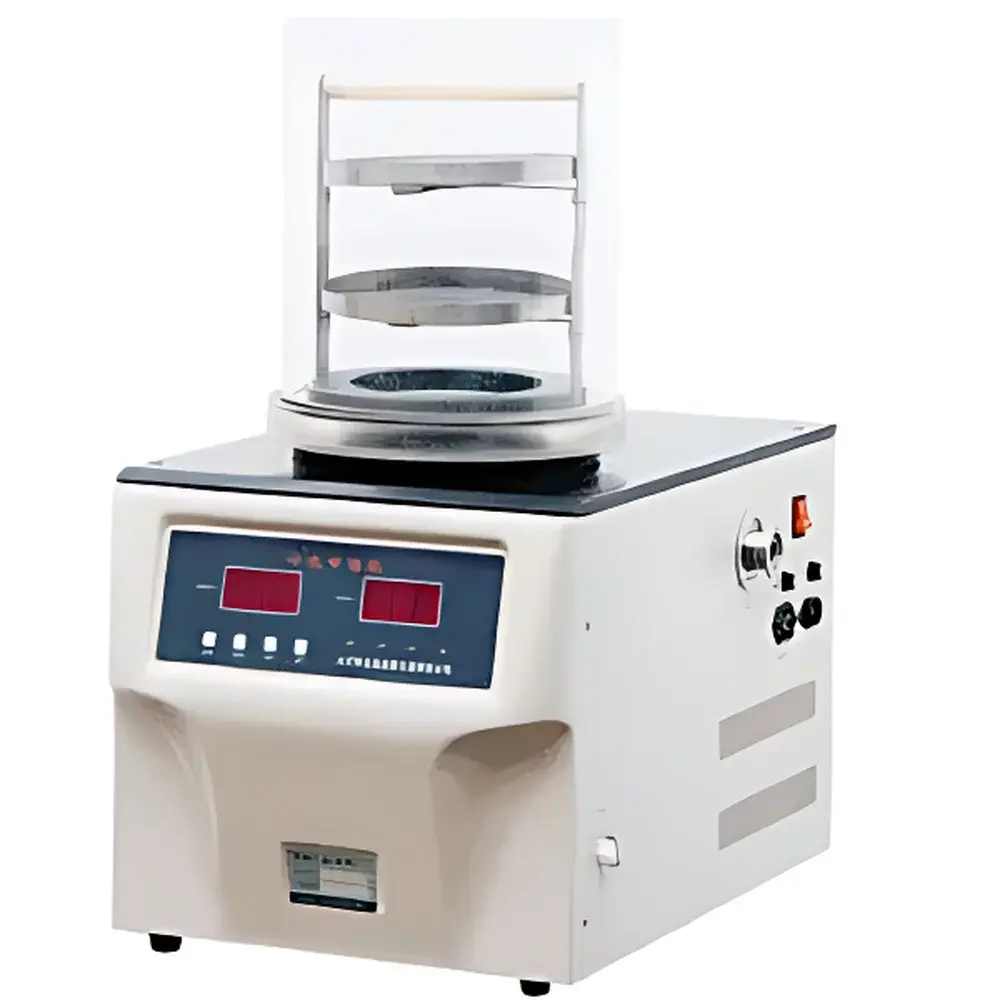
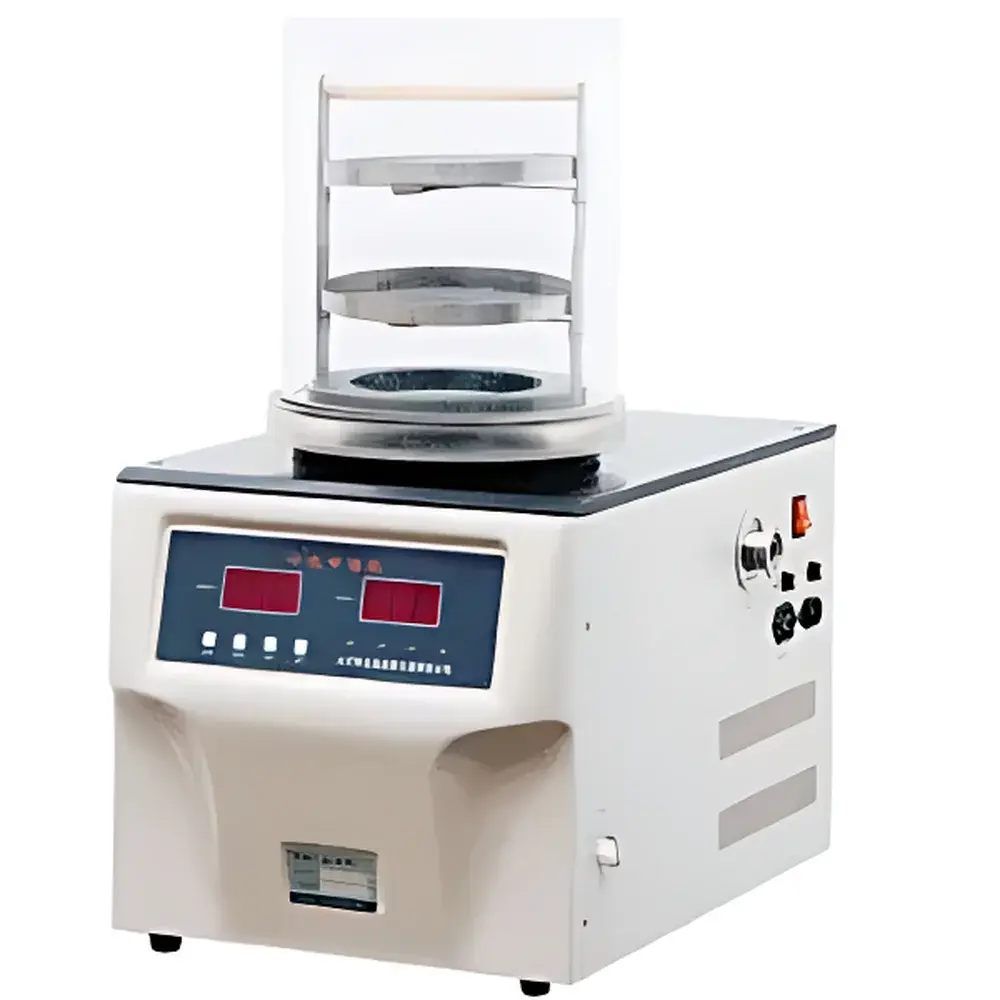
The BIOCOOL FD-1 is a compact, benchtop freeze dryer engineered for routine lyophilization tasks in academic research laboratories, quality control environments, and small-scale bioprocessing workflows. It operates on the fundamental principle of sublimation—removing water from frozen samples under deep vacuum while maintaining product integrity through low-temperature condensation. The system employs a single-stage, hermetically sealed refrigeration circuit to achieve a stable condenser temperature of ≤ −50 °C, sufficient for drying aqueous solutions with moderate eutectic points, such as buffers, enzyme preparations, and microbial cultures. Its 0.06 m² shelf area supports up to two standard Φ200 mm sample trays, enabling batch processing of up to 0.6 L of liquid load. Designed for operational simplicity and spatial efficiency, the FD-1 integrates a transparent polycarbonate bell jar, stainless-steel condenser chamber, and intuitive digital interface—making it suitable for users requiring reliable, entry-level lyophilization without complex automation or regulatory-grade validation features.
Key Features
- Benchtop form factor with footprint optimized for limited lab space (492 × 540 mm base)
- Stainless-steel condenser chamber with large-diameter opening and coil-free interior surface—enhancing cleanability, corrosion resistance, and ice removal efficiency
- Patented airflow-guiding cylinder design increases effective condensing surface area and improves vapor capture kinetics
- Transparent polycarbonate drying chamber enables real-time visual monitoring of sublimation progress and cake formation
- Integrated pre-freezing capability via direct contact cooling of shelves—eliminating need for external ultra-low temperature freezers for many applications
- Digital vacuum and condenser temperature display with high-resolution analog-to-digital conversion for consistent process oversight
- Standard ISO-KF 25 vacuum port compliant with common laboratory vacuum pumps (e.g., dual-stage rotary vane or diaphragm types)
- Imported solenoid-controlled inert gas inlet valve for controlled backfilling with dry nitrogen or argon—reducing oxidation and improving sterility assurance
Sample Compatibility & Compliance
The FD-1 accommodates a broad range of thermolabile biological and pharmaceutical materials including proteins, peptides, vaccines, probiotics, and diagnostic reagents. Its −50 °C condenser temperature ensures efficient trapping of water vapor from formulations with eutectic temperatures above −40 °C. While not certified for GMP manufacturing, the unit meets essential mechanical and electrical safety standards applicable to Class II laboratory equipment per IEC 61010-1. Its construction—using 304 stainless steel for wetted surfaces and food-grade polycarbonate for the drying chamber—supports cleaning protocols aligned with GLP documentation practices. All vacuum seals utilize fluorocarbon elastomers rated for continuous operation below −40 °C, ensuring long-term leak integrity. The system does not include 21 CFR Part 11-compliant audit trail functionality; however, its analog-style controls and discrete sensor outputs allow integration into validated environmental monitoring systems via external data loggers.
Software & Data Management
The FD-1 operates via a dedicated microcontroller-based interface with no embedded operating system or network connectivity. Real-time values for condenser temperature and chamber pressure are displayed on a dual-line LCD screen with 0.1 °C and 1 Pa resolution respectively. No proprietary software is required for operation, and no onboard data storage is provided. For traceable process recording, users may connect external USB or RS-232-compatible chart recorders or PC-based DAQ systems using the unit’s analog voltage outputs (0–5 V DC proportional to temperature and vacuum). Optional accessories include a calibrated PT100 probe for shelf temperature monitoring (FD-1A variant), though this remains an analog signal only—no digital calibration certificate or NIST-traceable documentation is supplied with base configuration.
Applications
- Routine dehydration of bacterial and fungal cultures for long-term preservation
- Stabilization of monoclonal antibodies and recombinant enzymes prior to analytical characterization
- Preparation of calibration standards for HPLC and mass spectrometry workflows
- Processing of botanical extracts and nutraceutical intermediates requiring low-residual moisture
- Lyophilization of ELISA reagents and lateral flow assay components
- Small-batch formulation development where cycle parameter flexibility outweighs full automation requirements
FAQ
What is the maximum sample volume the FD-1 can process per cycle?
The FD-1 supports up to 0.6 L of aqueous solution across two Φ200 mm trays, assuming uniform distribution and typical freezing behavior.
Does the FD-1 support shelf temperature control during primary drying?
No—the FD-1 provides passive shelf cooling only via thermal conduction from the condenser; active shelf heating or programmable ramping is not available in this model.
Can the FD-1 be used with aggressive solvents such as acetonitrile or methanol?
It is not recommended—the condenser temperature of −50 °C is insufficient to trap low-boiling organic vapors, which may overload the pump oil or compromise vacuum integrity.
Is the vacuum gauge calibrated and traceable to national standards?
The built-in piezoresistive vacuum sensor is factory-calibrated but does not include a certificate of calibration or NIST traceability; third-party verification is advised for critical applications.
What maintenance intervals are recommended for optimal performance?
Vacuum pump oil should be changed every 200 hours of cumulative operation; condenser defrosting is required after each run if ice accumulation exceeds 80% capacity; O-ring inspection is recommended quarterly.



