
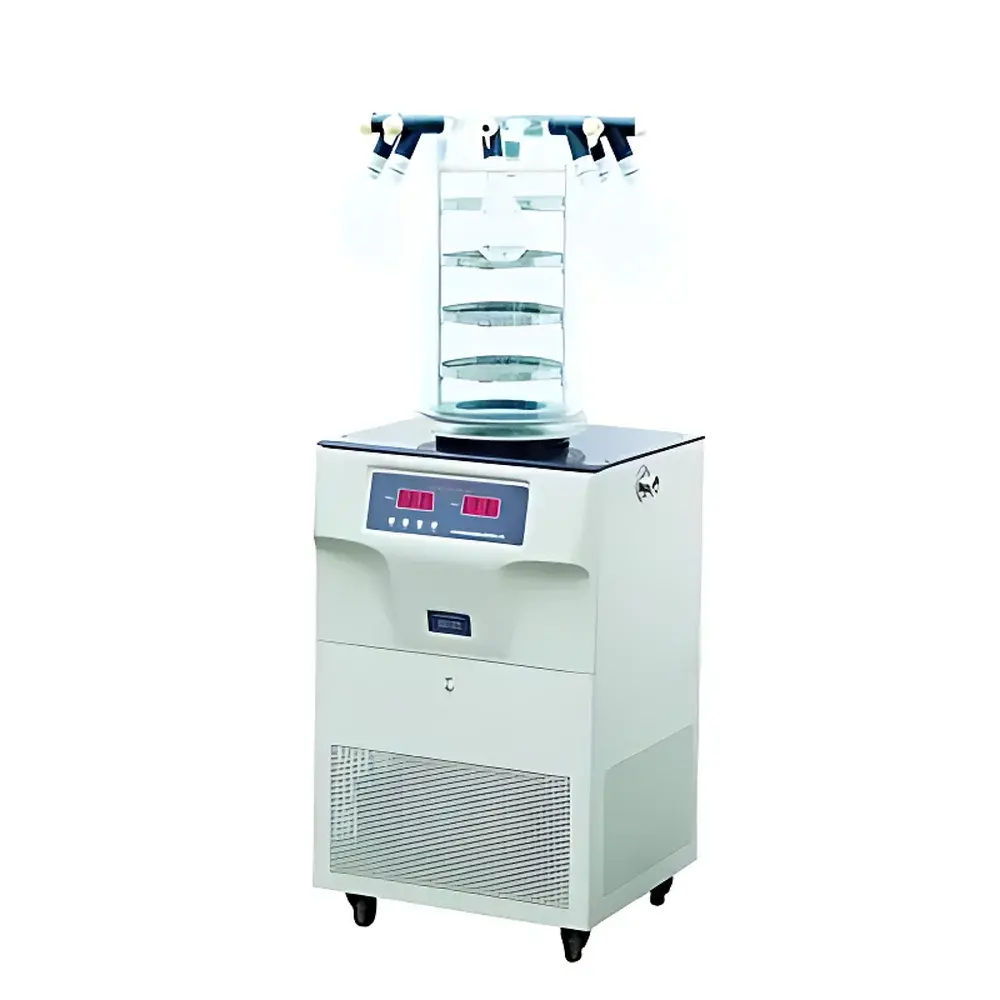
BIOCOOL FD-1C-80 Benchtop Freeze Dryer
| Brand | BIOCOOL |
|---|---|
| Origin | Beijing, China |
| Model | FD-1C-80 |
| Condenser Temperature | < −80 °C |
| Ultimate Vacuum | < 20 Pa |
| Freeze-Drying Area | 0.12 m² |
| Shelf Capacity | 4 × Φ200 mm Trays |
| Tray Loading Volume | 1.2 L |
| Condenser Dimensions | Φ200 × 200 mm |
| Ice Capacity | 4 kg/24 h |
| Drying Time (10 mm layer) | ~24 h |
| Flask Compatibility | 8 × (100/250/500/1000 mL) |
| Power Supply | 220 V, 50 Hz, 1300 W |
| Unit Dimensions | 492 × 540 × 800 mm (W × D × H) |
| Refrigeration System | Dual-stage cascade compressor (imported hermetic compressors) |
| Chamber Material | Transparent acrylic bell jar |
| Condenser Material | Electropolished stainless steel (coil-free design) |
| Vacuum Interface | Standard KF-25 (ISO-K) |
| Optional | Sample temperature probe |
Overview
The BIOCOOL FD-1C-80 is a benchtop freeze dryer engineered for laboratory-scale lyophilization of heat-sensitive biological, pharmaceutical, and chemical samples. It operates on the principle of sublimation—removing water or solvent from frozen material under high vacuum while maintaining the sample in its solid phase. This process preserves structural integrity, bioactivity, and chemical stability far more effectively than conventional drying methods. Designed with a vertical footprint and integrated casters, the FD-1C-80 delivers high-efficiency primary drying without requiring dedicated floor space. Its dual-stage cascade refrigeration system achieves condenser temperatures below −80 °C, enabling effective capture of volatile organic solvents—including acetone, ethanol, and ethyl acetate—commonly used in formulation development and extraction workflows. The unit supports both batch processing and scalable method development, making it suitable for R&D labs, QC/QA departments, and small-batch GMP-aligned production environments.
Key Features
- Compact vertical architecture with leveling feet and mobility casters for flexible lab integration
- Dual-stage cascade refrigeration using imported hermetic compressors for stable, low-noise operation and rapid cooldown to < −80 °C
- Coil-free electropolished stainless-steel condenser (Φ200 × 200 mm) offering corrosion resistance, easy cleaning, and uniform ice distribution
- Patented baffle-guided airflow design maximizes effective condensing surface area and improves sublimation kinetics
- Large-diameter condenser opening enables direct pre-freezing of samples inside the chamber—eliminating transfer steps and reducing contamination risk
- Transparent acrylic bell-jar drying chamber provides full visual monitoring while maintaining vacuum integrity and operator safety
- Digital PID-controlled display showing real-time condenser temperature and chamber pressure (0–100 Pa range, ±0.5 Pa resolution)
- KF-25 (ISO-K) vacuum port ensures compatibility with a wide range of oil-sealed, dry scroll, and diaphragm vacuum pumps
- Integrated inert gas inlet valve (standard) for backfilling with nitrogen or argon post-drying to prevent oxidation or moisture reabsorption
- Modular configuration support: compatible with FD-1 series accessories including shelf trays, manifold flasks, and T-type multi-port adapters
Sample Compatibility & Compliance
The FD-1C-80 accommodates diverse sample formats—including aqueous solutions, protein formulations, microbial cultures, botanical extracts, and polymer dispersions—via its standard 4-tier tray system (Φ200 mm per shelf) or optional manifold flask setup (8 ports, supporting 100–1000 mL vessels). Its deep-cold condenser and high ice-trapping capacity (4 kg/24 h) make it especially appropriate for lyophilizing formulations containing up to 15% v/v organic co-solvents. While not certified for Class A/B cleanroom use, the unit meets mechanical and electrical safety requirements per IEC 61010-1 and is routinely deployed in GLP-compliant laboratories. Data logging (when paired with optional temperature probes) supports audit readiness for USP , ISO 20387, and FDA 21 CFR Part 11–aligned workflows when integrated with validated third-party software.
Software & Data Management
The FD-1C-80 operates via an embedded microcontroller with local digital interface only; no proprietary software or USB connectivity is included by default. However, analog output signals (0–5 V or 4–20 mA) are available for condenser temperature and vacuum pressure—enabling integration into centralized Lab Information Management Systems (LIMS) or SCADA platforms. Optional PT100-compatible sample temperature probes provide direct monitoring at multiple points across the drying chamber, supporting critical process parameter (CPP) documentation required for regulatory submissions. All operational parameters—including run time, final vacuum level, and condenser delta-T—are retained in non-volatile memory for traceability.
Applications
- Stabilization of monoclonal antibodies, vaccines, and enzyme preparations for long-term storage
- Preparation of sterile powders for parenteral dosage form development
- Preservation of bacterial and fungal strains in microbiology and biobanking facilities
- Drying of chromatographic fractions and natural product isolates without thermal degradation
- Removal of residual solvents from nanoparticle suspensions and liposomal formulations
- Method optimization and cycle development prior to pilot- or production-scale lyophilizer transfer
FAQ
What types of solvents can the FD-1C-80 effectively trap?
It reliably captures water and common polar organics such as methanol, ethanol, acetone, and acetonitrile—provided total solvent load remains within the 4 kg/24 h ice capacity and vapor pressure does not exceed the condenser’s thermal sink capability.
Is the unit suitable for GMP manufacturing?
It is intended for R&D, quality control, and small-batch processing—not for commercial manufacturing under cGMP. Validation support documentation (IQ/OQ templates) is available upon request.
Can I monitor product temperature during drying?
Yes—optional calibrated PT100 probes can be inserted directly into vials or trays, with outputs routed to external data loggers or PLCs.
What vacuum pump is recommended?
A two-stage oil-lubricated rotary vane pump rated ≥4 m³/h at 0.1 mbar or a dry scroll pump with equivalent pumping speed and ultimate vacuum ≤1 × 10⁻² mbar is advised.
Does the condenser require defrosting between cycles?
Manual defrost is required after each run when ice mass approaches 80% of capacity; auto-defrost is not supported on this model.



