
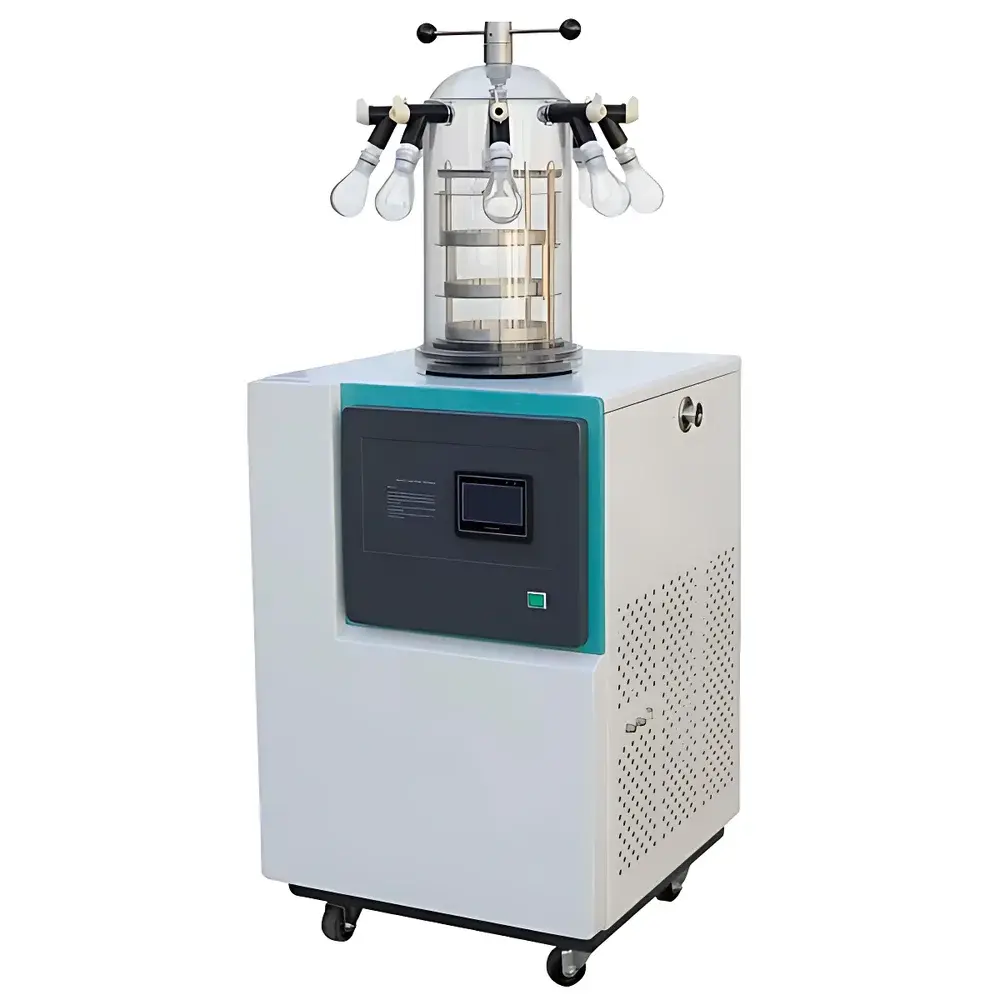
BioCool FD-1D-110+ Benchtop Freeze Dryer with -110°C Cold Trap and Stoppering Function
| Brand | BioCool |
|---|---|
| Origin | Beijing, China |
| Model | FD-1D-110+ |
| Instrument Type | Stoppering Freeze Dryer |
| Application | Laboratory-Scale Lyophilization |
| Shelf Area | 0.08 m² |
| Ultimate Vacuum | <3 Pa |
| Condenser Temperature (No Load) | -110°C |
| Water Capture Capacity (24 h) | 3 L |
| Refrigeration System | Dual-Stage Cascade Compressor |
| Control System | PLC + Touchscreen Interface |
| Sample Temperature Monitoring | Dual Pt100 Sensors |
| Optional Features | Pulse Backfill Valve (N₂/Inert Gas), Auto-Defrost, Lyophilization Curve Logging & USB Data Export |
Overview
The BioCool FD-1D-110+ is a laboratory-grade benchtop freeze dryer engineered for reproducible, high-fidelity lyophilization of heat-sensitive biologicals, pharmaceuticals, and organic-solvent-containing formulations. It operates on the fundamental principle of sublimation under deep vacuum: frozen water (or solvent) transitions directly from solid to vapor phase without passing through liquid, preserving structural integrity and bioactivity. Its defining feature is the ultra-low temperature condenser (-110°C), enabling efficient capture of volatile organic solvents—including acetone, ethanol, ethyl acetate, and acetonitrile—at concentrations up to 95% (v/v). This capability distinguishes it from standard -50°C or -80°C systems, which risk solvent breakthrough, pump oil contamination, and compromised vacuum stability. The monolithic drying chamber—fully welded, leak-tight stainless steel construction—eliminates gasket failure points and ensures long-term vacuum integrity. Integrated pre-freezing in the condenser allows primary freezing without external ultra-low temperature freezers, streamlining workflow for small-batch R&D and QC applications.
Key Features
- Ultra-low temperature condenser (-110°C no-load) with dual-stage cascade refrigeration system using internationally certified compressors for stable, low-noise operation
- Stoppering-compatible shelf design enabling in-chamber lyophilization and sterile stopper compression of vials—critical for aseptic pharmaceutical development
- Patented baffle flow duct technology optimizing vapor path geometry to reduce drying cycle time by up to 22% compared to conventional radial condensers
- Dual Pt100 sample temperature probes with real-time display and logging—supports accurate determination of collapse temperature (Tc) and optimization of shelf temperature ramping
- Pulse-controlled backfill system with OEM solenoid valve for precise inert gas (N₂ or argon) introduction post-drying, minimizing oxidation during storage
- PLC-based control architecture with 7-inch resistive touchscreen, supporting programmable multi-step drying profiles, alarm history, and audit-ready event logging
Sample Compatibility & Compliance
The FD-1D-110+ accommodates aqueous solutions, suspensions, emulsions, and organic-aqueous mixtures with eutectic temperatures above -20°C. It is validated for lyophilizing proteins, enzymes, vaccines, probiotics, and small-molecule APIs where residual solvent content must comply with ICH Q3C guidelines. The system supports GLP/GMP-aligned workflows: all process parameters—including shelf temperature, condenser temperature, chamber pressure, and sample thermocouple readings—are timestamped and exportable via USB. Data logs meet basic FDA 21 CFR Part 11 requirements when used with controlled user access and electronic signature protocols (configured separately). Vacuum integrity complies with ISO 20514:2018 for laboratory freeze dryers; condenser performance adheres to ASTM F2673-20 for solvent trapping efficiency testing.
Software & Data Management
The embedded HMI firmware enables full-cycle parameter programming (freezing rate, primary drying hold time, secondary drying ramp, pressure modulation). Real-time lyophilization curves—plotting shelf temperature, product temperature, and chamber pressure vs. time—are displayed and stored internally (≥100 cycles). All datasets export in CSV format via USB 2.0 port for offline analysis in MATLAB, Python, or commercial CQA tools. Firmware supports automatic defrost sequencing with condenser temperature monitoring to prevent ice bridging. Optional PC software (BioLyosoft™) provides advanced curve overlay, deviation alerting, and batch comparison analytics—compatible with Windows 10/11 and validated for networked lab environments.
Applications
- R&D-scale lyophilization of monoclonal antibodies, mRNA-LNPs, and viral vectors requiring strict solvent removal and thermal stability preservation
- QC release testing of reference standards and calibration materials where residual moisture must remain ≤1.0% w/w (per USP & Ph. Eur. methods)
- Stabilization of diagnostic reagents, microbial cultures, and botanical extracts containing ethanol or methanol-based extraction solvents
- Preparation of electron microscopy samples requiring artifact-free dehydration without chemical fixation
- Academic research in food science (e.g., freeze-dried probiotic powders) and material science (e.g., porous scaffold fabrication)
FAQ
What types of organic solvents can be safely processed in the FD-1D-110+?
It is validated for acetone, ethanol, isopropanol, ethyl acetate, acetonitrile, and tetrahydrofuran at concentrations up to 95% (v/v); methanol and chloroform require prior compatibility assessment due to higher vapor pressure.
Does the system support validation documentation (IQ/OQ/PQ)?
Yes—factory-installed sensors are NIST-traceable; BioCool provides OQ protocol templates and calibration certificates for condenser/shelf temperature and vacuum transducers.
Can the stoppering function be disabled for non-vial applications?
Yes—the hydraulic stoppering actuator is mechanically decoupled and may be bypassed via control panel setting; shelf remains fully functional for tray-based drying.
Is remote monitoring supported?
Standard Ethernet port enables Modbus TCP integration with SCADA or LIMS; optional Wi-Fi module available for cloud-based status alerts and log retrieval.
What maintenance intervals are recommended for the vacuum system?
Oil change every 1,000 operating hours; cold trap cleaning after each 50–100 cycles depending on solvent load; annual compressor oil analysis advised for continuous-use environments.



