
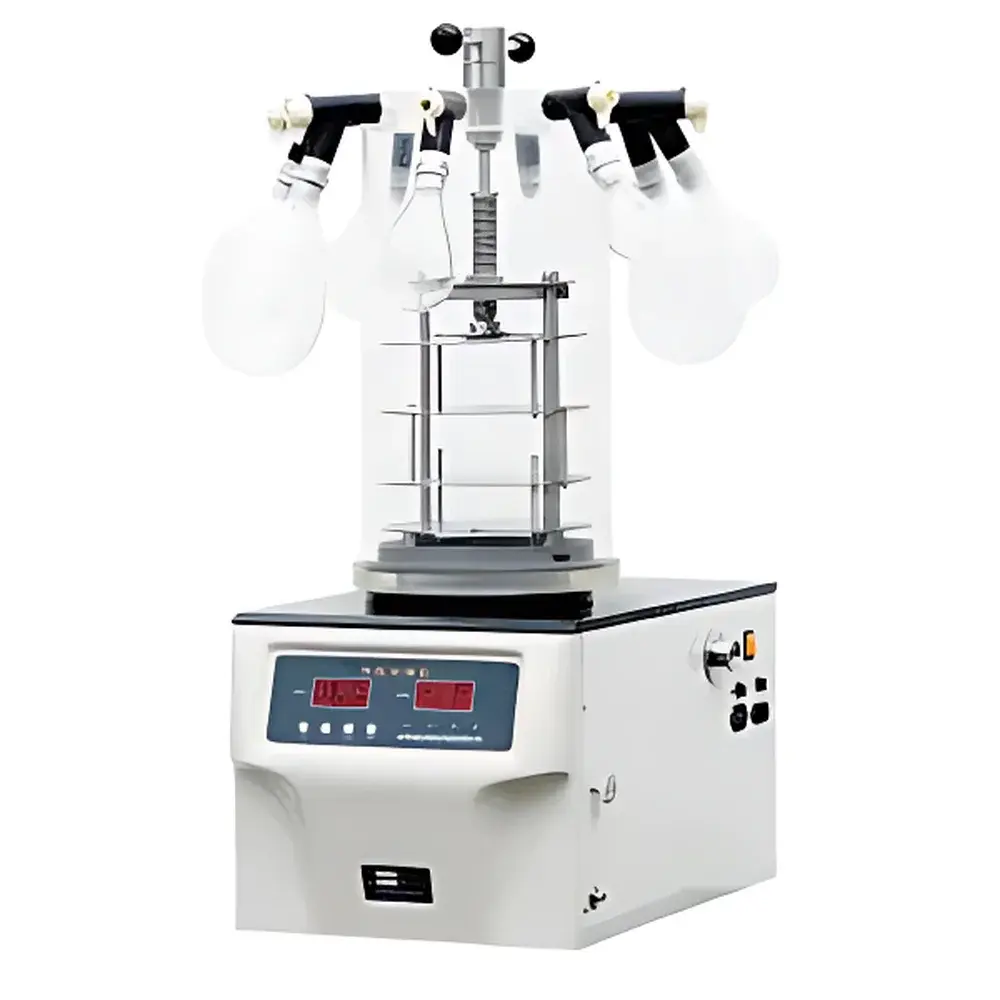
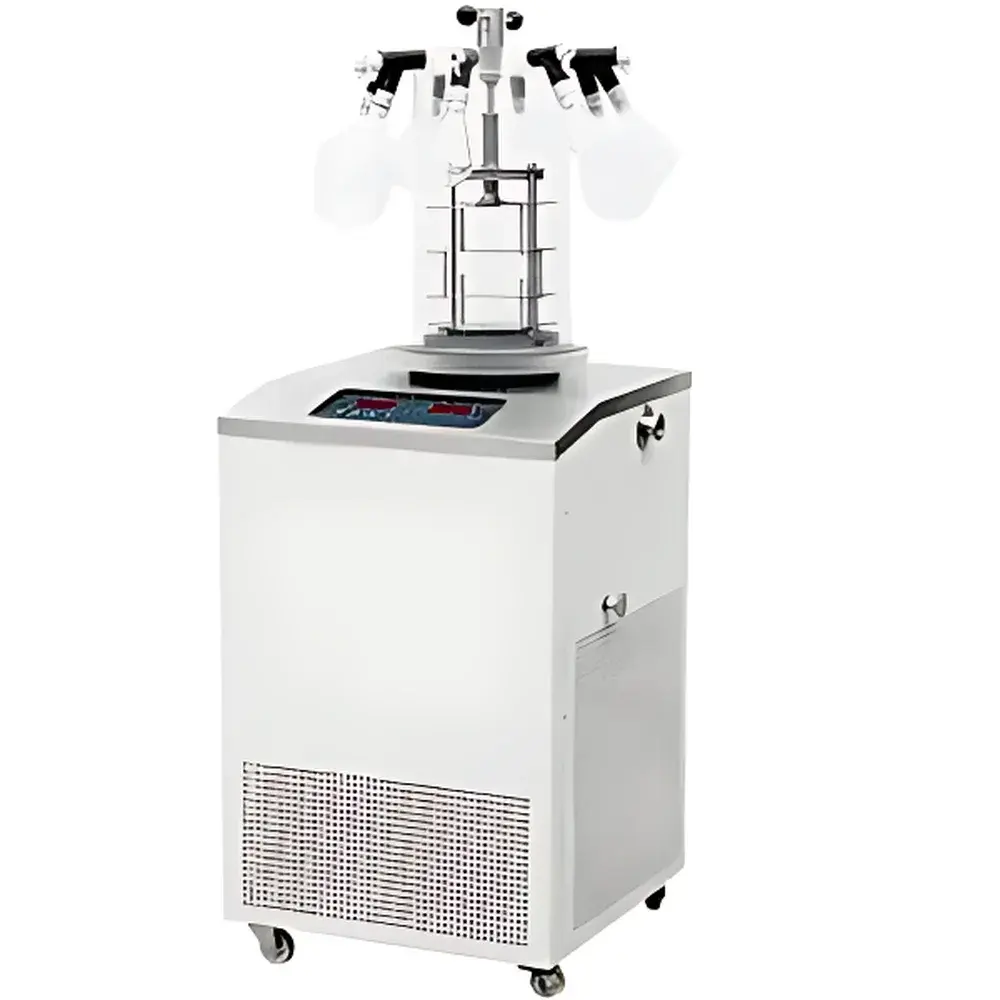
BIOCOOL FD-1D-50 & FD-1D-80 Stoppering Manifold Freeze Dryer
| Brand | BIOCOOL |
|---|---|
| Origin | Shanghai, China |
| Model | FD-1D-50 |
| Instrument Type | Stoppering Manifold Freeze Dryer |
| Application Scope | Pilot-Scale |
| Freeze-Drying Area | 0.12 m² |
| Ultimate Vacuum | ≤20 Pa |
| Condensate Capacity (24h) | 3 kg/24h |
| Cold Trap Temperature | −50 °C (FD-1D-50) / −80 °C (FD-1D-80) |
| Dimensions (W×D×H) | 380×600×345 mm (FD-1D-50) / 500×500×750 mm (FD-1D-80) |
| Power Supply | 220 V, 50 Hz, 800–850 W |
| Sample Shelf | Φ180 mm × 3 layers |
| Manifold Ports | 8 standard KF-16 ports |
| Optional | Sample Temperature Monitoring |
Overview
The BIOCOOL FD-1D-50 and FD-1D-80 are benchtop stoppering manifold freeze dryers engineered for pilot-scale lyophilization in regulated laboratory environments. These systems employ primary drying via sublimation under high vacuum (<20 Pa), coupled with secondary drying under controlled temperature ramping—principles aligned with ISO 22033 (Lyophilization Process Validation) and USP <1211> (Sterile Product Manufacturing). The dual-model architecture accommodates distinct thermal requirements: the FD-1D-50 utilizes a −50 °C cold trap suited for aqueous formulations with moderate eutectic points (e.g., buffers, monoclonal antibody intermediates), while the FD-1D-80 integrates a −80 °C deep-cold trap essential for low-eutectic solvents (e.g., tert-butanol/water mixtures, organic-aqueous cryoprotectant systems) and thermolabile biologics requiring extended shelf-life stability. Both models feature a stainless-steel condenser chamber without internal coil obstructions—minimizing frost accumulation interference and enabling uniform ice layer formation for reproducible water vapor capture kinetics.
Key Features
- Patented baffle-guided airflow design enhances effective condenser surface area by >25% versus conventional coil-based traps, accelerating primary drying cycles without compromising endpoint detection fidelity.
- Integrated pre-freezing capability within the cold trap allows simultaneous sample solidification and system evacuation—reducing total process time and eliminating separate ultra-low temperature freezer dependency.
- KF-16 standardized manifold ports (8 total) support interchangeable glassware (e.g., 100–500 mL round-bottom flasks, serum vials) and enable parallel processing of heterogeneous sample types under identical vacuum/temperature profiles.
- Optically transparent acrylic drying chamber with reinforced polycarbonate viewport permits real-time visual monitoring of cake morphology, collapse onset, and desiccation front progression—critical for empirical drying protocol optimization.
- Imported hermetic scroll compressors deliver stable refrigeration output across ambient temperatures ranging from 15–30 °C, with acoustic noise levels maintained below 58 dB(A) per ISO 3744 compliance.
- Dual-channel digital display provides simultaneous readouts of cold trap temperature (±0.5 °C accuracy), chamber pressure (capacitance manometer, ±0.5 Pa resolution), and optional shelf/sensor temperature (PT100 probe, ±0.3 °C).
Sample Compatibility & Compliance
The FD-1D series supports lyophilization of pharmaceuticals, diagnostics, and research-grade biomolecules—including proteins, plasmid DNA, viral vectors, and cell lysates—in both bulk tray format (0.7 L capacity on Φ180 mm × 3-tier stainless steel shelves) and individual vial/flask configurations. All wetted surfaces conform to ASTM F86-22 (Standard Practice for Surface Preparation and Marking of Metallic Surgical Implants) for passivation validation. Vacuum integrity meets ISO 2859-1 sampling plans for leak rate verification (≤1 × 10⁻³ mbar·L/s at 20 Pa). Optional temperature probe integration satisfies FDA 21 CFR Part 11 audit trail requirements when paired with compliant data logging software.
Software & Data Management
While the base configuration operates via standalone digital controls, the system is compatible with BIOCOOL’s optional LyoControl™ PC interface (Windows 10/11, USB 2.0). This platform enables automated cycle scripting, real-time graphing of Tshelf, Tproduct, Pchamber, and dP/dt trends, and export of timestamped CSV datasets compliant with ALCOA+ principles (Attributable, Legible, Contemporaneous, Original, Accurate, Complete, Consistent, Enduring, Available). Raw data files include embedded instrument ID, operator login, and environmental calibration stamps—supporting GLP/GMP-aligned documentation workflows.
Applications
- Stability studies of lyophilized reference standards under ICH Q5C guidelines.
- Process development for sterile fill-finish candidates prior to scale-up to production freeze dryers (e.g., validating collapse temperature via DSC-correlated shelf ramping).
- Rapid dehydration of microbial cultures (e.g., Lactobacillus, Bifidobacterium) for long-term storage without cryoprotectant additives.
- Preparation of electron microscopy specimens requiring structural preservation via critical-point drying alternatives.
- Concentration and purification of nanomaterial suspensions (e.g., liposomal doxorubicin, siRNA polyplexes) where solvent removal must avoid shear-induced aggregation.
FAQ
What is the maximum allowable load volume per batch in tray mode?
The system supports up to 0.7 L of homogeneous solution distributed across three Φ180 mm stainless steel trays—equivalent to ~210 g of water-equivalent mass at full saturation.
Can the manifold ports accommodate custom adapters for non-standard vial sizes?
Yes—KF-16 flanges accept ISO-KF standard adapters (e.g., DN16 to DN10 reducers, silicone O-ring sealed compression fittings) for integration with 10 mm, 20 mm, or 30 mm serum vials.
Is the cold trap designed for continuous operation beyond 24 hours?
The condenser is rated for uninterrupted service up to 72 hours at ≤70% ice capacity; automatic defrost cycles are not integrated, requiring manual ice removal after each run.
Does the system meet electromagnetic compatibility (EMC) requirements for clinical laboratory deployment?
Yes—certified to IEC 61326-1:2022 Class B emission limits and IEC 61000-4-2/3/4/6 immunity standards for use in shared diagnostic instrumentation suites.
What maintenance intervals are recommended for the vacuum pump interface?
The KF-25 vacuum port requires quarterly inspection of the Viton gasket seal and annual replacement of the diffusion pump oil (if used); rotary vane pumps should undergo oil change every 500 operating hours per manufacturer specifications.



