
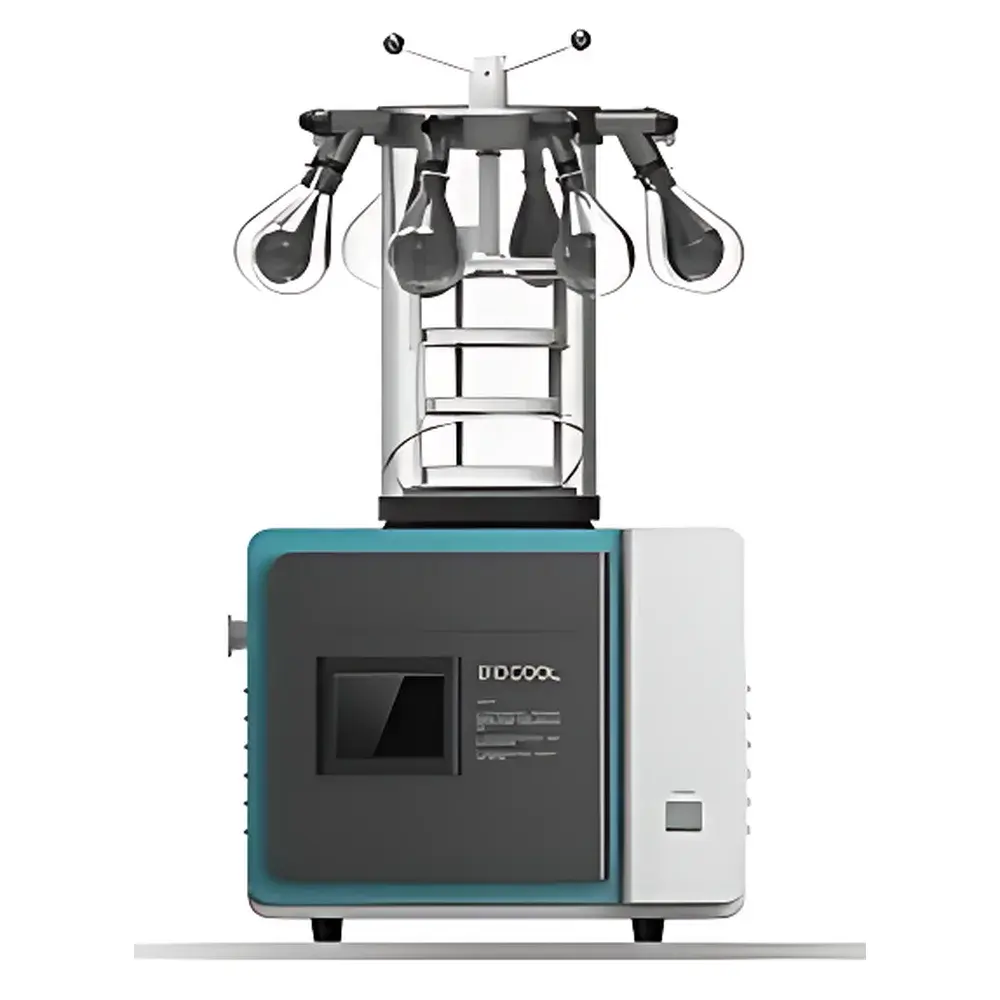
BIOCOOL Lab-1D-50 Benchtop Freeze Dryer with Top-Press Lid
| Brand | BIOCOOL |
|---|---|
| Origin | Beijing, China |
| Model | Lab-1D-50 |
| Instrument Type | Top-Press Lid Freeze Dryer |
| Application | Laboratory-Scale Lyophilization |
| Shelf Area | 0.07 m² |
| Ultimate Vacuum | <10 Pa |
| Condenser Capacity (24 h) | 2 L/24 h |
| Condenser Temperature | ≤−55 °C |
| Dimensions (W×D×H) | 470 × 600 × 400 mm |
| Cooling Power | 0.43 kW |
| Input Power | 220 V / 50 Hz / 800 W |
| Control System | Programmable Vacuum Regulation, Endpoint Detection, Auto Defrost & Drainage, Freeze-Drying Cycle Programming |
| Optional Configurations | 3-layer or 4-layer top-press lid assembly |
Overview
The BIOCOOL Lab-1D-50 is a compact, benchtop freeze dryer engineered for precision lyophilization in research laboratories, quality control environments, and small-scale R&D settings. It operates on the fundamental principle of sublimation—removing water from frozen samples under high vacuum while maintaining product integrity through controlled thermal management. The system integrates a high-efficiency condenser capable of achieving and sustaining temperatures ≤−55 °C, enabling reliable capture of volatile solvents and aqueous vapors during primary drying. With a shelf area of 0.07 m² and an ultimate vacuum level below 10 Pa, the Lab-1D-50 supports reproducible drying cycles for vials, ampoules, and round-bottom flasks—particularly suited for heat-sensitive biologics, pharmaceutical intermediates, enzyme preparations, and diagnostic reagents. Its modular design accommodates both standard 4-layer shelving and an optional 3-layer top-press lid configuration, allowing users to select between batch uniformity (shelved) and post-drying hermetic sealing (press-lid) based on formulation requirements.
Key Features
- Top-press lid mechanism with programmable actuation timing, ensuring consistent seal formation across all vials without manual intervention.
- Dual-stage vacuum control system with real-time pressure feedback and adjustable setpoints, supporting both coarse evacuation and fine-tuned drying phases.
- Intelligent endpoint detection algorithm that monitors pressure rise rate (PRR) and temperature differentials between shelf and product, minimizing over-drying risk and optimizing cycle duration.
- Integrated auto-defrost and drainage function triggered by condenser saturation thresholds, reducing operator dependency and improving daily throughput.
- Eight independently accessible flask ports with standardized 24/29 or 29/32 ground-glass joints, compatible with common laboratory glassware for parallel sample processing.
- Robust stainless-steel chamber and condenser housing, designed for long-term corrosion resistance and compliance with ISO 13485-aligned cleanroom maintenance protocols.
Sample Compatibility & Compliance
The Lab-1D-50 is validated for use with aqueous, buffer-based, and low-concentration organic solvent formulations typical in preformulation studies and analytical reference material preparation. It meets mechanical safety requirements per IEC 61010-1 and electromagnetic compatibility standards per EN 61326-1. While not certified as GMP-compliant out-of-the-box, its programmable logic controller (PLC)-based architecture supports audit-ready data logging—including timestamps, vacuum profiles, shelf temperature ramps, and condenser load history—enabling alignment with GLP documentation practices and FDA 21 CFR Part 11 expectations when paired with validated third-party software. Users performing lyophilization for regulatory submissions should conduct individual equipment qualification (IQ/OQ/PQ) per ASTM F2661-22 guidelines.
Software & Data Management
The embedded control interface provides intuitive navigation via a 5.7-inch TFT-LCD touchscreen with multilingual support (English, Spanish, German). All process parameters—including ramp rates, hold durations, vacuum setpoints, and condenser temperature limits—are fully programmable and storable in up to 100 user-defined protocols. Raw sensor data (shelf temp, chamber pressure, condenser temp, current draw) are logged at 1-second intervals and exportable via USB 2.0 to CSV format. Optional Ethernet connectivity enables remote monitoring and integration into centralized lab information management systems (LIMS), facilitating traceability and cross-instrument correlation in multi-device workflows.
Applications
- Stabilization of monoclonal antibodies, vaccines, and recombinant proteins prior to stability testing.
- Preparation of lyophilized calibration standards for HPLC, LC-MS, and ELISA assay development.
- Routine dehydration of microbial cultures, tissue extracts, and botanical concentrates for archival storage.
- Process development trials for scalable freeze-drying cycles, including shelf-ramp optimization and collapse temperature mapping.
- Small-batch production of sterile drug products under aseptic transfer conditions when used within Class A/B isolators.
FAQ
What is the maximum allowable sample volume per cycle?
The condenser capacity is rated at 2 L/24 h under continuous operation; however, the total ice load must remain below 4 L to avoid saturation. For optimal performance, total initial water content should be limited to ≤3.5 L per full-cycle run.
Can the Lab-1D-50 handle solvents other than water?
Yes—methanol, ethanol, acetone, and acetonitrile may be processed provided their vapor pressures at −55 °C fall within the condenser’s capture envelope. Consult the solvent compatibility chart in the technical manual before use.
Is validation documentation available for GxP environments?
BIOCOOL supplies factory test reports and electrical safety certifications. Full IQ/OQ/PQ templates and calibration certificates are available upon request and require site-specific execution by qualified personnel.
How often does the vacuum pump oil require replacement?
With standard aqueous sample loads and routine auto-defrost cycles, oil service intervals are recommended every 500 operating hours or annually—whichever occurs first—using ISO VG 100 rotary vane pump oil.
Does the system support external pressure control via Pirani or capacitance manometers?
The built-in piezoresistive vacuum sensor is calibrated for broad-range measurement (1000–0.1 Pa). For high-accuracy partial-pressure monitoring, an optional analog output port allows connection to external capacitance manometers with 0–10 V signal input capability.



