
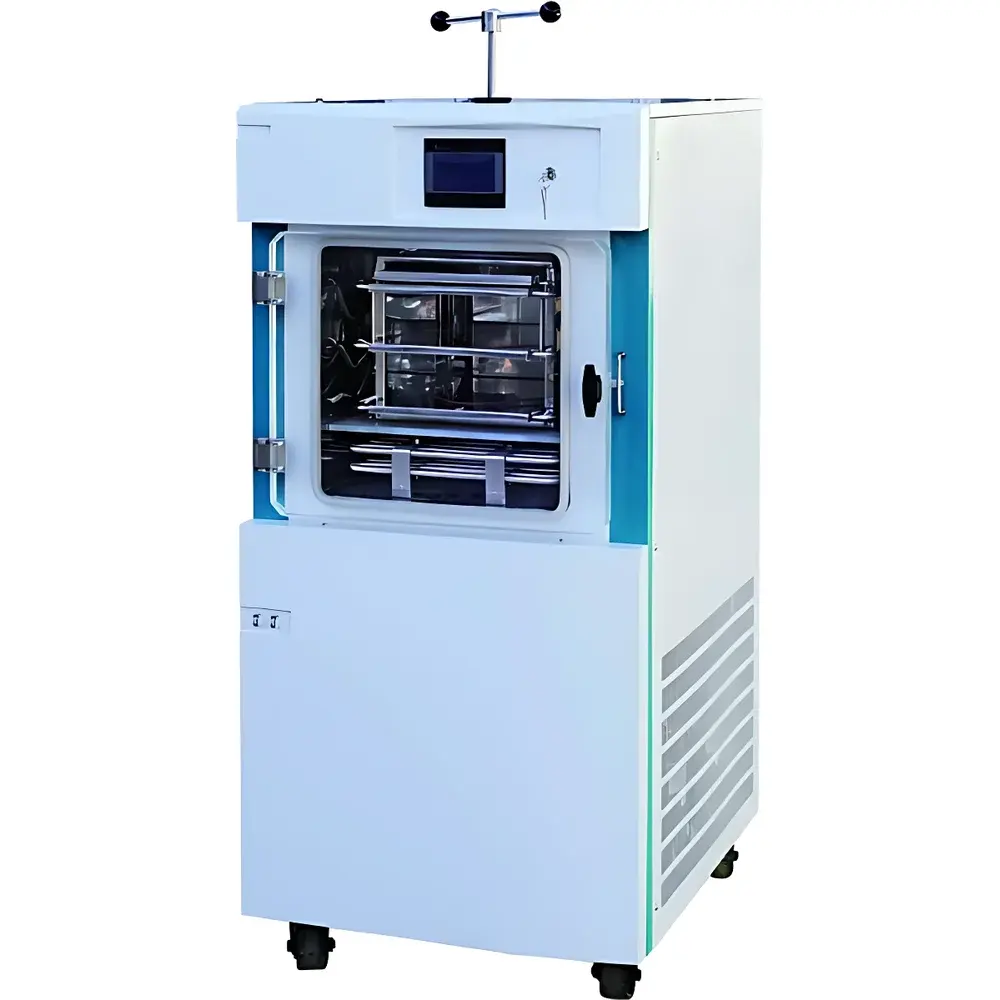
BIOCOOL Pilot2-4M Medium-Scale Freeze Dryer
| Brand | BIOCOOL |
|---|---|
| Origin | Beijing, China |
| Model | Pilot2-4M |
| Type | Shelf-Type Lyophilizer |
| Application | Pilot-Scale Processing |
| Lyophilization Area | 0.2 m² |
| Ultimate Vacuum | <6 Pa |
| Condenser Capacity (24 h) | 4 L/24 h |
| Condenser Temperature (No Load) | <−80 °C |
| Refrigeration Method | Direct Cooling |
| Shelf Temperature Range (No Load) | −55 °C to +70 °C |
| Programmable Recipes | 500 |
| Data Logging Options | Internal Memory (3-month retention), USB Storage (optional), PC Database Integration (optional) |
| Control Interface | Industrial Touchscreen HMI |
| Remote Monitoring Range | Up to 1.5 km (optional) |
| Safety Features | Overcurrent Protection, Overload Protection, 36 V Safe-Voltage Heating, Vacuum Interlock Drain System (optional), Anti-Oil-Backflow Vacuum Pump Kit (optional) |
Overview
The BIOCOOL Pilot2-4M is a medium-scale, shelf-type freeze dryer engineered for reproducible, scalable lyophilization under controlled laboratory and pilot production conditions. It operates on the fundamental principle of sublimation—removing water from frozen samples under high vacuum while maintaining product integrity through precise thermal management. Designed for transition from R&D to early-stage manufacturing, the system supports process development, stability testing, and small-batch production of biologics, pharmaceuticals, diagnostics, and functional food ingredients. Its direct-cooling condenser architecture achieves ≤−80 °C no-load temperature, enabling efficient capture of both bulk ice and volatile solvents. The unit complies with core engineering requirements for GMP-aligned environments—including structural integrity, traceable calibration, and audit-ready data handling—making it suitable for workflows aligned with ISO 22000, ICH Q5C, and USP <1211> guidance on lyophilized product quality.
Key Features
- Robust Condenser System: Dual-compressor configuration delivers stable ≤−80 °C condenser performance with 4 L/24 h ice capacity, minimizing vapor load during primary drying and supporting extended batch durations.
- Shelf Temperature Control: Independently regulated shelves with fuzzy PID algorithm and thermal cycle monitoring ensure uniform heat transfer across 0.2 m² drying area; operating range spans −55 °C to +70 °C with ±0.5 °C accuracy (calibration traceable).
- Programmable Process Automation: Full-cycle control—from pre-freezing and primary drying to secondary drying and inert gas backfilling—via customizable protocols stored in non-volatile memory (500 recipe slots).
- Vacuum Management Architecture: Integrated vacuum regulation module enables dynamic pressure control during sublimation and desorption phases, mitigating boil-over, collapse, or vial breakage in sensitive formulations.
- Safety-Engineered Defrost Mechanism: Non-electric, rapid condenser defrost system eliminates electrical hazards associated with resistive heating, reduces downtime, and avoids thermal shock to internal components.
- Human-Machine Interface: 10.1″ industrial touchscreen with intuitive navigation logic; supports both manual intervention (for parameter optimization) and fully automated execution (for validated processes).
- Data Integrity Framework: Real-time acquisition at 50 ms intervals for shelf temperature, condenser temperature, and chamber pressure; dual-path logging (internal flash memory + optional USB/PC database) meets ALCOA+ principles for raw data preservation.
Sample Compatibility & Compliance
The Pilot2-4M accommodates vials (with or without stopper compression), bulk trays, and external flasks via multi-port manifold configurations. It is optimized for aqueous solutions, suspensions, and pastes with eutectic temperatures above −40 °C. Optional accessories—including organic solvent traps, oil mist filters, and T-type manifold chambers—extend compatibility to low-boiling-point excipients and sterile-fill applications. All critical measurements (temperature, vacuum) are field-calibratable per ISO/IEC 17025 guidelines. The system supports 21 CFR Part 11–compliant electronic signatures when integrated with validated PC database software, and its mechanical design adheres to CE machinery directive (2006/42/EC) and electromagnetic compatibility standards (EN 61326-1).
Software & Data Management
Embedded firmware provides real-time visualization of lyophilization curves (shelf temp, product temp estimation, chamber pressure, condenser temp) with overlay capability for comparative analysis. Data export formats include CSV and XML for integration into LIMS or statistical process control platforms. Optional PC-based supervision software enables remote status monitoring, alarm notification via email/SMS, and synchronized backup to networked storage. Audit trail functionality records user actions, parameter changes, and system events with timestamp and operator ID—fully compliant with GLP and GMP documentation expectations. Firmware updates are delivered via secure USB media to maintain version control and cybersecurity hygiene.
Applications
- Development and scale-up of monoclonal antibody, vaccine, and peptide formulations
- Stability studies per ICH Q1A(R3) under accelerated and long-term storage conditions
- Lyophilization cycle optimization using Design of Experiments (DoE) methodologies
- Production of reference standards, diagnostic reagents, and probiotic powders
- Processing of heat-labile enzymes, nucleic acids, and cell-derived extracellular vesicles
- Support for FDA Pre-IND and Phase I clinical trial material manufacturing
FAQ
What is the maximum batch size supported by the Pilot2-4M?
With a 0.2 m² shelf area and standard 10-mm vial spacing, the system accommodates up to 1,200 × 10 mL vials or equivalent bulk volume—sufficient for ~2–3 kg of frozen solution depending on solids content.
Can the system handle organic solvents such as ethanol or acetone?
Yes—when equipped with the optional organic solvent trap and cold trap upgrade, the condenser maintains efficiency down to −85 °C and captures low-molecular-weight volatiles without compromising vacuum integrity.
Is validation support provided for IQ/OQ/PQ protocols?
BIOCOOL supplies vendor-specific URS templates, factory test reports, and calibration certificates. On-site OQ execution and PQ protocol development assistance are available under separate service agreements.
How does the freeze-dry endpoint detection work?
The optional endpoint module uses comparative pressure rise testing (PRCT) or tunable diode laser absorption spectroscopy (TDLAS) to detect residual moisture levels below 1 wt%, triggering automatic transition to secondary drying.
What maintenance intervals are recommended for the vacuum pump and compressors?
Vacuum pump oil replacement every 500 operating hours; compressor refrigerant charge verification annually; full system performance verification recommended every 12 months or after 200 cycles.



