
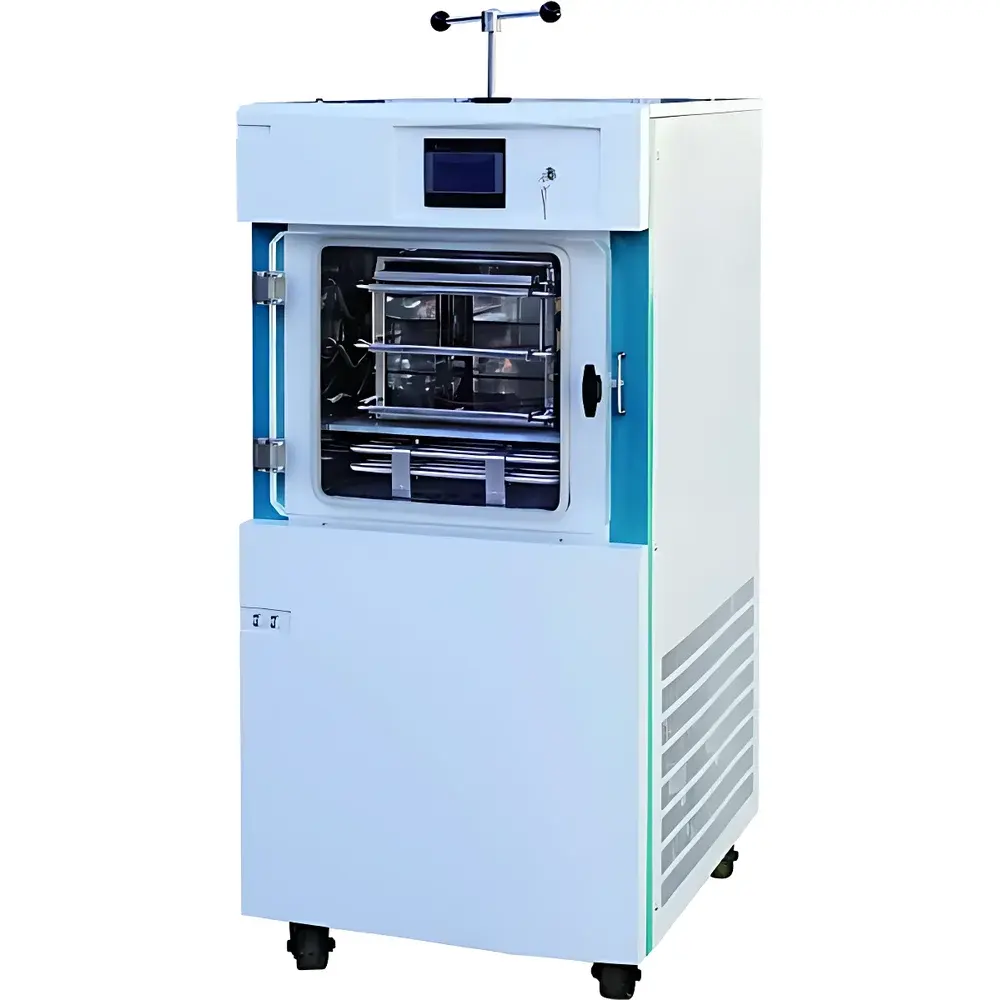
BIOCOOL Pilot2-4M Silicone Oil Medium-Scale Freeze Dryer
| Brand | BIOCOOL |
|---|---|
| Origin | Beijing, China |
| Model | Pilot2-4M (Silicone Oil) |
| Type | Standard Shelf-Type Freeze Dryer |
| Application | Pilot-Scale Lyophilization |
| Lyophilization Area | 0.2 m² |
| Ultimate Vacuum | <6 Pa |
| Condensate Capacity (24 h) | 4 L/24 h |
| Cold Trap Temperature | <−80 °C |
| Refrigeration Method | Silicone Oil Circulation |
| Control System | Industrial Touchscreen with Programmable Logic Controller (PLC) |
| Data Storage | Internal Memory (3-month retention), USB Export (optional), PC Database Integration (optional) |
| Compliance | Designed for GLP/GMP-aligned process development and scale-up |
Overview
The BIOCOOL Pilot2-4M is a medium-scale, silicone oil-heated shelf-type freeze dryer engineered for reproducible, scalable lyophilization under controlled laboratory and pilot plant conditions. It operates on the fundamental principles of sublimation-based drying: frozen aqueous or suspension-based samples are subjected to deep vacuum (<6 Pa) while heat is precisely delivered via temperature-regulated shelves, enabling ice removal without phase transition through liquid water. Its −80 °C cold trap ensures efficient vapor condensation, critical for maintaining low chamber pressure and preventing backstreaming during extended cycles. Designed explicitly for process transfer—from lab-scale formulation studies to clinical batch production—the Pilot2-4M bridges the gap between R&D feasibility and manufacturing readiness. Its architecture supports full-cycle automation, real-time parameter logging, and compliance-ready data integrity—making it suitable for environments requiring traceability per FDA 21 CFR Part 11, ISO 22000, and ICH Q5C stability guidelines.
Key Features
- Silicone oil circulation heating system: Enables uniform, stable shelf temperature control from −55 °C to +70 °C with ±0.5 °C accuracy across all five shelves; eliminates thermal gradients common in direct-cooled systems.
- Programmable freeze-drying protocol engine: Supports up to 500 user-defined or preloaded recipes, each with multi-step ramp/hold sequences for freezing, primary drying (sublimation), and secondary drying (desorption).
- Intelligent vacuum regulation: Dynamic pressure control during both primary and secondary drying phases mitigates sample collapse, bubbling, or vial breakage—especially critical for high-viscosity or low-eutectic formulations.
- Pulse-controlled inert gas backfill: Three adjustable modes (slow/medium/fast) ensure gentle repressurization to preserve fragile cake morphology and prevent powder dispersion during nitrogen or argon reintroduction.
- Non-electric cold trap defrost: Uses internal heat exchange and timed purge cycles—eliminating resistive heating elements, reducing fire risk, and shortening downtime versus immersion-based methods.
- Real-time monitoring at 50 ms sampling interval: Continuous acquisition of shelf temperature, product thermocouple readings (via optional Pt100 probes), chamber pressure, and condenser temperature with timestamped digital logs.
- Industrial-grade HMI touchscreen interface: Intuitive navigation without reference manuals; supports bilingual (English/Chinese) UI, role-based access control, and audit trail generation for operator actions.
- Comprehensive safety architecture: Includes overcurrent protection, 36 V SELV shelf heating circuits, vacuum interlocks, condenser overtemperature cutoff, and automatic drain valve vacuum-safety lockout (optional).
Sample Compatibility & Compliance
The Pilot2-4M accommodates bulk trays (up to 0.2 m²), stoppered vials (with manual or optional semi-automatic stoppering integration), and external flasks via multi-port manifold configuration. It is validated for aqueous solutions, colloidal suspensions, protein-rich biologics, and polymer-based hydrogels—provided their eutectic point exceeds −40 °C. Optional eutectic point measurement module enables in-situ determination of optimal freezing endpoints. All firmware and data handling modules comply with ALCOA+ principles (Attributable, Legible, Contemporaneous, Original, Accurate, Complete, Consistent, Enduring, Available). When configured with USB or PC database export, raw sensor data, event logs, and cycle reports meet GLP documentation standards and support regulatory submissions under USP , Ph. Eur. 2.9.40, and ISO 13485 quality management frameworks.
Software & Data Management
Embedded PLC-based control software provides full lifecycle data capture—including setpoints, actual values, alarms, and operator interventions—with encrypted internal storage retaining ≥90 days of compressed cycle history. Optional USB export generates CSV-formatted datasets compatible with MATLAB, JMP, or UNIFI for multivariate process analysis. The PC remote monitoring interface (up to 1.5 km via Ethernet or 4G modem) delivers live dashboards, email/SMS alerts on deviation events, and secure web-based access with TLS 1.2 encryption. Calibration logs for shelf sensors and Pirani/Penning gauges are digitally signed and version-controlled, supporting routine IQ/OQ/PQ validation protocols and annual requalification per GAMP 5 guidance.
Applications
This system serves as a platform for formulation optimization (e.g., cryoprotectant screening, annealing studies), stability-indicating method development, clinical trial material production (up to 2000 vials/batch), and technology transfer to commercial freeze dryers. It is routinely deployed in pharmaceutical QC labs validating lyo cycle robustness, academic research groups studying amorphous solid dispersions, and contract development organizations performing comparative drying kinetics under variable shelf-ramp profiles. Its modular design permits integration with environmental chambers, residual moisture analyzers (e.g., Karl Fischer coulometric titration), and PAT tools such as NIR spectroscopy for real-time endpoint detection.
FAQ
What distinguishes the Pilot2-4M from laboratory benchtop models?
It features silicone oil-based shelf temperature control, higher condensate capacity (4 L/24 h), deeper cold trap performance (<−80 °C), and full automation architecture—enabling consistent replication of cycles across batches and scalability to manufacturing equipment.
Is the system compliant with 21 CFR Part 11 requirements?
Yes—when equipped with optional PC database export, electronic signatures, and audit trail functionality, it meets electronic record and signature criteria for regulated pharmaceutical environments.
Can the Pilot2-4M handle organic solvent-containing formulations?
With the optional organic solvent trap accessory, it safely captures acetone, ethanol, or tert-butanol vapors—preventing contamination of the vacuum pump and extending service intervals.
How is calibration maintained over time?
Built-in calibration routines support field verification of shelf temperature sensors and vacuum transducers using NIST-traceable references; calibration certificates are generated and stored with metadata.
What support is included post-purchase?
Standard offering includes 18-month parts-and-labor warranty (excluding vacuum pump), one onsite installation and operation training session, one lyophilization process optimization workshop using customer-supplied samples, and lifetime technical consultation (fees apply for on-site service beyond warranty period).



