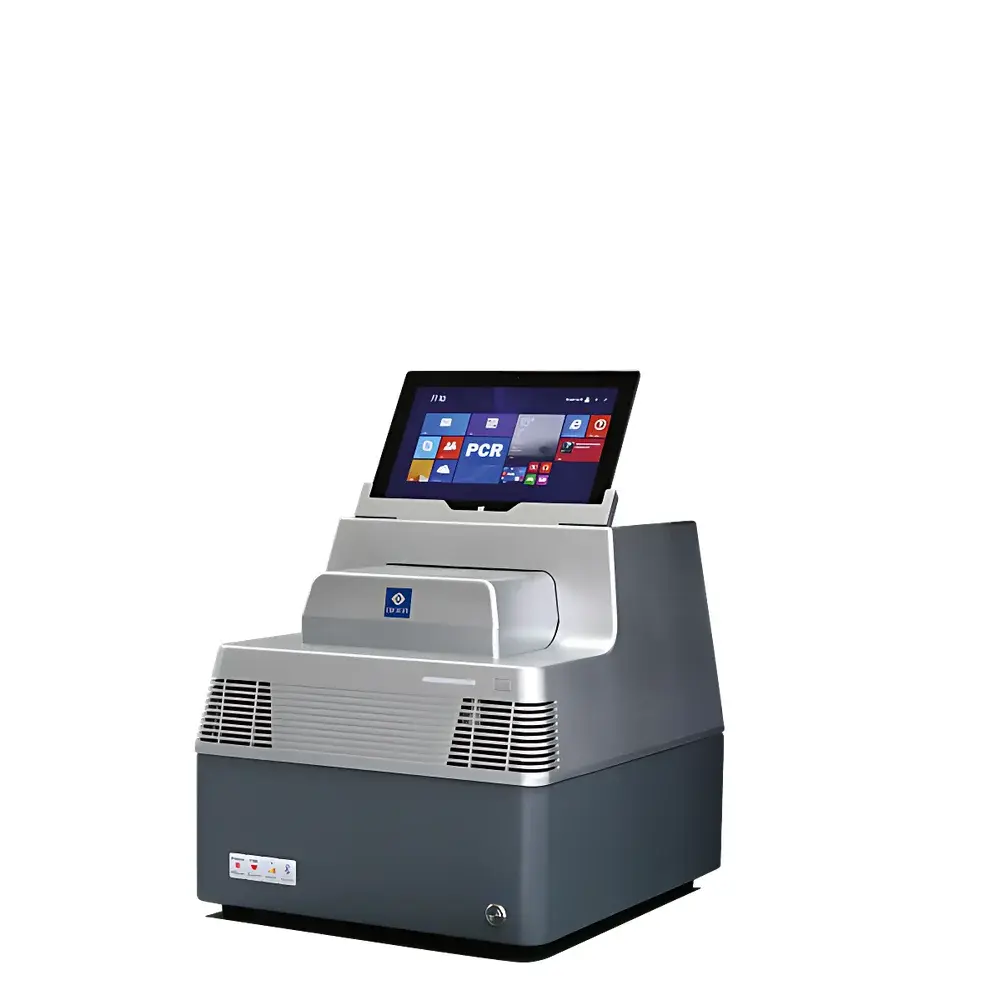
Bioer LineGene 9600 Plus Real-Time Fluorescence Quantitative PCR System
| Brand | Bioer |
|---|---|
| Origin | Zhejiang, China |
| Model | FQD-96A |
| Instrument Type | Real-Time Fluorescence Quantitative PCR System |
| Sample Throughput | 96-well |
| Max Heating Rate | 5.0°C/s |
| Temperature Accuracy | ≤ ±0.1°C |
| Well-to-Well Temperature Uniformity | ≤ ±0.3°C |
| Excitation Source | Long-Life LED |
| Detection Mode | Bottom-Reading Optical System (Patented) |
| Thermal Control | Multi-Point PID with Peltier-based Semiconductor Modules (Ferrotec Custom) |
| Power Input | AC 100–240 V, 50/60 Hz, 650 W |
| Dimensions (L×W×H) | 410 × 386 × 352 mm |
| Net Weight | 28 kg |
| Interfaces | RS232, USB, Bluetooth |
| OS Compatibility | Windows 7 / 8.1 / 10 |
Overview
The Bioer LineGene 9600 Plus Real-Time Fluorescence Quantitative PCR System is an engineered platform for high-fidelity nucleic acid quantification and genotyping in research, clinical diagnostics, and quality control laboratories. It operates on the principle of real-time monitoring of fluorescent signal accumulation during exponential amplification—enabling precise determination of initial template copy number via threshold cycle (Ct) analysis. The system integrates a custom Ferrotec thermoelectric module architecture with multi-point temperature sensing and closed-loop PID control to deliver rapid thermal transitions (up to 5.0°C/s), exceptional thermal accuracy (≤ ±0.1°C), and superior inter-well uniformity (≤ ±0.3°C across all 96 positions). Its patented bottom-reading optical configuration minimizes cross-well optical crosstalk and eliminates edge-effect artifacts commonly observed in top-illuminated systems—critical for reproducible melt curve analysis and high-resolution HRM (High-Resolution Melting) applications. Designed for regulatory-compliant environments, the instrument supports audit-ready data integrity through time-stamped run logs, user-access controls, and exportable raw fluorescence traces compatible with third-party analysis tools.
Key Features
- Custom Ferrotec Peltier modules with extended service life (3× longer operational lifetime vs. standard units)
- Patented heat-sink module design ensuring stable thermal performance under continuous cycling
- Bottom-illumination detection geometry—reduces well-to-well fluorescence interference and improves signal-to-noise ratio
- Automated pressure-regulated thermal lid—self-adjusts contact force for 0.2 mL tubes, 96-well plates, and 8-tube strips regardless of height variation
- TAS (Temperature Adjustment System) compensation algorithm mitigates peripheral well drift during prolonged ramping phases
- Dual-channel LED excitation (470 nm & 530 nm) paired with high-quantum-efficiency photodiodes for SYBR Green I, FAM, HEX, VIC, ROX, and Cy5 detection
- Full-touch 10.1-inch capacitive display with Windows-compatible UI; supports offline operation and local method storage
- Onboard analysis suite including absolute quantification, relative quantification (ΔΔCt), SNP genotyping, HRM-based allele discrimination, and auto-gain optimization
Sample Compatibility & Compliance
The LineGene 9600 Plus accepts standard 0.2 mL reaction formats: full-skirted or semi-skirted 96-well PCR plates, individual 0.2 mL tubes (flat or domed caps), and 8-tube strips (flat or domed). Its optical path and thermal profile are validated per ISO 13485 and aligned with key performance benchmarks referenced in CLSI EP17-A2 and ASTM E2587–21. While not FDA-cleared as an IVD device, the system meets essential requirements for GLP/GMP-aligned workflows—including secure user authentication, electronic signature support, and full traceability of instrument parameters, calibration history, and run metadata. Data files adhere to MIQE-compliant structure and can be exported in CSV, Excel, or RDML format for integration into LIMS or ELN platforms.
Software & Data Management
The embedded Windows-based software provides intuitive workflow navigation—from protocol setup and real-time monitoring to post-run analysis and report generation. All experimental parameters—including ramp rates, hold times, fluorescence acquisition points, and passive reference normalization—are fully configurable and saved with version-controlled method templates. Audit trails record operator ID, timestamp, parameter modifications, and result exports. Raw fluorescence data (.lgd) is stored with embedded instrument calibration coefficients and thermal history. Export options include PDF reports with Ct values, amplification plots, melt curves, and statistical summaries compliant with ISO/IEC 17025 documentation standards. Remote monitoring via Bluetooth enables status checks from mobile devices without compromising network security.
Applications
- Viral load monitoring (HBV, HCV, HIV-1, CMV, EBV, SARS-CoV-2) using probe-based hydrolysis assays
- Bacterial pathogen detection in food safety and environmental testing (Salmonella spp., Enterobacter sakazakii, Mycobacterium tuberculosis)
- Gene expression profiling via two-step RT-qPCR with SYBR Green or probe chemistries
- SNP genotyping and methylation-specific PCR (MSP) using melting curve differentiation
- HRM-based mutation scanning in oncology and inherited disease panels
- mRNA quantification of telomerase subunits (hTERT, hTR) in cancer biomarker studies
- Microbial load assessment in dairy and beverage matrices using total bacterial DNA assays
FAQ
Does the LineGene 9600 Plus comply with 21 CFR Part 11 requirements?
It supports core elements—including electronic signatures, audit trails, and role-based access—but final validation must be performed by the end-user laboratory per their internal SOPs and regulatory jurisdiction.
Can the system perform multiplex qPCR with more than two dyes?
Yes—its dual-excitation/dual-detection architecture supports up to four fluorescent channels when configured with appropriate filters and calibrated dyes (e.g., FAM/VIC/ROX/Cy5).
Is remote software update supported over LAN or cloud?
Firmware updates require local USB installation; no internet-connected update mechanism is implemented to maintain air-gapped security in regulated labs.
What is the recommended maintenance interval for optical calibration?
Annual verification using Bioer’s certified calibration kit (Cat. No. CAL-9600P) is advised; LED source stability eliminates routine lamp replacement.
How does the bottom-read design improve HRM resolution?
By eliminating meniscus-related refraction artifacts and ensuring consistent focal depth across all wells, it yields higher reproducibility in Tm shift detection (<0.1°C SD between replicates).