
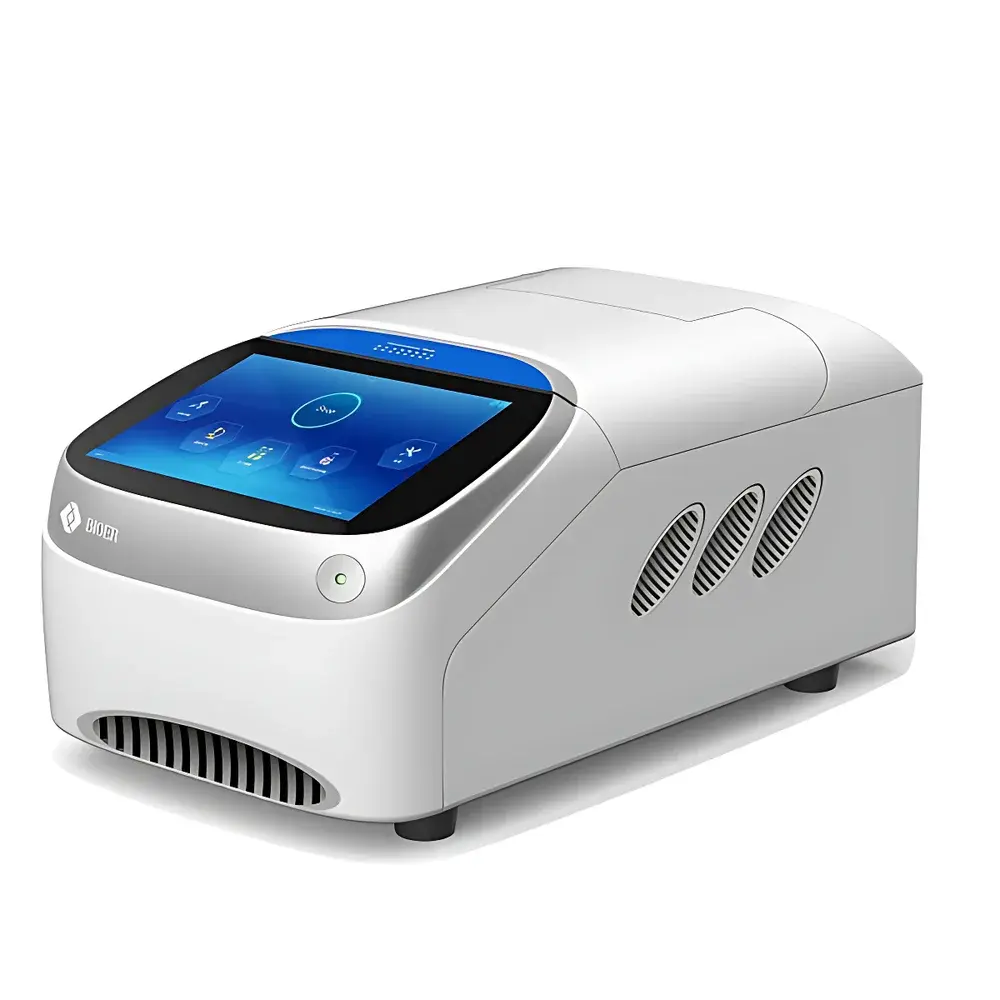
Bioer LineGene Mini S Real-Time Fluorescent Quantitative PCR System
| Brand | Bioer |
|---|---|
| Origin | Zhejiang, China |
| Manufacturer Type | Authorized Distributor |
| Instrument Type | Real-Time Fluorescent Quantitative PCR System |
| Model | LineGene Mini S |
| Sample Capacity | 16 × 0.2 mL tubes or 2 × 8-tube strips (0.2 mL) |
| Power Input | 100–240 V, 50/60 Hz |
| Communication Interfaces | Ethernet port (for PC connectivity), Bluetooth 4.2 |
| Dimensions (L×W×H) | 240 mm × 180 mm × 160 mm |
| Net Weight | 4.0 kg |
| Regulatory Compliance | CE-IVD compliant per EN ISO 13485:2016 |
Overview
The Bioer LineGene Mini S Real-Time Fluorescent Quantitative PCR System is a compact, field-deployable thermal cycler engineered for nucleic acid amplification and quantification using SYBR Green I, hydrolysis probes (TaqMan), molecular beacons, and other fluorescent chemistries. It operates on the principle of real-time detection of fluorescence accumulation during exponential-phase PCR amplification—enabling absolute and relative quantification of target DNA or cDNA with high specificity and reproducibility. Designed for mission-critical environments—including veterinary clinics, agricultural surveillance units, environmental water testing stations, mobile diagnostic labs, and emergency response settings—the LineGene Mini S integrates precision thermocycling control (ramp rate up to 5.0 °C/s), uniform block temperature uniformity (±0.3 °C across all 16 wells), and optical detection optimized for low-volume reactions. Its lightweight chassis (4.0 kg) and dual communication architecture (Ethernet + Bluetooth) support both standalone operation and networked data synchronization in regulated workflows.
Key Features
- 16-well reaction capacity accommodating either individual 0.2 mL tubes or two 8-tube strips—ideal for targeted assays, rapid screening, and low-throughput validation studies.
- High-fidelity optical module featuring LED excitation sources and photodiode-based emission detection, delivering stable signal-to-noise ratio (>100:1) across multiple fluorescence channels (FAM, HEX/VIC, ROX, Cy5).
- Intelligent auto-gain calibration algorithm that dynamically adjusts detector sensitivity per run—minimizing inter-run variability and eliminating manual threshold optimization.
- Capacitive touch screen interface with intuitive icon-driven navigation, supporting multi-language UI (English, Spanish, French, Arabic) and offline protocol storage for up to 100 user-defined programs.
- Robust aluminum alloy housing with IP20-rated enclosure, shock-absorbing feet, and internal thermal insulation—certified for continuous operation at ambient temperatures from 10 °C to 35 °C and relative humidity ≤80% non-condensing.
- Integrated thermal gradient function (spanning ±5 °C across the block) for fast assay optimization without hardware modification.
Sample Compatibility & Compliance
The LineGene Mini S accepts standard 0.2 mL thin-wall PCR tubes and 8-tube strips compatible with major reagent suppliers (e.g., Thermo Fisher, Qiagen, Takara). It meets essential performance criteria outlined in ISO 20387:2018 (Biobanking) and ASTM E2923-22 (Standard Guide for Real-Time PCR Instrument Performance Verification). When configured with Bioer’s certified qPCR analysis software (v3.2+), the system supports audit trail logging, electronic signatures, and user access levels aligned with FDA 21 CFR Part 11 requirements for regulated laboratories. CE-IVD marking confirms conformity with EU In Vitro Diagnostic Regulation (IVDR) Annex I general safety and performance requirements for qualitative and quantitative nucleic acid detection.
Software & Data Management
The instrument ships with Bioer Q-Analyzer software (Windows-compatible), providing full-cycle workflow management—from experimental design and thermal profile setup to melt curve analysis, standard curve generation, and ΔΔCt-based gene expression reporting. Raw fluorescence data (.rfu files) and processed results (.xlsx, .pdf) are exportable with embedded metadata (operator ID, timestamp, instrument serial number, calibration history). Cloud sync via secure HTTPS is supported through optional Bioer Connect Gateway, enabling remote monitoring, centralized database archiving, and cross-site result comparison under ISO/IEC 27001-compliant infrastructure.
Applications
- Rapid pathogen detection in livestock feed, aquaculture water, and wild animal samples (e.g., ASFV, PEDV, AIV subtyping).
- Point-of-need clinical triage for respiratory viruses (SARS-CoV-2, RSV, influenza A/B) in decentralized healthcare settings.
- Transgenic organism verification and GMO quantification in food safety compliance testing.
- Low-input gene expression profiling in plant stress response studies using leaf tissue lysates.
- Validation of CRISPR editing efficiency via T7E1 or NGS library QC prior to sequencing.
FAQ
Is the LineGene Mini S suitable for use in GMP-regulated environments?
Yes—when deployed with validated software configuration, password-protected user roles, and enabled audit trail functionality, it fulfills core documentation and traceability requirements of Annex 11 and USP .
Can the system perform melt curve analysis?
Yes—it supports post-amplification high-resolution melting (HRM) with 0.1 °C incremental ramping and real-time fluorescence capture at 20 points/°C.
What maintenance is required for long-term optical stability?
No routine lamp replacement is needed; the solid-state LED excitation source has a rated lifetime exceeding 50,000 hours. Annual optical calibration using Bioer-certified reference dyes is recommended.
Does the instrument support external barcode scanning for sample tracking?
Yes—via USB-connected barcode readers; scanned IDs are automatically appended to run logs and exported reports.
Related Products




