
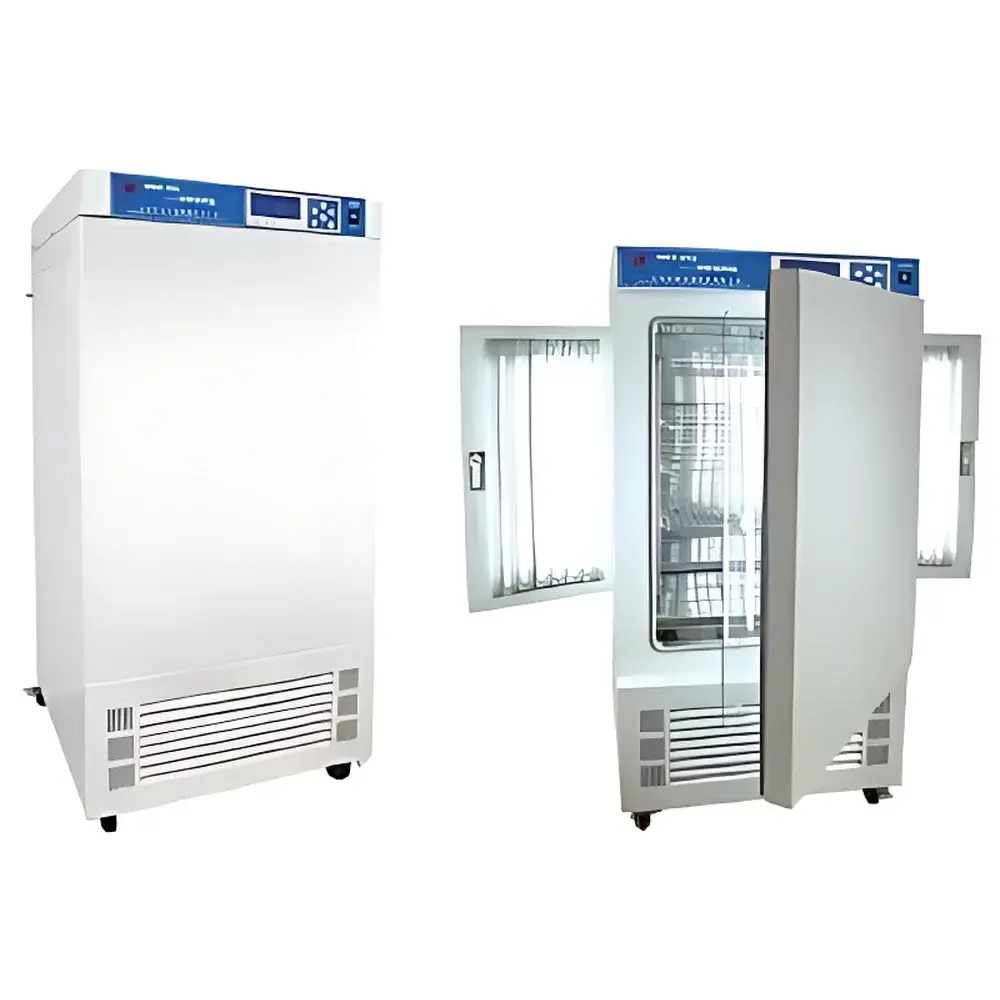
BIOGENE HGZ-300 Plant Growth Chamber with LED Illumination, Fluorine-Free Refrigeration & Large-Touch LCD Interface
| Origin | Shanghai, China |
|---|---|
| Manufacturer Type | Authorized Distributor |
| Regional Classification | Domestic (China) |
| Model | HGZ-300 |
| Power Supply | AC 220 V, 50 Hz |
| Temperature Range | 4–50 °C (dark), 10–50 °C (light-on) |
| Temperature Uniformity | ±1 °C |
| Temperature Resolution | 0.1 °C |
| Illuminance Range | 0–20,000 lux (6-step adjustable) |
| Chamber Volume | 300 L |
| Internal Dimensions (W×D×H) | 580 × 550 × 950 mm |
| External Dimensions (W×D×H) | 780 × 780 × 1660 mm |
| Input Power | 2200 W |
| Operating Ambient | 5–30 °C |
| Continuous Operation Capability | ≥360 h |
| Safety Protection | Over-temperature cutoff with audible/visual alarm |
| Standard Shelves | 3 adjustable stainless-steel shelves |
| Refrigerant | R134a / R406A (CFC-free, ozone-friendly) |
Overview
The BIOGENE HGZ-300 Plant Growth Chamber is an engineered environmental simulation system designed for reproducible, long-term cultivation of photobiological specimens under tightly controlled temperature and illumination conditions. Based on dual-mode thermoregulation—active vapor-compression cooling coupled with PID-driven heating—and uniform multi-directional LED-based irradiance delivery, the chamber supports rigorous experimental protocols in plant physiology, seed germination studies, tissue culture, entomological rearing, and small-mammal acclimation research. Its fluorine-free refrigerant formulation (R134a/R406A blend) complies with Montreal Protocol guidelines and EU F-Gas Regulation (EU No. 517/2014), ensuring sustainable operation without compromising thermal stability or energy efficiency. The unit operates across a wide ambient range (5–30 °C) and maintains ±1 °C temperature uniformity throughout its 300 L working volume—validated under ISO 17025-aligned calibration conditions (empty chamber, no external vibration or magnetic interference, 20 °C/50% RH reference environment).
Key Features
- Large-format capacitive-touch LCD interface displaying real-time temperature, illuminance level, elapsed time, and program status—all simultaneously visible in a single view.
- Dual-compressor redundancy architecture: Two independent refrigeration circuits automatically alternate duty cycles to extend service life and ensure uninterrupted operation over extended durations (>360 h continuous runtime).
- Mirror-finish 304 stainless-steel interior with radius-cornered construction minimizes microbial retention and simplifies decontamination—fully compatible with ethanol, hydrogen peroxide vapor (HPV), and autoclave-safe cleaning agents.
- Triple-face illumination system using T4-specification cold-white LED arrays delivering uniform photosynthetic photon flux density (PPFD) distribution; no shadow zones or intensity gradients across the growth plane.
- Advanced air management: JAKEL-type axial circulation fan integrated with laminar-flow duct geometry ensures <±0.5 °C spatial deviation across all shelf levels (per ASTM E1753-22 test methodology).
- Double-glazed insulated door with low-emissivity coating preserves internal thermal integrity during observation—door opening induces <0.8 °C transient deviation (measured at center point, per IEC 61000-4-2).
- Programmable multi-cycle control: Up to 99 user-defined programs, each containing 30 segments with individual setpoints for temperature, light intensity, and duration (max. 99 h 59 min per segment).
Sample Compatibility & Compliance
The HGZ-300 accommodates standard Petri dishes (up to 150 mm), Magenta boxes, growth pouches, multi-well plates, and small caging systems (e.g., mouse breeding modules ≤20 cm height). Its interior geometry permits full compatibility with ISO 8573-1 Class 4 compressed-air–assisted humidification add-ons (optional). Regulatory alignment includes conformity with IEC 61010-1 (safety requirements for laboratory equipment), GB/T 2423.2–2008 (high-temperature testing), and GB/T 2423.3–2016 (damp heat cycling). For GLP-compliant laboratories, optional audit-trail firmware enables timestamped event logging per FDA 21 CFR Part 11 Annex 11 principles when paired with validated USB data export.
Software & Data Management
The embedded microcontroller supports RS485 Modbus RTU and USB 2.0 host interfaces (both standard). Optional PC software (BioChamber Control Suite v3.2) provides real-time graphing, CSV export, alarm history review, and remote parameter adjustment via Ethernet/Wi-Fi bridge (accessory required). All recorded datasets include ISO 8601 timestamps, sensor ID tags, and CRC-16 checksum validation. Data encryption (AES-128) and role-based access control (RBAC) are available in enterprise license tiers for GxP environments.
Applications
- Photoperiod-dependent phenotyping of Arabidopsis thaliana and Oryza sativa under diurnal temperature/light cycling.
- In vitro propagation of orchid meristems requiring precise 22 °C/16 h light : 18 °C/8 h dark regimes.
- Standardized insect rearing (Drosophila melanogaster, Tribolium castaneum) per OECD Guideline 211.
- Pre-germination stress assays (osmotic, thermal, light-quality variation) compliant with ISTA Rules Section 5.3.
- Controlled-environment validation of biodegradable packaging degradation kinetics (ASTM D5338-21).
FAQ
Does the HGZ-300 support custom spectral output (e.g., red/blue ratio tuning)?
No—this model delivers fixed-spectrum white light (5000 K CCT) optimized for broad-spectrum photosynthesis. Spectral tunability requires the optional HGZ-Spectra module (sold separately).
Can the unit operate continuously at 4 °C in complete darkness?
Yes—minimum dark-setpoint operation is validated at 4 °C with sustained stability over 72 h, provided ambient conditions remain within 5–30 °C and relative humidity does not exceed 75% RH.
Is the refrigerant charge serviceable in-field by certified technicians?
Yes—R134a/R406A blend is accessible via standard SAE J2099 service ports; refrigerant recovery and recharge procedures follow ASHRAE Standard 15-2022 guidelines.
What is the mean time between failures (MTBF) for the dual-compressor system?
Based on accelerated life testing (IEC 60601-1 Annex H), MTBF exceeds 12,500 hours at 25 °C ambient, assuming scheduled maintenance every 18 months.
Are third-party calibration certificates available?
Yes—NIST-traceable temperature and illuminance calibration reports (ISO/IEC 17025 accredited) can be ordered at time of purchase or as retrofitted service.





