
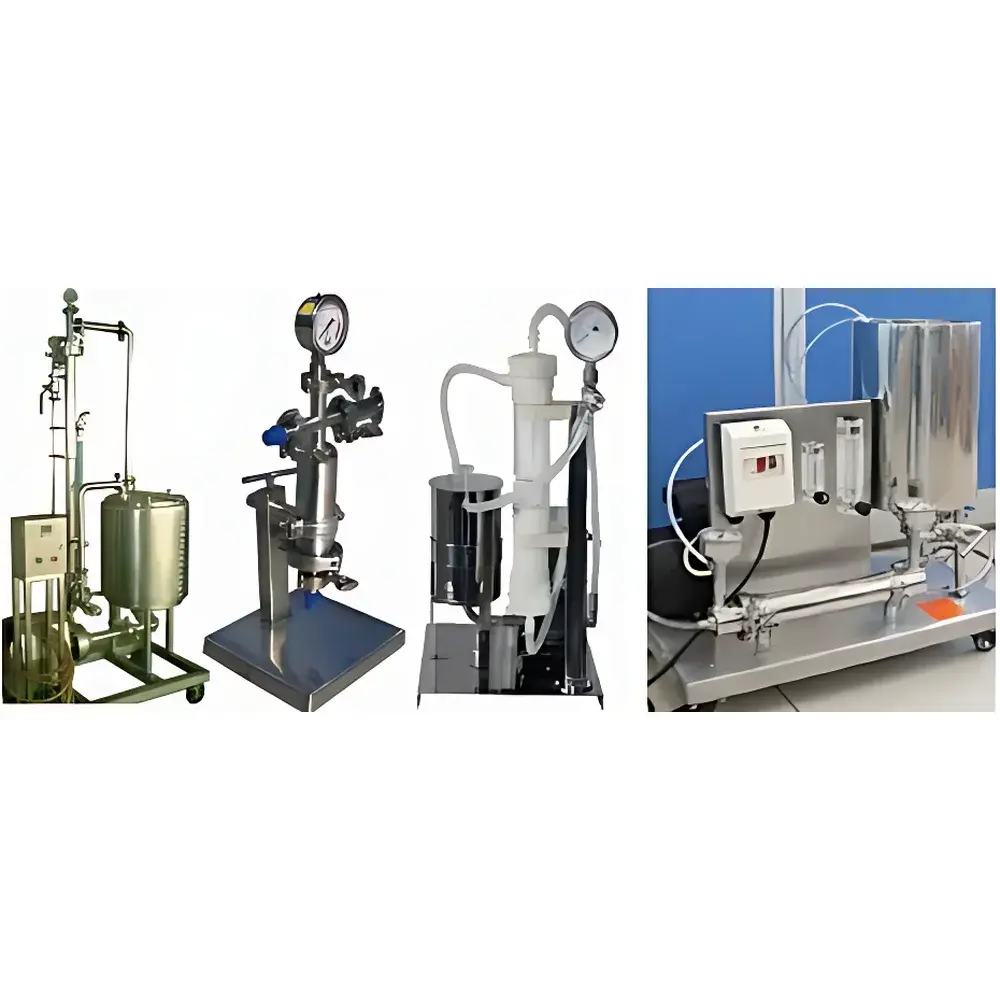
New Biolink Membrane Pilot Testing System
| Brand | New Biolink |
|---|---|
| Origin | Beijing, China |
| Manufacturer Type | Authorized Distributor |
| Product Origin | Domestic (China) |
| Model | Membrane Pilot Testing System |
| Pricing | Upon Request |
| Sample Processing | Wastewater Treatment |
| Membrane Types Supported | Ceramic & Organic (Polymeric) Membranes |
| Configurable MWCO Range | 1 kDa – 500 kDa |
| Operating Pressure Range | Up to 10 bar |
| Feed Capacity | 5–100 L per batch |
| System Architecture | Skid-mounted, Modular, Benchtop-to-Pilot Scale |
Overview
The New Biolink Membrane Pilot Testing System is an engineered benchtop-to-pilot-scale platform designed for systematic evaluation of membrane separation performance under controlled process conditions. Based on cross-flow filtration principles—utilizing tangential flow to minimize concentration polarization and fouling—the system enables quantitative assessment of flux, rejection efficiency, fouling kinetics, and long-term operational stability across ceramic and organic (polymeric) membrane modules. It serves as a critical bridge between laboratory-scale discovery and industrial-scale implementation, supporting technology transfer for applications in bioprocessing, environmental engineering, natural product isolation, and pharmaceutical purification. The system’s modular architecture allows configuration with flat-sheet, tubular, or hollow-fiber membrane elements, accommodating diverse hydrodynamic and chemical compatibility requirements.
Key Features
- Modular design supports rapid interchange of membrane cassettes (ceramic, PVDF, PES, PP, PAN) with standardized hydraulic interfaces
- Integrated variable-speed feed pump (0.1–5 L/min range) and backpulse capability for fouling mitigation
- Real-time monitoring of transmembrane pressure (TMP), feed/retentate/permeate flow rates, and temperature via calibrated digital sensors
- Stainless-steel 316L wetted parts and sanitary tri-clamp connections compliant with ASME BPE-2023 standards
- Pressure-rated up to 10 bar (145 psi) for nanofiltration and tight ultrafiltration applications
- Optional integrated conductivity, pH, and turbidity probes for inline quality tracking
- CE-marked electrical cabinet with IP54 protection; compatible with Class I, Division 2 hazardous area environments when specified
Sample Compatibility & Compliance
The system accommodates complex feed streams including fermentation broths, plant extracts, municipal and industrial wastewater, protein solutions, colloidal suspensions, and saline effluents. It supports validation protocols aligned with ISO 27427 (membrane performance testing), ASTM D4189 (membrane fouling index), and USP (verification of analytical procedures). For regulated environments, the control interface can be configured to meet FDA 21 CFR Part 11 requirements—including electronic signatures, audit trails, and user access levels—when paired with validated SCADA software. All wetted materials comply with USP Class VI and EU 10/2011 food-contact regulations.
Software & Data Management
Data acquisition is managed through a Windows-based HMI running New Biolink’s MemTest Suite v3.2, which logs timestamped process variables at 1 Hz resolution. The software supports customizable test protocols (e.g., constant-flux vs. constant-pressure modes), automated cleaning-in-place (CIP) sequences, and comparative analysis across multiple membrane lots or operating conditions. Export formats include CSV, Excel, and PDF reports compliant with GLP documentation standards. Raw data files are stored with SHA-256 hash integrity verification; optional cloud backup via secure TLS 1.3 encrypted channels is available for multi-site R&D collaboration.
Applications
- Process development for bioseparation: clarification of monoclonal antibody harvests, virus removal, and plasmid DNA concentration
- Wastewater reclamation: nutrient recovery (N/P), micropollutant retention (pharmaceuticals, endocrine disruptors), and zero-liquid discharge (ZLD) feasibility studies
- Natural product processing: anthocyanin enrichment from berry pressings, polysaccharide fractionation from algal biomass, and alkaloid purification from herbal extracts
- Food & beverage: cold sterilization of juices, lactose reduction in dairy permeates, and whey protein fractionation
- Chemical manufacturing: catalyst recovery from homogeneous reaction mixtures and solvent-resistant nanofiltration (SRNF) screening
FAQ
What membrane types and molecular weight cut-offs (MWCO) are supported?
The system accepts commercially available flat-sheet, tubular, and hollow-fiber modules with MWCO ranging from 1 kDa (tight ultrafiltration) to 500 kDa (microfiltration), including ceramic (Al₂O₃, ZrO₂), polyethersulfone (PES), polyvinylidene fluoride (PVDF), and regenerated cellulose (RC) membranes.
Can the system be validated for GMP-compliant process development?
Yes—when equipped with IQ/OQ documentation packages, calibrated sensor certificates (NIST-traceable), and Part 11–enabled software, the system meets baseline requirements for early-phase process validation under ICH Q5A and Q5D guidelines.
Is remote operation and monitoring supported?
Standard Ethernet connectivity enables local network integration; optional VPN-enabled remote desktop access and Modbus TCP gateway support allow off-site supervision without compromising cybersecurity protocols.
What maintenance intervals are recommended for pump seals and pressure sensors?
Feed pump diaphragms require replacement every 1,500 operating hours; pressure transducers are factory-calibrated annually and field-verifiable using dead-weight testers per ISO/IEC 17025.
Related Products



