
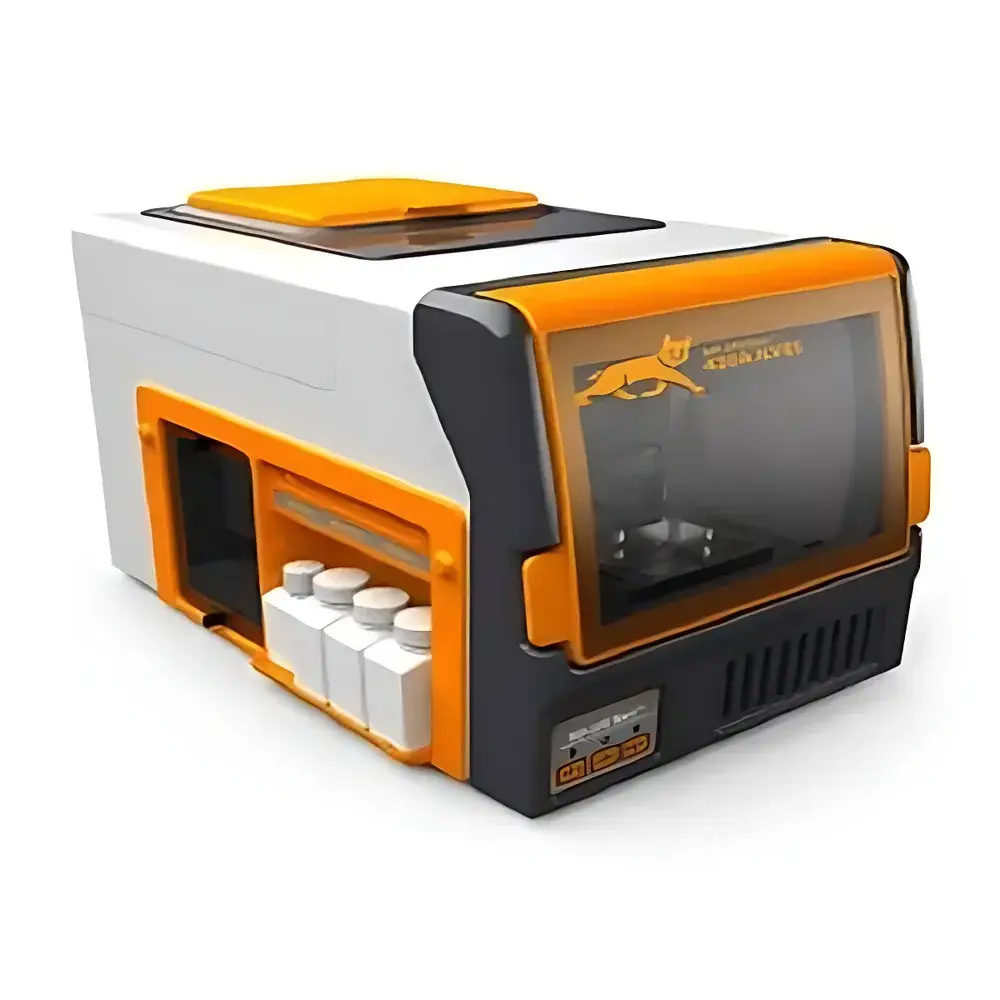
Bionavis MP-SPR Navi 420A ILVES Multi-Parameter Surface Plasmon Resonance Analyzer
| Brand | Bionavis |
|---|---|
| Origin | Finland |
| Model | MP-SPR Navi 420A ILVES |
| Sample Volume | 250 µL |
| Injection Volume | 50 µL |
| Analysis Time | 5–10 min |
| Temperature Control Range | 15–45 °C (ambient ±7 °C / +20 °C) |
Overview
The Bionavis MP-SPR Navi 420A ILVES is a high-performance, label-free, real-time multi-parameter surface plasmon resonance (MP-SPR) analyzer engineered for quantitative molecular interaction analysis under physiologically relevant conditions. Unlike conventional single-angle SPR systems, MP-SPR operates on true angular interrogation—measuring the full SPR dip across a broad angular range (40°–78°) with <0.001° angular resolution—enabling simultaneous extraction of multiple optical parameters (e.g., resonance angle, full width at half maximum, reflectivity minimum) from a single scan. This multi-parameter capability provides intrinsic compensation for bulk refractive index (RI) shifts and matrix effects, eliminating the need for reference channels or double-referencing routines. The system employs a rotating laser and detector architecture at a fixed wavelength of 670 nm, supporting measurements in both aqueous and organic media (e.g., ethanol, acetonitrile), as well as gas-phase environments. Its ability to resolve interactions in undiluted biological matrices—including 100% human serum, urine, and saliva—makes it uniquely suited for translational life science research and regulatory-compliant biotherapeutic characterization.
Key Features
- Four independent flow channels configurable in parallel or serial mode, enabling multiplexed kinetics, buffer screening, or internal referencing without hardware reconfiguration.
- PureKinetics™ technology: Real-time correction of bulk RI contributions during injection, enabling accurate kinetic analysis even with large RI mismatches (e.g., 0% DMSO running buffer vs. 5% DMSO sample), thereby extending sensor functionalization lifetime and reducing assay cost per run.
- PureSample™ function: On-the-fly removal of diluted sample fractions prior to detection, minimizing dead-volume artifacts and ensuring that only undiluted analyte interacts with the sensing surface.
- Automated 96-well plate liquid handling with integrated degassing, precision syringe pumps (flow range: 1–1000 µL/min), and dual-loop injection for rapid Kinetic Titration experiments.
- Modular fluidic architecture: PDMS-based standard flow cell (1 µL/channel, 4-channel); optional electrochemical flow cell (SPR321-EC); quick-release mechanism enables tool-free flow cell exchange in <30 seconds.
- Universal prism coupling: Index-matching gel eliminates need for immersion oil, prevents sample contamination, and allows post-assay ex situ analysis (e.g., SEM, XPS) of the same sensor chip.
- Extended RI measurement range: 1.00–1.40 (bulk liquid), with demonstrated capability to characterize high-RI layers such as diamond-like carbon (n ≈ 2.7) and inorganic crystals.
Sample Compatibility & Compliance
The MP-SPR Navi 420A ILVES supports direct analysis of complex, unprocessed biological samples without pre-purification or labeling. It has been validated for kinetic characterization of antibody–antigen, protein–small molecule, lipid–peptide, and nanoparticle–cell interactions in native matrices including whole serum, plasma, and mucosal fluids. Sensor surfaces are available in Au, Ag, Cu, Pt, SiO₂, Al₂O₃, TiO₂, and functionalized chemistries (CMD, Ni²⁺, Protein A, streptavidin, thiol, biotin). All hardware and software components comply with ISO 13485 design control principles. Data acquisition and processing support audit trails, electronic signatures, and 21 CFR Part 11–compliant configurations when deployed with TraceDrawer™ and MP-SPR Navi™ in GLP/GMP environments. Instrument calibration is traceable to NIST-certified RI standards; no routine service contract is required for operation.
Software & Data Management
The system ships with three integrated software modules: MP-SPR Navi™ Control (instrument operation, method programming, real-time monitoring), MP-SPR DataViewer™ (multi-dimensional data visualization, baseline correction, event annotation), and TraceDrawer™ (global fitting of association/dissociation phases using heterogeneous ligand models, mass transport correction, and statistical uncertainty estimation). Optional LayerSolver™ enables quantitative modeling of thin-film thickness, density, and anisotropy from full SPR curves. All software runs natively on Windows 7/8.1/10 (64-bit), requires ≥4 GB RAM and ≥10 GB HDD space, and exports data in ASCII, CSV, and HDF5 formats for third-party integration (e.g., Python, MATLAB, Spotfire). Raw angular scans and processed sensorgrams are stored with full metadata (temperature, flow rate, RI, timestamp, user ID) to ensure full experimental reproducibility and regulatory submission readiness.
Applications
- Therapeutic antibody characterization: Affinity (KD = 10−12–10−3 M), kinetics (ka = 103–108 M−1s−1; kd = 10−7–0.1 s−1), epitope binning, and FcγR binding in undiluted serum.
- Small-molecule drug discovery: Detection of low-MW analytes (<100 Da) in organic-aqueous mixtures; quantification of membrane permeability and cellular uptake kinetics using live-cell SPR configurations.
- Biosensor development: Real-time monitoring of probe immobilization, blocking efficiency, and regeneration cycles on polymer, glass, or nanomaterial substrates.
- Biomaterial interface science: In situ measurement of protein adsorption, polymer hydration, and cell adhesion dynamics on coatings up to 5 µm thick.
- Nanoparticle targeting validation: Quantitative assessment of ligand–receptor binding avidity and off-rate heterogeneity in physiological buffers.
FAQ
What is the minimum analyte molecular weight detectable by the MP-SPR Navi 420A ILVES?
In liquid phase, the system reliably detects molecules with molecular weights below 100 Da; in gas phase, hydrogen (2 Da) has been resolved.
Can the instrument operate in organic solvents?
Yes—measurements are supported in ethanol, acetonitrile, and other polar organic solvents; compatibility with additional solvents can be confirmed upon request.
Is temperature control precise enough for thermodynamic studies?
The Peltier-driven thermal module maintains setpoints within ±0.1 °C over the 15–45 °C range, enabling van’t Hoff analysis across multiple temperatures.
How is sensor regeneration handled?
Regeneration protocols are programmable via MP-SPR Navi™; common strategies include low-pH glycine, high-salt NaCl, or chaotropic agents—optimized empirically per ligand–analyte pair.
Does the system support electrochemical SPR (EC-SPR)?
Yes—the optional SPR321-EC electrochemical flow cell integrates potentiostat control with SPR detection for simultaneous redox-state and binding-event monitoring.



