
Bioptechs Delta T Live-Cell Culture System
| Brand | Bioptechs |
|---|---|
| Origin | USA |
| Model | Delta T |
| Microscope Type | Upright Microscope |
| Sample Chamber | 35 mm Standard Petri Dish with Bonded 170 µm Glass Coverslip |
| Temperature Control Method | ITO (Indium Tin Oxide) Transparent Heated Layer on Coverslip Bottom |
| Temperature Feedback | External Thermistor |
| Thermal Response Rate | ~0.1 °C/s |
| Compatible Imaging Modes | Brightfield, Darkfield, Polarized Light, Phase Contrast, DIC, HMC, Fluorescence, Multiphoton, Confocal |
| Coverslip Options | Stress-Free Glass, Variable Thickness (Including High-NA Optimized) |
| Adapter Support | Brain Slices, Monolayer Cultures, Tissue Explants, Small-Area Cell Preparations |
| Compliance Context | Designed for GLP/GMP-aligned live-cell imaging workflows requiring thermal stability and environmental reproducibility |
Overview
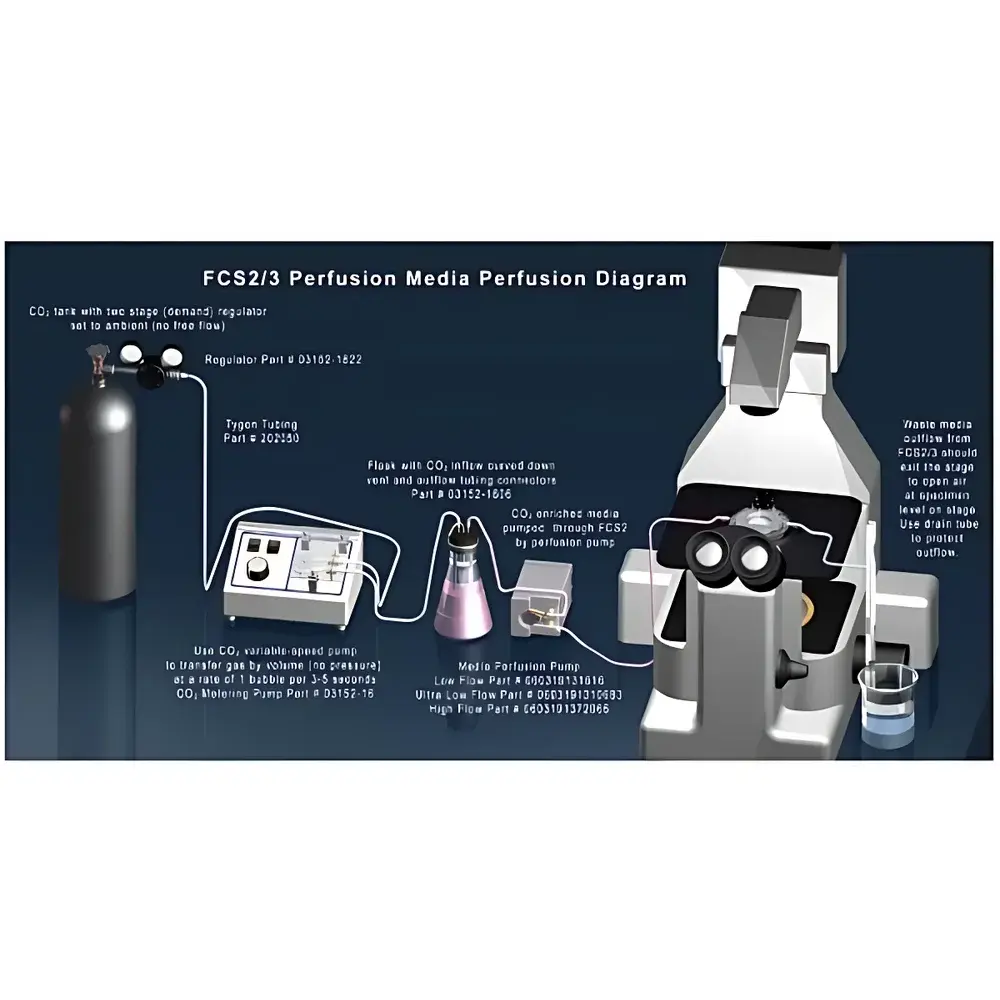
The Bioptechs Delta T Live-Cell Culture System is an engineered thermal and perfusion control platform designed specifically for upright and inverted microscope-based time-lapse imaging of living biological specimens. It operates on the principle of first-surface heat transfer via a transparent, electrically resistive indium tin oxide (ITO) layer deposited directly onto the underside of a precision-thickness (170 µm) optical-grade glass coverslip, which is permanently bonded to a standard 35 mm Petri dish base. This architecture eliminates thermal gradients across the specimen plane by enabling direct conductive heating from the imaging interface—minimizing convective drift, thermal lensing, and focal plane instability during extended acquisition. Unlike conventional stage-top incubators or heated objective collars, the Delta T system delivers spatially uniform temperature regulation (< ±0.2 °C stability over 60 min) with dynamic compensation for entropy-driven cooling (e.g., due to media perfusion or evaporation), achieving thermal response rates of approximately 0.1 °C per second. Its design conforms to foundational requirements for quantitative live-cell microscopy: mechanical stability, optical flatness, and minimal perturbation of physiological microenvironments.
Key Features
- First-surface ITO-based heating integrated into the imaging coverslip—ensuring direct thermal coupling between heater and specimen without air gaps or intermediate materials.
- High-precision thermistor feedback loop located adjacent to the coverslip’s basal surface, enabling closed-loop temperature regulation with sub-degree accuracy and rapid transient compensation.
- Stress-free, optically optimized glass substrates available in multiple thicknesses—including variants engineered for high-numerical-aperture (NA ≥ 1.4) oil-immersion and water-dipping objectives.
- Modular adapter system supporting diverse biological preparations: acute brain slices (up to 500 µm thick), adherent monolayers, suspended cells, tissue explants, and micro-patterned substrates.
- No external gas mixing or humidification required—compatible with ambient-air, CO₂-controlled, or hypoxic chamber integration depending on experimental configuration.
- Electromagnetic compatibility certified for use alongside sensitive electrophysiology rigs and low-noise fluorescence detection systems.
Sample Compatibility & Compliance
The Delta T system accommodates specimens ranging from single-cell suspensions to intact organotypic slices, with mechanical support structures that maintain physiological tension and prevent shear-induced detachment during perfusion. Its 35 mm dish format enables seamless integration with standard microscope stages and motorized XY positioning systems. All wetted surfaces are autoclavable or ethanol-compatible, supporting aseptic handling under laminar flow conditions. The system meets essential design criteria referenced in ISO 13485 (for in vitro diagnostic ancillary equipment), ASTM F2170 (thermal performance testing of biomedical devices), and FDA guidance for live-cell assay instrumentation used in preclinical pharmacology and toxicology studies. While not a medical device itself, its architecture supports 21 CFR Part 11–compliant data acquisition when paired with validated imaging software platforms featuring audit trails and electronic signatures.
Software & Data Management
The Delta T operates as a hardware-peripheral subsystem—requiring no proprietary control software. Temperature setpoints and ramp profiles are managed via analog voltage input (0–5 V) or RS-232/USB interface compatible with third-party experiment controllers (e.g., MetaMorph, NIS-Elements, μManager, or custom LabVIEW applications). Real-time temperature telemetry is provided through calibrated analog output, allowing synchronization with frame timestamps and environmental metadata logging. When deployed in regulated environments, users may configure temperature history export in CSV or HDF5 formats, with timestamp alignment to microscope acquisition clocks—facilitating retrospective correlation of thermal transients with morphological or functional readouts (e.g., calcium dynamics, mitochondrial membrane potential shifts).
Applications
- Long-term time-lapse imaging of mitotic progression, organelle trafficking, and cytoskeletal remodeling under physiologically stable thermal conditions.
- Perfusion-based functional assays including drug wash-in/wash-out kinetics, receptor internalization studies, and real-time ion flux monitoring using ratiometric dyes.
- Combined electrophysiology and optical imaging (e.g., patch-clamp + confocal Ca²⁺ imaging) where thermal drift must be held below 50 nm/min to preserve electrode seal integrity.
- Developmental biology experiments involving zebrafish embryos, Drosophila tissues, or mouse cortical slices subjected to controlled thermal challenges.
- Validation of thermal sensitivity in CRISPR-edited cell lines or patient-derived organoids exposed to hyperthermic or hypothermic stress protocols.
FAQ
Can the Delta T system be used with inverted microscopes?
Yes—the Delta T dish assembly is fully compatible with both upright and inverted configurations; adapter plates are available for standard nosepiece-mounting or stage-insertion mounting.
Is the ITO layer resistant to repeated sterilization cycles?
The ITO-coated coverslip retains functionality after ≥20 autoclave cycles (121 °C, 20 min) or unlimited ethanol immersion; optical transmission remains >92% across 400–800 nm post-sterilization.
Does the system support dual-temperature zoning (e.g., different temperatures for dish bottom vs. perfusate)?
No—Delta T maintains uniform temperature across the entire coverslip plane; independent perfusate temperature control requires an external inline heater/cooler module upstream of the chamber inlet.
What is the maximum recommended perfusion flow rate without inducing mechanical disturbance?
For monolayer cultures, ≤1.5 mL/min is optimal; higher rates (>3 mL/min) require laminar-flow adapters to prevent shear-induced cell detachment or meniscus oscillation.
Are custom dish geometries or non-standard coverslip thicknesses available?
Yes—Bioptechs offers OEM fabrication services for application-specific variants, including 25 mm dishes, quartz coverslips, or multi-well inserts with integrated ITO layers, subject to minimum order quantities and lead time validation.




