
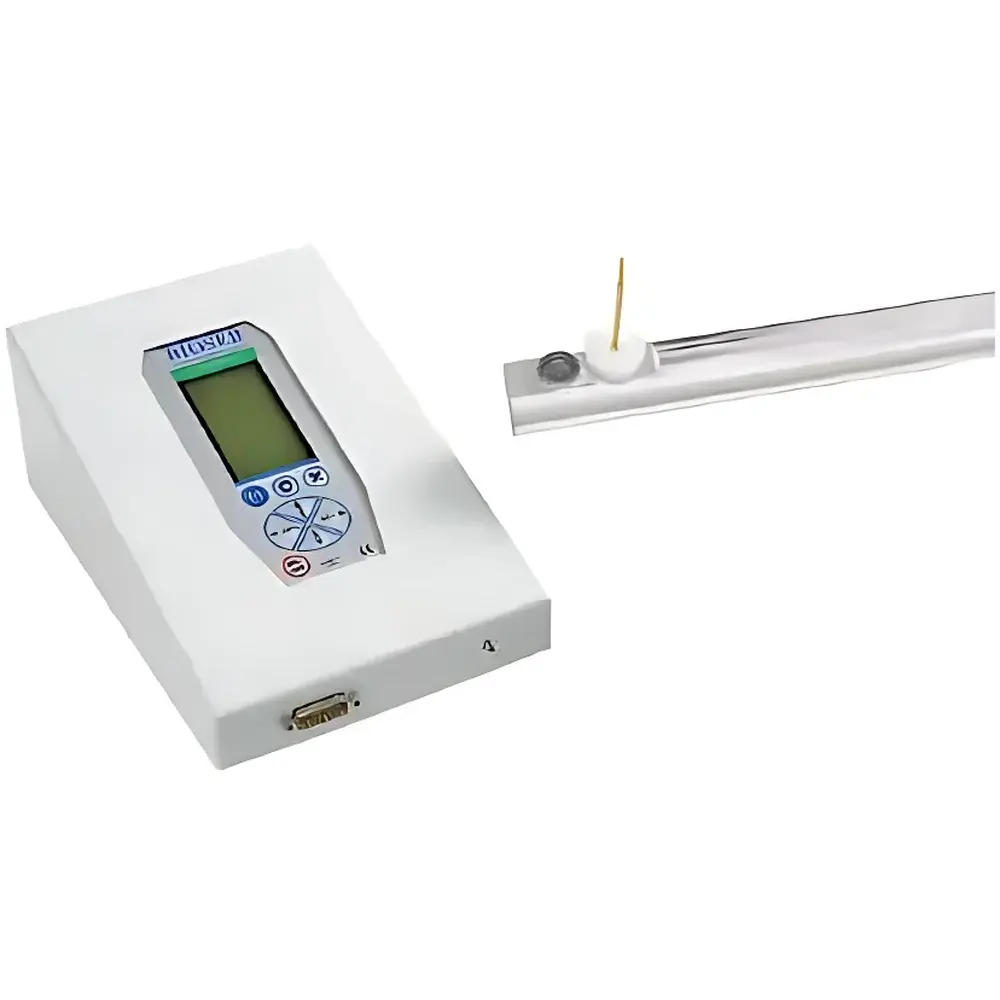
Bioseb BIO-EVF3 Electronic Von Frey Anesthesiometer
| Brand | Bioseb |
|---|---|
| Model | BIO-EVF3 |
| Measurement Principle | Precision resistive force transduction |
| Range | 0–500 g (0–5 N) |
| Accuracy | ±0.2 g |
| Resolution | 0.1 g |
| Overload Capacity | 120% (6 N) without sensor damage |
| Temperature Compensation | 0–50 °C |
| Data Storage | Up to 100 measurements internally |
| Interface | RS-232 (with optional RSIC software) |
| Compliance | COFRAC-accredited calibration (ISO 9001), EMC certified |
| Probe Types | Rigid plastic probe (rat), flexible elastomeric probe (mouse) |
| Display | Backlit LCD with real-time force reading and peak-hold function |
| Control | Footswitch-enabled zeroing and measurement freeze (“Patient” mode) |
| Statistical Functions | Automatic mean and standard deviation calculation |
| Accessories | Included transport case, optional BIO-VF-M filament set (20 calibrated filaments, forces from 0.008 g to 300 g) |
Overview
The Bioseb BIO-EVF3 Electronic Von Frey Anesthesiometer is a handheld, microprocessor-controlled force measurement instrument engineered for precise, repeatable assessment of mechanical allodynia and hyperalgesia in rodent models. Unlike traditional filament-based Von Frey assays—which rely on discrete, stepwise filament replacement and subjective endpoint interpretation—the BIO-EVF3 employs a high-stability resistive load cell to deliver continuous, real-time force quantification during controlled vertical skin indentation. This eliminates inter-filament variability, eliminates manual force estimation errors, and removes humidity- and temperature-dependent compliance artifacts inherent in nylon monofilament bending mechanics. Designed specifically for behavioral neuroscience and preclinical pain research, the device operates under standardized tactile stimulation protocols aligned with IASP (International Association for the Study of Pain) guidelines and supports consistent endpoint detection in paw withdrawal reflex testing across C57BL/6, Sprague-Dawley, and Wistar strains.
Key Features
- High-resolution force sensing (0.1 g resolution, ±0.2 g accuracy) over a validated 0–500 g range, with robust 120% overload tolerance ensuring long-term sensor integrity
- Dual-probe configuration: rigid plastic tip for rat hindpaw testing; low-stiffness elastomeric tip optimized for mouse sensitivity and minimal tissue deformation
- Real-time backlit LCD display showing instantaneous force, peak hold value, and statistical summary (mean ± SD) of active session data
- Footswitch-integrated operation enabling hands-free zeroing, measurement initiation, and numeric freeze (“Patient” mode) for unambiguous endpoint recording
- Onboard memory storing up to 100 timestamped measurements—each including force value, peak time, and operator ID—without external power or PC connection
- RS-232 serial interface compatible with Bioseb’s optional RSIC software for GLP-compliant data export, audit trail generation, and batch statistical analysis
- COFRAC-accredited factory calibration traceable to national standards (ISO/IEC 17025), accompanied by certificate of conformity per ISO 9001 quality management system requirements
- EMC-certified electromagnetic compatibility ensures stable performance in multi-instrument vivarium environments with adjacent electrophysiology or imaging systems
Sample Compatibility & Compliance
The BIO-EVF3 is validated for use in adult and adolescent mice (C57BL/6, BALB/c, CD-1) and rats (Sprague-Dawley, Wistar) under standard IACUC-approved housing and acclimation protocols. Its probe geometry and force ramp profiles comply with recommendations outlined in the NIH Office of Laboratory Animal Welfare (OLAW) Guidance on Pain Assessment and the European Directive 2010/63/EU Annex VIII for humane endpoints. All internal firmware and data handling routines are designed to support ALAC (Association for Assessment and Accreditation of Laboratory Animal Care) and AAALAC International audit readiness. While not FDA 21 CFR Part 11–validated out-of-the-box, the RSIC software package enables electronic signature capture, user access control, and immutable audit logs required for regulated toxicology and IND-enabling studies.
Software & Data Management
Data acquisition and post-processing are supported via the optional RSIC (RheoSoft Instrument Control) software suite—a Windows-based application compliant with Good Laboratory Practice (GLP) documentation standards. RSIC enables automated synchronization of measurement timestamps with video recording metadata (e.g., EthoVision XT integration), batch export to CSV or Excel formats with embedded metadata headers (animal ID, strain, treatment group, experimenter, date/time), and statistical reporting templates aligned with common journal submission requirements (e.g., *Pain*, *Journal of Neuroscience Methods*). Audit trails record every parameter change, data export event, and user login—fully traceable for regulatory inspections or internal QA review.
Applications
- Quantitative assessment of mechanical nociceptive thresholds in neuropathic pain models (e.g., CCI, SNI, STZ-induced diabetic neuropathy)
- Longitudinal monitoring of analgesic efficacy in opioid, NSAID, or novel biologic intervention studies
- Phenotypic screening of genetically modified mouse lines for sensory neuron dysfunction
- Validation of dorsal root ganglion (DRG) excitability changes following intrathecal drug delivery
- Standardized endpoint determination in regulatory safety pharmacology studies (ICH S7A)
- Training platform for novice technicians in reproducible behavioral phenotyping techniques
FAQ
Is the BIO-EVF3 compatible with both mice and rats?
Yes—the system includes two interchangeable probes: a rigid plastic probe for rat hindpaw testing and a compliant elastomeric probe optimized for murine sensitivity and reduced tissue displacement.
Does the device require recalibration between animals or sessions?
No—each measurement cycle begins with footswitch-activated auto-zeroing, compensating for minor thermal drift and mechanical hysteresis. Annual COFRAC-traceable recalibration is recommended for GLP work.
Can stored data be exported directly to statistical packages like GraphPad Prism or R?
Yes—RSIC software exports fully annotated CSV files with column headers compatible with direct import into Prism, R, Python (pandas), or SPSS without manual formatting.
What is the warranty and service support coverage?
Bioseb provides a 24-month limited warranty covering parts and labor; extended service plans with priority response and on-site calibration support are available through authorized distributors.
Is the BIO-EVF3 suitable for use in biosafety level 2 (BSL-2) animal facilities?
Yes—the unit’s sealed enclosure, non-porous probe surfaces, and alcohol-wipe–compatible housing meet BSL-2 decontamination requirements; no internal airflow or vacuum pathways compromise containment integrity.




