
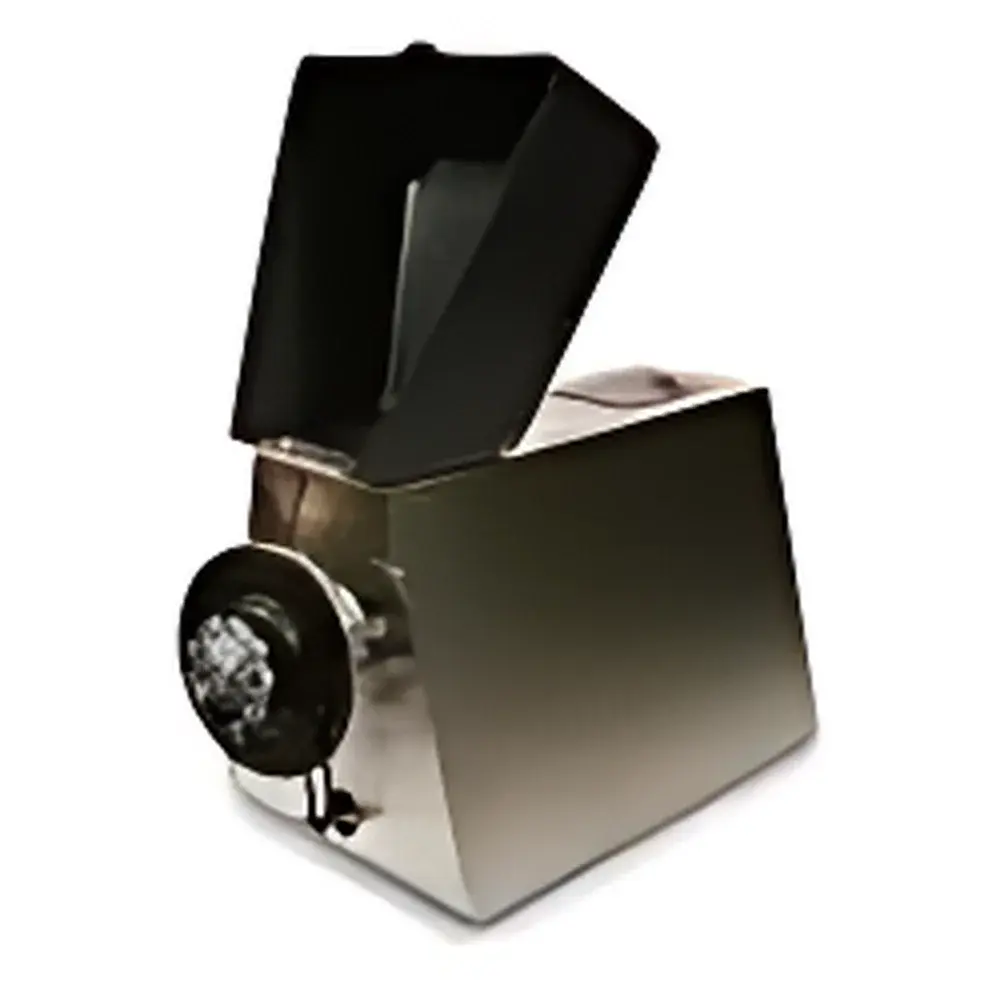
Biospec MiniBeadbeater-24 High-Efficiency Bead Mill Homogenizer
| Brand | Biospec |
|---|---|
| Origin | USA |
| Model | MiniBeadbeater-24 |
| Sample Capacity | 24 × 2 mL tubes (standard) or 8 × 7 mL tubes (with optional adapter) |
| Operating Speed | 2000–3450 rpm |
| Timer Range | 0–5 min, programmable with auto-reset |
| Input Particle Size | <5 mm |
| Output Particle Size | <0.01 mm |
| Cryogenic Compatibility | Yes, validated for frozen sample processing |
| Instrument Type | Bead-based mechanical homogenizer |
Overview
The Biospec MiniBeadbeater-24 is a high-throughput, benchtop bead mill homogenizer engineered for rapid, reproducible mechanical lysis of biological and environmental samples. It operates on the principle of high-frequency horizontal oscillation, driving ceramic, steel, or glass beads within sealed sample tubes to generate intense shear, impact, and grinding forces. This mechanism effectively disrupts cell membranes, breaks down fibrous tissues, and homogenizes tough matrices—including frozen, lyophilized, or highly viscous specimens—without significant thermal buildup when used with cryogenic protocols. Designed for laboratories requiring parallel processing under controlled conditions, the MiniBeadbeater-24 delivers consistent mechanical energy input across all 24 positions, eliminating inter-sample variability common in manual or low-throughput methods. Its compact footprint and robust stainless-steel construction support integration into biosafety cabinets, cold rooms, and regulated QC environments.
Key Features
- Simultaneous processing of up to 24 × 2 mL microtubes (e.g., standard screw-cap PCR or deep-well tubes), with optional 8-position 7 mL tube adapter for larger-volume applications.
- Precisely adjustable oscillation speed from 2000 to 3450 rpm, enabling method optimization for diverse sample types—from soft mammalian cells to resilient bacterial spores, plant tissues, or soil aggregates.
- Digital timer with 1-second resolution and automatic reset function; programmable for durations between 0 and 5 minutes, ensuring repeatability across batches and operators.
- Cryogenically compatible design: validated for use with dry ice or liquid nitrogen-cooled sample tubes, preserving labile analytes (e.g., RNA, enzymes, metabolites) during homogenization.
- Reinforced stainless-steel sample holder and vibration-dampening housing minimize operational noise and ensure long-term mechanical stability under repeated high-G loading.
- No external cooling unit required—heat generation is inherently limited by short cycle times and efficient energy transfer directly to beads rather than bulk sample heating.
Sample Compatibility & Compliance
The MiniBeadbeater-24 accommodates a broad range of sample types, including microbial cultures (Gram-positive/negative bacteria, yeasts, fungi), mammalian and insect cell pellets, plant leaves and roots, animal tissues (liver, muscle, brain), soil, fecal matter, and environmental biofilms. Compatible bead materials include zirconium oxide (for DNA/RNA isolation), stainless steel (for tough tissues), and silica/glass (for protein extraction). All sample tubes must be certified for centrifugal and impact resistance (e.g., polypropylene or stainless-steel microtubes rated ≥15,000 × g). The instrument supports GLP/GMP-aligned workflows: its fixed-speed/timer architecture enables full SOP documentation, and process parameters are manually logged per run—consistent with FDA 21 CFR Part 11 requirements when integrated with compliant LIMS or ELN systems. While not CE-marked for IVD use, it complies with general electrical safety standards (UL/CSA 61010-1) and meets ISO 13485-relevant mechanical performance expectations for research-grade instrumentation.
Software & Data Management
The MiniBeadbeater-24 operates via an embedded digital control panel with no proprietary software dependency. All settings—speed, duration, and auto-reset—are set locally and retained without firmware updates or cloud connectivity. This architecture eliminates cybersecurity concerns, ensures uninterrupted operation during network outages, and simplifies audit readiness: parameter logs are maintained manually in lab notebooks or electronic records per institutional SOPs. For laboratories implementing automated data capture, third-party hardware interfaces (e.g., TTL-triggered relay modules) can synchronize start/stop signals with time-stamped acquisition systems (e.g., spectrophotometers, qPCR cyclers) to establish traceable event chains. No drivers, SDKs, or vendor-specific platforms are required—ensuring compatibility with existing IT infrastructure and minimizing validation burden.
Applications
- Routine nucleic acid extraction: Efficient lysis of difficult-to-lyse microbes (e.g., Mycobacterium tuberculosis, Bacillus subtilis) prior to column- or magnetic-bead-based purification.
- Proteomics sample prep: Mechanical disruption of inclusion bodies, membrane fractions, or cross-linked tissues while maintaining native conformation for downstream LC-MS/MS.
- Metabolomics: Rapid quenching and homogenization of snap-frozen biopsies or cultured cells to stabilize labile metabolites (e.g., ATP, NADH, acyl-CoAs).
- Environmental microbiology: Recovery of intact microbial DNA/RNA from complex matrices such as activated sludge, rhizosphere soil, or bioaerosol filters.
- Vaccine development: Consistent antigen release from whole-pathogen preparations or virus-like particles (VLPs) for immunoassay standardization.
- Quality control in biomanufacturing: Batch homogenization of cell banks or intermediate harvests for residual host-cell protein (HCP) quantification per USP <1043> guidelines.
FAQ
Can the MiniBeadbeater-24 be used for RNA extraction without degradation?
Yes—when operated at ≤3000 rpm for ≤90 seconds with chilled tubes and RNase-free zirconia beads, it achieves >95% RNA integrity (RIN ≥8.5) for most eukaryotic tissues.
Is it possible to homogenize samples in 96-well plates?
No—the instrument is mechanically configured for tube-based agitation only; 96-well plate homogenization requires dedicated plate-shaker systems with different force coupling mechanisms.
What maintenance is required for long-term reliability?
Annual inspection of the drive belt tension and sample holder alignment is recommended; no lubrication or calibration is needed due to the fixed-mechanism oscillator design.
Does Biospec provide validation documentation for GxP environments?
Biospec supplies factory test reports and mechanical performance specifications; site-specific IQ/OQ protocols must be developed internally or by qualified third parties per ISO/IEC 17025 requirements.
Can stainless-steel beads be reused across samples?
Yes—provided they undergo validated cleaning (e.g., 1 hr sonication in 70% ethanol, followed by 121°C autoclaving), though single-use is recommended for high-sensitivity applications like low-input NGS library prep.



