
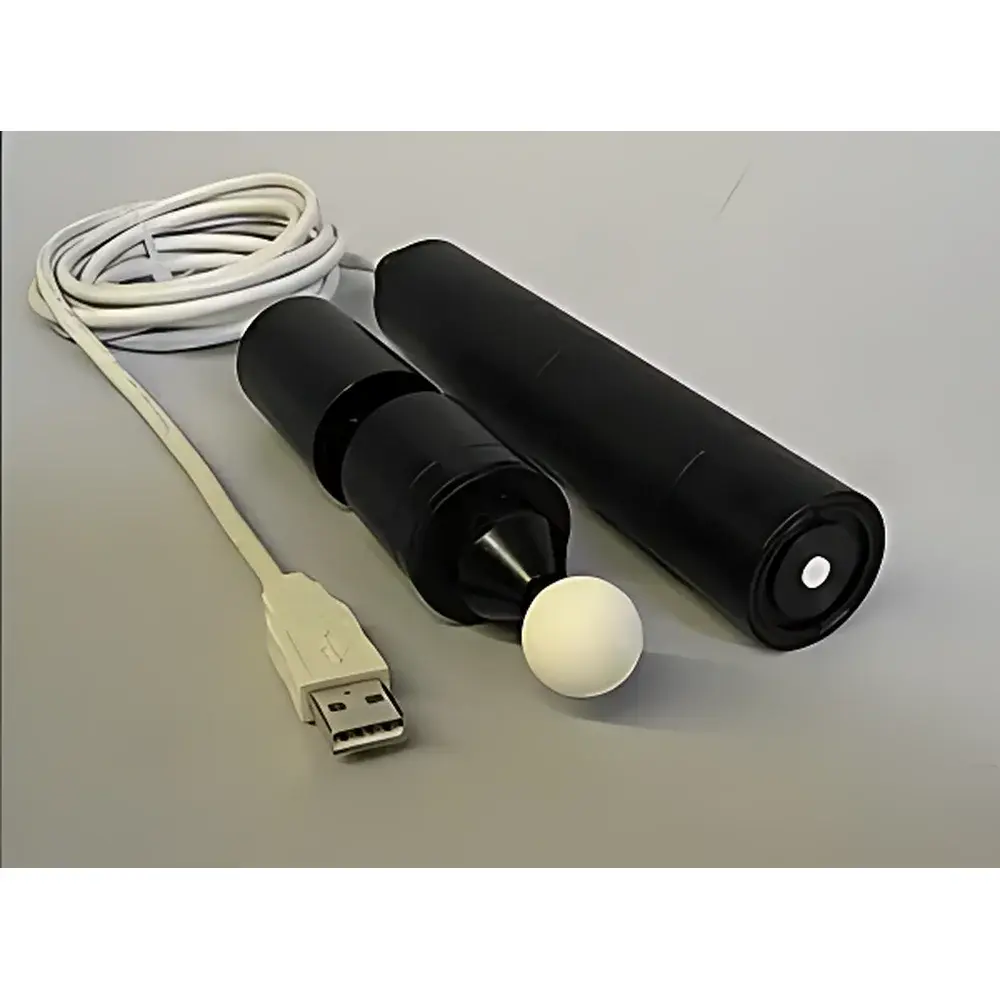
Biospherical AMOUR Advanced Multi-purpose USB Radiometer
| Origin | USA |
|---|---|
| Manufacturer Type | Authorized Distributor |
| Origin Category | Imported |
| Model | AMOUR |
| Pricing | Upon Request |
Overview
The Biospherical AMOUR (Advanced Multi-purpOse Usb Radiometer) is a precision optical radiation measurement instrument engineered for high-fidelity scalar irradiance, cosine-corrected irradiance, and radiance quantification across environmental, marine, atmospheric, and laboratory applications. Based on Biospherical Instruments’ fourth-generation micro-radiometer architecture—developed under NASA contracts and validated in global UV monitoring networks—the AMOUR implements solid-state photodetector physics with calibrated spectral responsivity spanning 25–1650 nm (dependent on detector type: Si, InGaAs, or GaAsP). Its core measurement principle relies on absolute photon flux detection via low-noise, 24-bit bipolar analog-to-digital conversion, coupled with real-time dark-current compensation and tri-level programmable gain amplification (1×, 2000×, 4000×). Designed for both field-deployable robustness and lab-grade reproducibility, the AMOUR delivers >10¹⁰ dynamic range and sub-10 fA current resolution—enabling trace-level PAR (Photosynthetically Active Radiation), UV-B hazard assessment, and narrowband spectral irradiance measurements without external signal conditioning.
Key Features
- Three interchangeable optical geometries: Cosine-corrected irradiance (±3% cosine error up to 85° zenith angle), isotropic scalar irradiance (±5% directional error within ±135° incidence), and forward-looking radiance (field-of-view selectable from 2.5° to 20°)
- USB 2.0 interface as standard; optional RS-232/RS-485 serial output for integration into SCADA or legacy data acquisition systems
- Modular front-end optics compatible with SMA-threaded extension rods, integrating seamlessly with underwater profiling frames, optical benches, or custom light-tight enclosures
- Detector options: 13 mm² silicon (250–1100 nm), 7 mm² InGaAs (900–1650 nm), or 7 mm² GaAsP (300–700 nm) — each factory-calibrated with NIST-traceable spectral responsivity functions
- Configurable spectral filtering: Standard PAR (400–700 nm, quantum-weighted), erythemal, photopic, blue-light hazard (400–500 nm), or user-defined narrowband (FWHM ≈10 nm) filters
- Real-time internal averaging (1/60–125 Hz) and raw sampling (4–125 Hz); electro-optical time constant <10 ms
Sample Compatibility & Compliance
The AMOUR supports direct measurement of radiant exposure in heterogeneous, anisotropic, or highly scattering media—including phytoplankton cultures, turbid freshwater columns, greenhouse canopies, LED arrays, and solar-exposed surfaces. Its scalar irradiance probe enables accurate characterization of omnidirectional photon fields critical for aquatic photosynthesis modeling and microbial photobiology studies. All factory calibrations comply with ISO/IEC 17025:2017 requirements through Biospherical’s A2LA-accredited calibration laboratory. Instrument firmware and data logging protocols support audit-ready metadata tagging (timestamp, GPS coordinates if externally synced, probe ID, filter configuration, gain setting), satisfying GLP and FDA 21 CFR Part 11 data integrity expectations when deployed in regulated water quality or photobioreactor validation workflows.
Software & Data Management
AMOUR operates natively with Biospherical’s RadiantView™ desktop application (Windows/macOS), providing real-time visualization, spectral weighting selection, unit conversion (e.g., µmol·m⁻²·s⁻¹ ↔ W·m⁻²·nm⁻¹), and batch export to CSV, HDF5, or NetCDF-4 formats. Raw binary files include embedded calibration coefficients and uncertainty budgets per measurement channel. The SDK supports Python (via PySerial), MATLAB, and LabVIEW integration for automated long-term deployments. Data files embed EXIF-like headers containing full instrument configuration history, enabling traceable reprocessing under updated calibration models—essential for multi-year ecological time-series analysis aligned with NOAA, NASA Ocean Color, or ESA Sentinel-3 validation protocols.
Applications
- Marine & freshwater optics: In situ scalar PAR profiling in phytoplankton blooms; validation of satellite-derived water-leaving radiances (e.g., VIIRS, OLCI)
- Photobioreactor optimization: Quantifying intra-culture light gradients and photon utilization efficiency in algal biomanufacturing
- UV ecosystem impact studies: Long-term monitoring of erythemal dose rates in polar regions under NSF-funded Polar Observing Networks
- LED horticultural lighting: Spectral power distribution mapping and PAR uniformity assessment in controlled-environment agriculture
- Occupational safety: Blue-light hazard evaluation (IEC 62471) for display technologies and medical phototherapy devices
- Atmospheric science: Ground-truthing of total column ozone via Brewer-type UV spectral irradiance comparisons
FAQ
What calibration standards are applied to AMOUR instruments?
All AMOUR units ship with NIST-traceable calibration certificates for each configured optical geometry and filter combination, performed at Biospherical’s A2LA-accredited facility using primary-standard tungsten-halogen and deuterium lamps.
Can AMOUR be used underwater without pressure housing?
No. While the optical head is epoxy-sealed and corrosion-resistant, it is rated only for splash protection (IP65). For submersion, users must integrate the probe into a pressure-rated housing or mount it on a CTD frame with appropriate O-ring seals.
Is spectral responsivity correction required for PAR measurements?
Yes—PAR is defined as quantum-based (µmol photons·m⁻²·s⁻¹) rather than energy-based. AMOUR applies factory-measured quantum efficiency curves during post-processing; no user correction is needed if the PAR filter option is selected at order time.
How does AMOUR ensure compliance with FDA 21 CFR Part 11 for regulated bioprocess applications?
When operated with RadiantView™ in Audit Mode, the system enforces electronic signatures, automatic audit trails (including gain changes, filter swaps, and calibration updates), and immutable data file hashing—meeting ALCOA+ principles for data integrity in GMP environments.
What is the typical recalibration interval recommended for field-deployed units?
Biospherical recommends annual recalibration for instruments used in quantitative research or regulatory reporting; biennial verification is acceptable for qualitative trend monitoring where relative stability suffices.







