
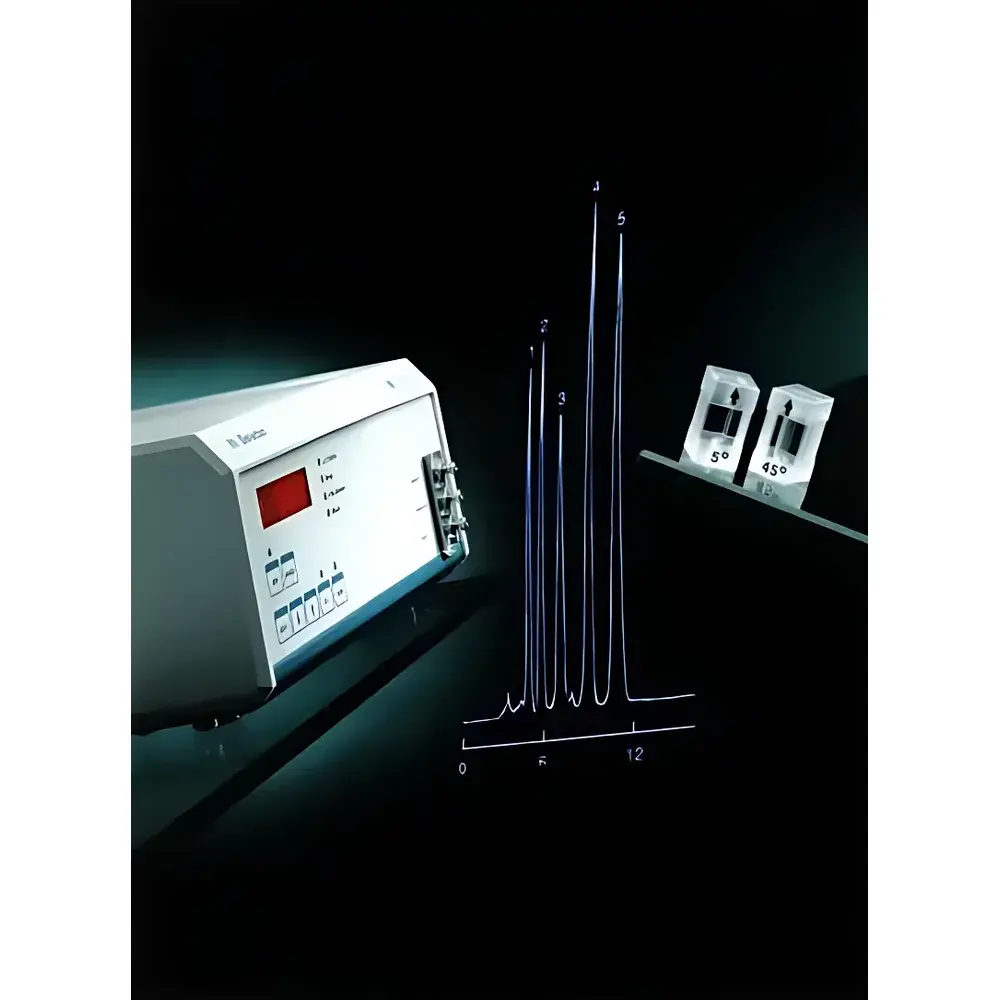
Bischoff RI-8120 / RI-8120P Differential Refractometer Detector
| Brand | Unimicro Technologies |
|---|---|
| Origin | Germany |
| Manufacturer | Bischoff GmbH |
| Model | RI-8120 (Analytical), RI-8120P (Preparative) |
| Detection Principle | Differential Refractive Index |
| Wavelength | 950 nm LED |
| Optical Sensor | Silicon Photodiode |
| Temperature Control | Integrated Heat Exchanger System |
| Compatibility | HPLC & Prep-LC Systems |
| Compliance | Designed for GLP/GMP environments with stable baseline performance per ISO 17025-relevant operational principles |
Overview
The Bischoff RI-8120 and RI-8120P are high-stability differential refractometer detectors engineered for universal detection in liquid chromatography systems. Operating on the principle of measuring minute differences in refractive index between a reference solvent stream and an eluent stream exiting the chromatographic column, these detectors provide non-destructive, mass-sensitive quantification—critical for analytes lacking UV chromophores, such as polysaccharides, synthetic polymers, lipids, alcohols, and other optically transparent compounds. Unlike destructive or response-variable detectors (e.g., ELSD or CAD), the RI detector delivers inherently linear, concentration-proportional signals across broad dynamic ranges when properly temperature-stabilized and calibrated. The RI-8120 is optimized for analytical-scale HPLC applications, while the RI-8120P features enhanced flow-cell geometry and pressure tolerance to accommodate preparative-scale flow rates up to 20 mL/min without signal distortion or thermal lag.
Key Features
- Optical bench architecture with high mechanical symmetry—minimizing beam path asymmetry and drift induced by vibration or thermal expansion.
- 950 nm infrared LED light source—eliminates chromatic dispersion artifacts common with broadband halogen lamps, improving linearity and reducing baseline curvature over extended run times.
- Integrated heat exchanger system—actively stabilizes thermal equilibrium between reference and sample cells, suppressing baseline drift to < ±1.5 × 10⁻⁶ RIU/h under controlled ambient conditions.
- Silicon photodiode array—provides high quantum efficiency at 950 nm and excellent signal-to-noise ratio (>60 dB), enabling detection limits of ~0.2 µRIU (refractive index units) with 1 s time constant.
- Dual-mode operation—RI-8120 supports standard analytical HPLC (0.1–5 mL/min); RI-8120P includes reinforced flow cell, extended purge volume, and pressure-rated housing for prep-LC integration (up to 10 MPa).
- Onboard auto-zero function with high-resolution digital offset compensation—performs real-time baseline correction during gradient elution without interrupting data acquisition.
- Manual and programmable cell rinse protocol via front-panel controls—ensures reproducible removal of residual solutes between injections, critical for polymer analysis where carryover affects molecular weight distribution accuracy.
Sample Compatibility & Compliance
The Bischoff RI-8120/8120P is compatible with all common HPLC mobile phases—including aqueous buffers, THF, chloroform, DMF, and ethyl acetate—provided refractive index contrast between solvent and analyte exceeds 1 × 10⁻⁵ RIU. It is routinely deployed in SEC/GPC laboratories for absolute molecular weight determination per ASTM D5296 and ISO 16014 standards. Its non-destructive nature makes it suitable for fraction collection in preparative purification workflows compliant with ICH Q5A (biotechnology-derived impurities) and USP . Instrument firmware supports audit trail logging and user-access control protocols aligned with FDA 21 CFR Part 11 requirements when integrated with validated LIMS or CDS platforms.
Software & Data Management
The detector communicates via RS-232 or optional Ethernet interface, supporting native integration with major chromatography data systems (CDS), including Thermo Chromeleon, Waters Empower, and Agilent OpenLab. Raw analog output (0–1 V or 0–5 V) and digital TTL trigger signals are provided for synchronization with fraction collectors or auxiliary detectors. Baseline stability metrics, zero-drift logs, and cell temperature history are exportable in CSV format for QA/QC review. Firmware updates are performed via secure USB interface with version rollback capability—ensuring traceability during method validation per ISO/IEC 17025 clause 7.7.
Applications
- Gel permeation chromatography (GPC) and size-exclusion chromatography (SEC) of synthetic and natural polymers (e.g., polystyrene, PEG, dextran, cellulose derivatives).
- Carbohydrate profiling in food, pharmaceutical, and biofuel research—including mono-/di-saccharide separation and oligosaccharide mapping.
- Quality control of surfactants, plasticizers, and hydrophobic small molecules in formulation development.
- Process analytical technology (PAT) deployment in continuous chromatography skids for bioprocess monitoring.
- Method transfer between analytical and preparative scales—leveraging identical detection physics to ensure retention time and response correlation.
FAQ
What is the minimum detectable refractive index change (Δn)?
The detector achieves a noise-equivalent sensitivity of 0.2 µRIU (rms, 1 s time constant) under optimal thermal stabilization.
Can the RI-8120P be used with high-pressure preparative systems?
Yes—the RI-8120P flow cell and housing are rated to 10 MPa and support flow rates up to 20 mL/min with active thermal management.
Does the detector require post-column solvent mixing or flow splitting?
No—it operates in true dual-stream mode; no flow division or post-column dilution is needed, preserving quantitative integrity.
Is temperature calibration traceable to NIST standards?
While the detector itself does not include embedded NIST-traceable thermistors, its temperature control module is designed to maintain setpoint stability within ±0.01 °C—enabling external calibration using NIST-certified thermostats per ISO 17025 procedures.
How is baseline drift corrected during long SEC runs?
The auto-zero function allows periodic baseline re-reference without stopping acquisition; combined with the heat exchanger, drift remains below 2 µRIU over 8-hour continuous operation.



