
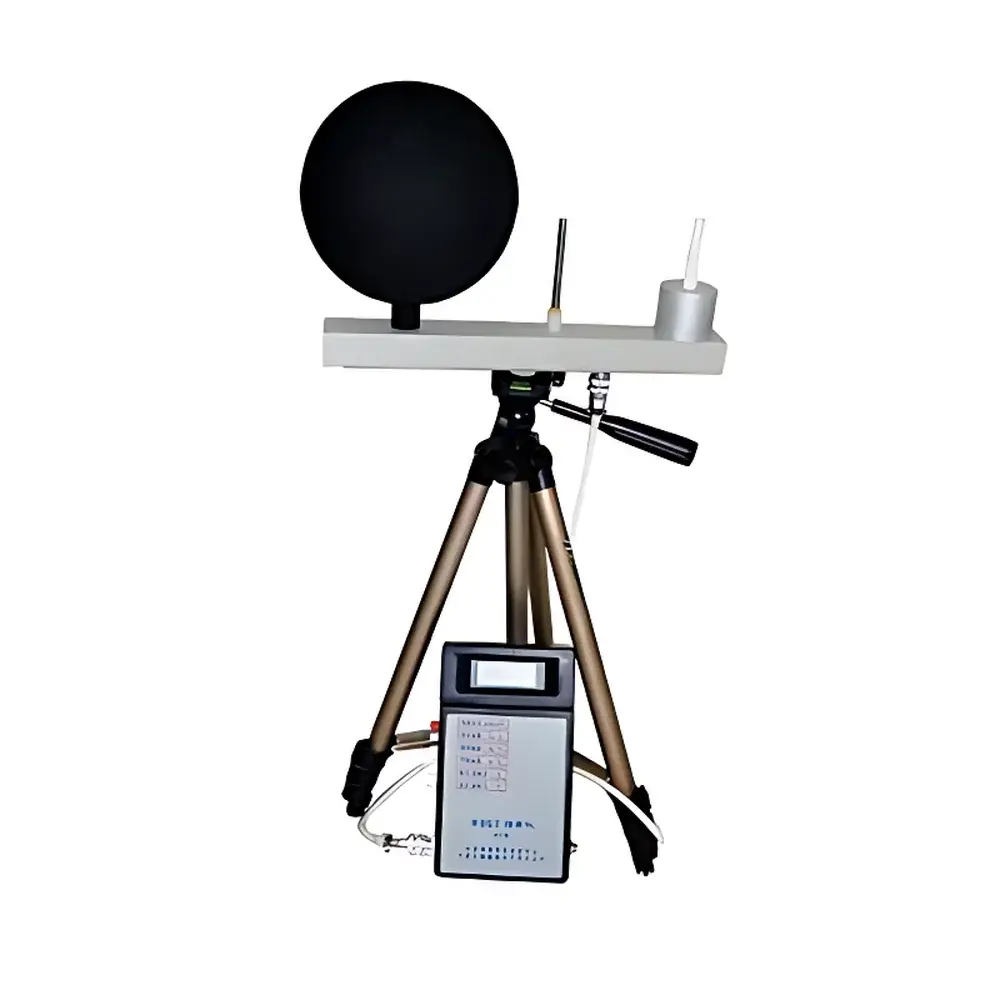
BJBY WBGT-2006 Wet Bulb Globe Temperature Index Meter
| Brand | BJBY (Beijing Baoyun) |
|---|---|
| Model | WBGT-2006 |
| Origin | Imported (U.S.-sourced instrumentation platform) |
| Compliance | GB/T 4200–2008, ISO 7243:1989 |
| Measurement Principle | Simultaneous dry-bulb, natural wet-bulb, and black-globe temperature acquisition for WBGT index calculation |
| Display | Real-time concurrent readout of T<sub>db</sub>, T<sub>nwb</sub>, T<sub>g</sub>, and WBGT value |
| Data Logging | Up to 100 hours internal storage |
| Interface | USB 2.0 for PC connectivity |
| Software | Dedicated Windows-based analysis suite supporting max/min/avg extraction per user-defined time segment |
| Operating Menu | Full Chinese GUI (host unit only) |
| Sensor Type | Digital precision thermistors with direct digital output |
| Dry-Bulb Range | 10–60 °C ±0.5 °C |
| Natural Wet-Bulb Range | 5–40 °C ±0.5 °C |
| Black-Globe Range | 20–120 °C (±0.5 °C @ 20–40 °C |
| Globe Diameter | 150 mm, Emissivity ≥0.95 |
| Wet-Bulb Wicking | Cylindrical cotton sleeve (6±1 mm OD, 30±5 mm length), 20–30 mm free hanging length, water reservoir isolation from radiant heating |
Overview
The BJBY WBGT-2006 Wet Bulb Globe Temperature Index Meter is a calibrated, tri-sensor environmental monitoring instrument engineered for quantitative assessment of heat stress in occupational settings. It implements the internationally standardized WBGT methodology defined in ISO 7243:1989 and adopted by national standards including GB/T 4200–2008 (China) and ACGIH TLVs® (USA). Unlike single-parameter thermal monitors, the WBGT-2006 simultaneously acquires three independent temperature measurements—dry-bulb air temperature (Tdb), naturally ventilated wet-bulb temperature (Tnwb), and black-globe temperature (Tg)—and computes the weighted WBGT index in real time using the formula: WBGT = 0.7×Tnwb + 0.2×Tg + 0.1×Tdb (for indoor or outdoor settings without solar load). This physical model integrates convective, evaporative, and radiant heat transfer components, making it uniquely suitable for evaluating cumulative thermal strain across full work shifts in foundries, glass manufacturing, power generation, and logistics facilities.
Key Features
- Triple-sensor architecture with traceable calibration: separate high-stability digital thermistors for dry-bulb, natural wet-bulb, and black-globe measurement—each conforming to dimensional and emissivity specifications per ISO 7243 Annex B
- Real-time on-screen display of all four primary parameters: Tdb, Tnwb, Tg, and calculated WBGT value—updated at 2-second intervals
- Internal non-volatile memory supporting up to 100 hours of continuous timestamped logging at user-selectable intervals (1 s to 60 min)
- USB 2.0 interface enabling bidirectional communication with Windows-based analysis software for post-acquisition processing
- Dedicated software application permitting segmentation-based statistical analysis—including maximum, minimum, arithmetic mean, and standard deviation—for any user-defined time window
- Full Chinese graphical user interface on host unit—designed for rapid field deployment by occupational hygienists and safety officers without English-language proficiency requirements
- Black-globe sensor constructed to exact ISO 7243 dimensions: 150 mm diameter, matte-black finish with emissivity ≥0.95, wall thickness optimized for thermal mass equilibrium
Sample Compatibility & Compliance
The WBGT-2006 is validated for use in industrial environments where radiant heat flux exceeds 500 W/m² and ambient temperatures range from 10 °C to 60 °C. Its natural wet-bulb probe employs a standardized cylindrical cotton wick (6±1 mm outer diameter, 30±5 mm active length) suspended over a shielded water reservoir to minimize conductive and radiative interference—ensuring compliance with ISO 7243’s ventilation-free wet-bulb definition. The instrument’s metrological design satisfies the geometric, thermal, and material requirements specified in ISO 7243:1989 Annexes A and B. It is routinely deployed in GLP-aligned occupational health audits and supports documentation traceability for OSHA 1910.142, EU Directive 89/391/EEC, and China’s GBZ 2.2–2014 workplace exposure limits. Calibration certificates are issued with NIST-traceable reference standards for each sensor channel.
Software & Data Management
The included Windows-compatible software (v3.2+) provides audit-ready data handling compliant with 21 CFR Part 11 principles: electronic signatures, operator-level access control, and immutable audit trails for all file exports and parameter modifications. Raw sensor logs are stored in CSV format with millisecond timestamps and include metadata (instrument ID, operator name, location tag, calibration expiry date). Statistical modules enable batch processing of multi-day datasets, automatic flagging of WBGT excursions above threshold values (e.g., 28 °C for moderate work), and export of summary reports in PDF or Excel formats. All software operations retain full backward compatibility with legacy WBGT-2000 series log files, facilitating longitudinal trend analysis across instrument generations.
Applications
- Occupational heat stress evaluation in steel mills, aluminum smelters, and cement kiln operations
- Validation of engineering controls (e.g., local exhaust ventilation, radiant barrier installation) under real-world thermal loads
- Baseline assessment prior to implementation of acclimatization programs per ANSI/ACGIH Z359.2
- Supporting regulatory submissions for heat illness prevention plans required under Cal/OSHA Title 8 §3395
- Field validation of computational fluid dynamics (CFD) thermal models in process facility design
- Research applications in ergonomics laboratories studying human thermoregulatory response under combined environmental stressors
FAQ
What standards does the WBGT-2006 comply with?
It conforms to ISO 7243:1989, GB/T 4200–2008, and supports alignment with ACGIH TLVs®, OSHA Technical Manual Chapter 3, and EU Directive 89/391/EEC.
Can the instrument be used outdoors under direct sunlight?
Yes—the black-globe sensor is specifically designed to capture solar radiant load; however, the WBGT formula applied must switch to the outdoor weighting: WBGT = 0.7×Tnwb + 0.3×Tg.
Is the wet-bulb wick replaceable, and how often should it be changed?
Cotton wicks are consumable components; replacement is recommended after 40 hours of continuous use or immediately upon visible soiling, desiccation, or capillary failure.
Does the device support external power for extended field deployments?
The host unit operates on rechargeable Li-ion battery (≥12 h runtime); optional 12 V DC input enables continuous operation via portable power station or vehicle socket.
How is sensor calibration maintained between official recalibrations?
Field verification checks using NIST-traceable dry-block calibrators (e.g., Fluke 9143) are supported through the software’s zero-offset adjustment mode—documented per ISO/IEC 17025 clause 7.7.







