
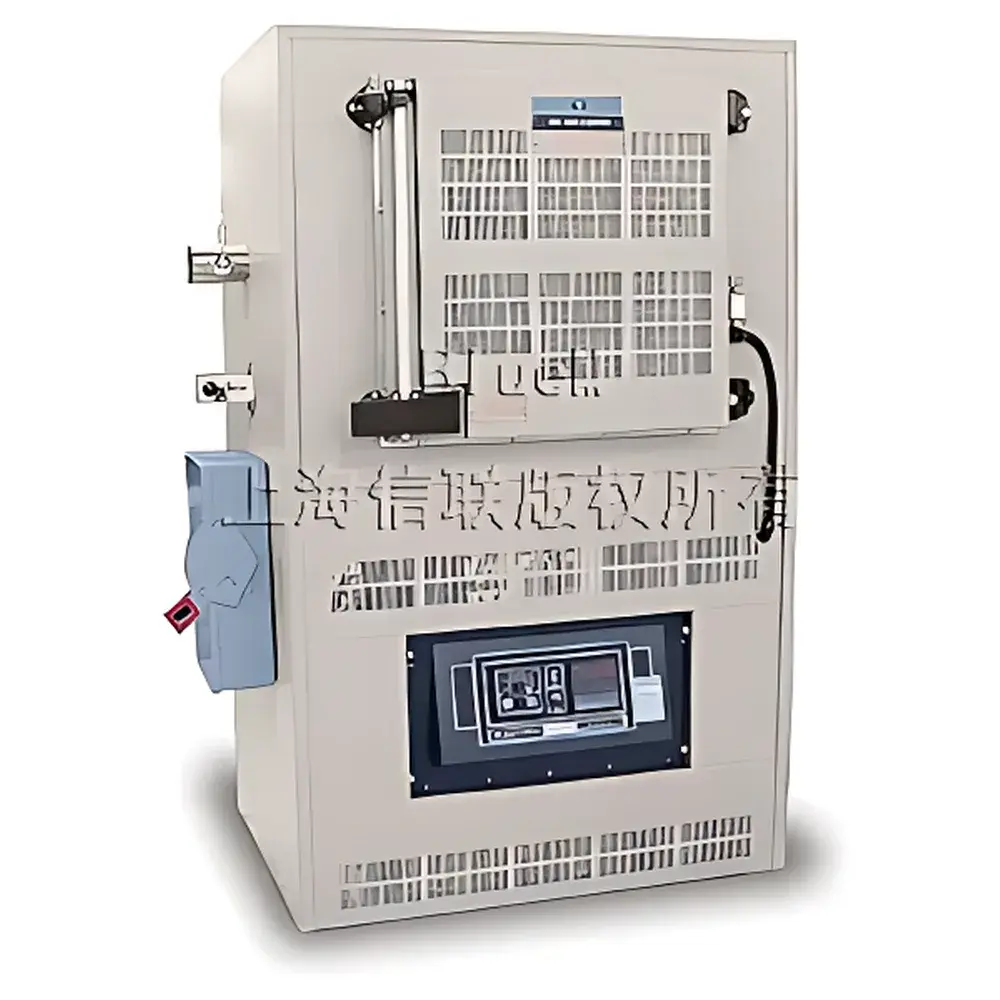
Blue M CW-6680 High-Temperature Forced-Air Drying Oven
| Brand | Blue M |
|---|---|
| Origin | USA |
| Model | CW-6680 |
| Temperature Range | Ambient to 700 °C |
| Temperature Uniformity | ±0.5 °C |
| External Dimensions | 40×34×57 to 68×40×82 cm (W×D×H) |
| Internal Chamber Dimensions | 20×18×20 to 48×24×36 cm (W×D×H) |
| Chamber Material | 304 Stainless Steel |
| Heating Method | Horizontal Forced-Air Circulation |
| Compliance | Designed for ASTM E145 Class I & II, ISO 17025-compliant thermal validation workflows, GLP/GMP-ready architecture |
Overview
The Blue M CW-6680 High-Temperature Forced-Air Drying Oven is an industrial-grade thermal processing system engineered for precision-controlled elevated-temperature applications in materials science, metallurgy, ceramics, and advanced coating R&D laboratories. Operating on the principle of horizontal forced-air convection, the oven delivers uniform heat distribution across the entire working chamber—critical for reproducible annealing, stress-relief heat treatment, binder burnout, ceramic sintering, and high-temperature curing of polymer-based coatings. Its robust construction, including a 304 stainless steel interior chamber and double-walled insulated door with high-temperature glass fiber gasketing, ensures long-term dimensional stability and thermal integrity at sustained 700 °C operation. Unlike natural-convection ovens, the CW-6680’s horizontally oriented airflow path minimizes vertical temperature gradients, enabling consistent thermal exposure regardless of sample load configuration or rack positioning.
Key Features
- Temperature capability up to 700 °C with ±0.5 °C stability under steady-state conditions—validated per ASTM E145 Annex A3 methodology
- Horizontal forced-air circulation system with adjustable blower speed, ensuring uniform thermal profiles across full chamber volume (verified via 9-point thermocouple mapping)
- Dual-wall insulated door with compression-sealed glass fiber gasketing—maintains external surface temperature below 55 °C at maximum operating temperature
- Integrated safety interlocks: automatic heater and fan shutdown upon door opening; independent air-flow monitoring switch prevents ignition hazard during maintenance or airflow obstruction
- Chamber interior coated with high-purity, acid-resistant ceramic enamel over 304 stainless steel substrate—resistant to halogenated volatiles, organic solvents, and acidic off-gases generated during binder pyrolysis
- Dual-stage overtemperature protection: primary controller limit + independent mechanical high-limit cutout (UL-listed, resettable)
- Standard analog/digital hybrid control architecture compatible with third-party data loggers and SCADA integration via 4–20 mA output and RS-485 Modbus RTU
Sample Compatibility & Compliance
The CW-6680 accommodates a broad range of sample formats—including crucibles (alumina, quartz, molybdenum), metal trays, coated substrates (e.g., coil-coated steel, aluminum foil), ceramic green bodies, and composite preforms—without compromising thermal uniformity. Its chamber geometry supports both single-layer and multi-tier rack loading while maintaining compliance with ISO 17025 requirements for thermal validation traceability. The oven is routinely deployed in laboratories subject to FDA 21 CFR Part 11 and EU Annex 11 expectations: its controller firmware supports audit-trail-enabled event logging (door open/close, setpoint changes, alarm triggers), password-protected parameter modification, and electronic signature-capable calibration records. It meets UL 61010-1 and CSA C22.2 No. 61010-1 safety standards for laboratory electrical equipment.
Software & Data Management
While the CW-6680 ships with a factory-calibrated analog/digital hybrid controller (Blue M Ultra-Temp Series), optional digital upgrades include the Blue M SmartLink™ interface module—a DIN-rail mountable gateway supporting Ethernet/IP, OPC UA, and MQTT protocols. This enables real-time temperature telemetry, remote setpoint adjustment, and automated export of time-stamped CSV datasets compliant with 21 CFR Part 11 electronic record requirements. All controller firmware versions are version-controlled and documented per ISO/IEC 17025 Clause 5.9.2; calibration certificates include as-found/as-left data, uncertainty budgets, and traceability to NIST-traceable reference standards. Audit trails retain minimum 90 days of operational history without external storage dependency.
Applications
- Metallurgical annealing and stress-relief cycles for aerospace alloys (e.g., Inconel 718, Ti-6Al-4V)
- Binder removal (burnout) from investment casting molds prior to ceramic shell firing
- Ceramic green body pre-sintering and controlled oxide layer growth on refractory substrates
- Thermal aging studies of powder coatings and coil-coated architectural metals per ASTM D5894 and ISO 11341
- High-temperature gravimetric analysis support (TGA coupling via purge gas routing ports)
- Accelerated corrosion testing preconditioning (e.g., ASTM B117 salt-spray cycle pre-bake)
FAQ
What is the maximum continuous operating temperature rating of the CW-6680?
The CW-6680 is rated for continuous operation at 700 °C, validated per Blue M’s internal thermal endurance protocol (1000-hour soak test with periodic uniformity verification).
Does the oven support IQ/OQ/PQ documentation packages?
Yes—standard delivery includes Factory Acceptance Test (FAT) report and calibration certificate; optional IQ/OQ/PQ kits include protocol templates, execution logs, and witness sign-off sheets aligned with ISO 13485 and GAMP 5 guidance.
Can the chamber be purged with inert gas?
Yes—the unit features dual 1/4″ NPT inlet/outlet ports on the rear panel, configurable for nitrogen or argon purge with flowmeter integration.
Is the controller compliant with 21 CFR Part 11 for electronic records?
The base analog controller is not Part 11–compliant; however, the SmartLink™ digital upgrade provides full Part 11 functionality including role-based access, electronic signatures, and immutable audit trails.
What maintenance intervals are recommended for the blower motor and heating elements?
Blower motor inspection every 12 months; heating element resistance verification every 6 months—both procedures detailed in the Maintenance Manual (Rev. 4.2, included with shipment).



