
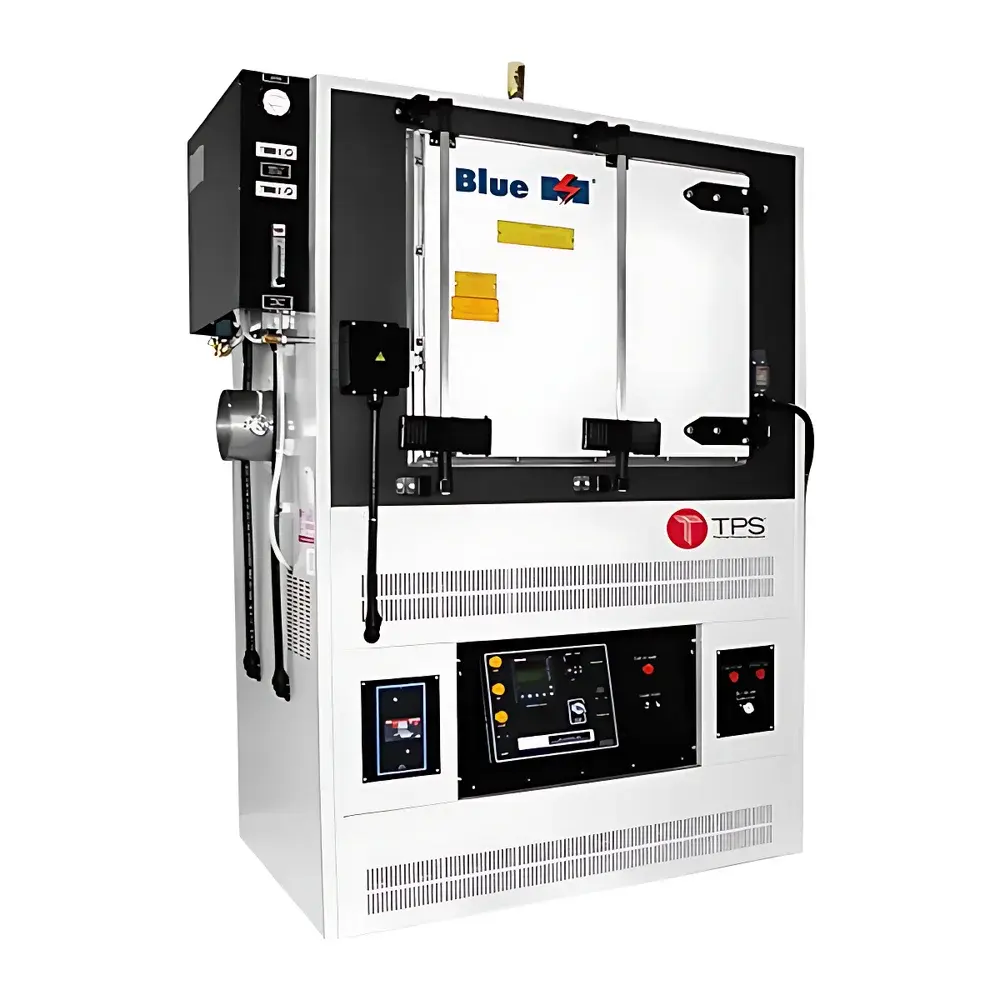
Blue M IGF Series Inert Atmosphere High-Temperature Aging Ovens for PBO Curing
| Brand | Blue M |
|---|---|
| Model | IGF 6680 / IGF 7780 / IGF 8880 / IGF 9980 |
| Origin | USA |
| Temperature Range | Ambient +15°C to 593°C (1099°F) |
| Uniformity | ±2% of setpoint |
| Stability | ±2% of setpoint |
| Accuracy | ±0.5°C |
| Resolution | ±0.1°C |
| Internal Chamber Dimensions (W×H×D) | 25×20×20 cm (IGF 7780) |
| Heating Element | Open-wire NiCr |
| Insulation | 6-inch mineral wool |
| Gas Compatibility | N₂, Ar, He, CO₂, and forming gas (4% H₂/96% N₂) |
| Safety Features | Door interlock (heater & blower shutdown), inert gas leak detection with audible/visual alarm and heater disable, pressure monitoring, purge timer, pressure relief valve, water-cooled door (IGF 8880 & 9980) |
| Compliance | NFPA 86 Class B |
Overview
The Blue M IGF Series Inert Atmosphere High-Temperature Aging Ovens are engineered for precision thermal processing of polybenzoxazole (PBO) fibers, tapes, and composites under controlled inert or reducing atmospheres. These ovens operate on the principle of forced convection heating within a sealed, welded stainless-steel inner chamber, enabling stable, uniform thermal exposure critical for polymer crosslinking, imidization, and oxidative stabilization—key steps in PBO precursor curing and final property development. Designed to meet NFPA 86 Class B requirements for inert-atmosphere industrial ovens, the IGF series supports continuous operation from ambient +15°C up to 593°C (1099°F), with rigorous thermal performance validation across the full range. The dual-shell construction—featuring an outer structural shell and an independently sealed inner cavity—allows for active cooling-fluid circulation around the inert-gas chamber, minimizing external heat radiation and enhancing operator safety during extended high-temperature cycles.
Key Features
- Hermetically welded 304 stainless-steel inner chamber prevents gas leakage and eliminates migration of volatiles into insulation layers—critical for maintaining inert integrity and preventing oxidation of oxygen-sensitive PBO precursors.
- Open-wire nickel-chromium (NiCr) heating elements mounted externally to the inner chamber ensure rapid, controllable heat transfer without introducing contamination or hot spots inside the process zone.
- Integrated inert gas management system includes mass flow meters, chamber pressure transducers, manual and automated purge timers, and real-time gas flow/pressure display on the front-panel controller.
- Dual-stage safety architecture: (1) door interlock circuit de-energizes both heaters and circulation blower upon door opening; (2) inert gas leak detection triggers visual/audible alarms and automatically disables heating elements if chamber pressure drops below threshold.
- Water-cooled door assembly standard on IGF 8880 and IGF 9980 models ensures surface temperature remains below 60°C during 593°C operation—complying with OSHA and ISO 13732-1 surface temperature safety guidelines.
- 6-inch (152 mm) mineral wool insulation combined with Blue M’s proprietary fiberglass door gasket provides thermal efficiency exceeding ASTM C177 requirements for high-temperature insulation performance.
Sample Compatibility & Compliance
The IGF ovens accommodate flat, filamentous, and laminated PBO substrates—including spun yarns, woven fabrics, prepreg tapes, and thin-film coatings—within standardized internal workspaces ranging from 4.2 ft³ (IGF 6680) to 24.0 ft³ (IGF 9980). Chamber geometry supports horizontal airflow patterns optimized for uniform convective heat transfer across vertically hung fiber bundles or horizontally stacked laminates. All models comply with NFPA 86 Standard for Ovens and Furnaces (Class B for inert and flammable-atmosphere applications), and support integration into GLP/GMP environments through optional data logging, audit trail-enabled controllers, and 21 CFR Part 11-compliant software packages (available via third-party SCADA interfaces). The sealed chamber design meets ISO 8501-1 requirements for controlled atmosphere conditioning prior to coating adhesion testing.
Software & Data Management
Standard IGF controllers feature programmable ramp-soak profiles, real-time temperature/pressure/gas flow trending, and non-volatile memory for up to 100 user-defined recipes. Optional Ethernet-enabled controllers (Model 9000 Series) provide Modbus TCP and OPC UA connectivity for centralized lab automation systems. Data export is supported via USB flash drive in CSV format, including timestamped temperature deviation logs, gas flow rate history, and alarm event records. For regulated environments, validated firmware versions include electronic signature capability, user role-based access control, and immutable audit trails meeting FDA 21 CFR Part 11 Annex 11 requirements when deployed with compliant IT infrastructure.
Applications
- Thermal imidization and cyclodehydration of PBO precursor fibers (e.g., poly(o-benzamide) derivatives) under nitrogen or argon at 300–400°C.
- Oxidative stabilization of high-performance organic fibers prior to carbonization or ceramic conversion.
- Aging studies of PBO-reinforced composites per ASTM D3045 (heat aging of plastics) and ISO 188 (vulcanized rubber).
- Controlled pyrolysis screening for next-generation thermally stable polymers under forming gas (4% H₂/N₂).
- Residual solvent removal and post-cure annealing of aerospace-grade PBO laminates per Boeing BMS 8-268 and Airbus AITM 1-0003 specifications.
FAQ
What inert gases are certified for use in the IGF series?
Nitrogen (N₂), argon (Ar), helium (He), carbon dioxide (CO₂), and forming gas (4% H₂ in N₂) are fully supported. Hydrogen concentrations exceeding 4% require custom engineering review per NFPA 86 Section 5.4.
Is the oven suitable for vacuum operation?
No—the IGF series is designed exclusively for positive-pressure inert gas environments. Vacuum compatibility requires the Blue M VGF series, which features reinforced chamber walls and vacuum-rated seals.
Can temperature uniformity be verified per ASTM E2203?
Yes. Each unit ships with a factory-generated temperature uniformity report based on 9-point sensor mapping at three setpoints (200°C, 400°C, and 593°C), traceable to NIST standards.
What maintenance intervals are recommended for the gas delivery system?
Mass flow controllers and pressure transducers should be calibrated annually; inlet filters require replacement every 6 months under continuous operation; door gaskets are rated for 5,000 thermal cycles and should be inspected quarterly.
Does Blue M offer IQ/OQ/PQ documentation packages?
Yes—validated installation qualification (IQ), operational qualification (OQ), and performance qualification (PQ) protocols are available as part of the GxP Support Package, aligned with ISO/IEC 17025 and ASTM E2500 guidance.



