
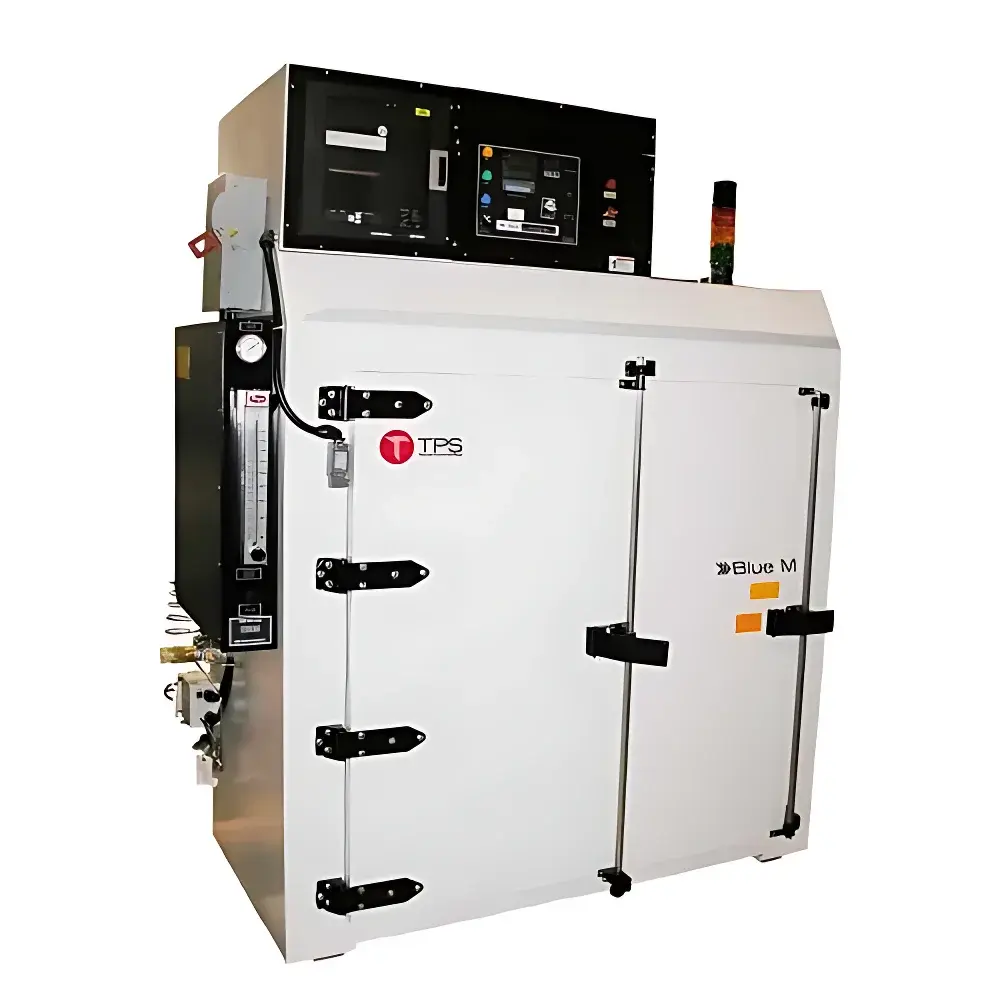
Blue M Inert Atmosphere Cabinet Oven (Debinding Furnace)
| Brand | Blue M |
|---|---|
| Origin | USA |
| Type | Inert Gas Cabinet Oven |
| Max Temperature | 316°C |
| Temperature Uniformity | ±2% of setpoint |
| Max Power | 48 kW |
| Ramp Time to Max Temp | 60 min |
| Heating Method | Forced-air convection |
| Internal Dimensions | 60.7 × 60.7 × 121.9 mm (W×D×H) |
| Compliance | NEC-compliant design, UL-listed components |
Overview
The Blue M Inert Atmosphere Cabinet Oven (Debinding Furnace) is an industrial-grade, laboratory-certified thermal processing system engineered for controlled-atmosphere debinding, binder burnout, pre-sintering, and low-oxygen drying applications. Unlike standard benchtop ovens, this cabinet-style furnace integrates a sealed inert gas environment—typically nitrogen or argon—to suppress oxidation during thermal decomposition of organic binders in ceramic and metal injection molding (MIM) feedstocks. Its core operating principle relies on precise forced-air convection heating within a gastight chamber, enabling reproducible thermal profiles across the full working volume (up to 96 ft³). Designed for integration into QC/QA workflows and pilot-scale production lines, it meets foundational requirements for ASTM F2885 (Standard Practice for Thermal Debinding of Metal Injection Molded Parts) and supports GLP-compliant process documentation when paired with validated data logging systems.
Key Features
- Sealed inert gas chamber with integrated purge control: Configurable gas inlet/outlet ports, flow monitoring, and automatic heater shutoff upon airflow loss detection per ANSI Z21.56 safety protocols.
- Robust heating architecture: Open-coil nickel-chromium (NiCr) heating elements mounted on refractory-ceramic insulators ensure long-term stability at sustained temperatures up to 316°C (600°F).
- High-efficiency forced-air circulation: Centrifugal blower with balanced impeller delivers uniform laminar airflow—validated to ±2% temperature uniformity across the working zone per ISO 17025 calibration guidelines.
- NEC-compliant electrical enclosure: Side-mounted control panel with UL-listed components, grounded chassis, and redundant overtemperature protection (mechanical and electronic limit switches).
- Modular scalability: Available in seven standard internal volumes (16–96 ft³), supporting both R&D-scale sample batches and production-line throughput requirements.
- Dual-voltage compatibility: Field-configurable for 208 VAC, 240 VAC, or 480 VAC three-phase 60 Hz supply—enabling seamless integration into diverse facility power infrastructures.
Sample Compatibility & Compliance
This oven accommodates a broad range of substrate geometries—including green parts from MIM, CIM, and powder metallurgy processes—as well as polymer-coated substrates, composite preforms, and moisture-sensitive electronic assemblies. Chamber dimensions support horizontal loading of trays up to 48″ × 48″ × 72″. All models are constructed with stainless-steel interior linings (304 SS standard; optional 316 SS available) and high-density mineral fiber insulation to minimize thermal leakage. The system complies with UL 746B (polymeric materials), CSA C22.2 No. 61010-1 (electrical safety), and meets baseline requirements for FDA 21 CFR Part 11 when used with compliant data acquisition software. Optional third-party IQ/OQ/PQ validation packages are available for GMP-regulated environments.
Software & Data Management
The oven operates via a microprocessor-based PID controller with programmable ramp-soak profiles (up to 20 segments), real-time digital display (±0.1°C resolution), and analog output for external SCADA integration. Optional Ethernet-enabled data loggers provide timestamped CSV exports with audit trail functionality, supporting traceability under ISO/IEC 17025 and GLP frameworks. All recorded parameters—including chamber temperature, gas flow rate, elapsed time, and alarm status—are stored with user-defined retention policies. Firmware updates are performed via secure USB interface; no cloud connectivity is embedded by default, preserving network isolation per ITAR and internal cybersecurity policies.
Applications
- Controlled debinding of thermoplastic and wax-based binders in MIM/CIM green parts prior to sintering.
- Oxidation-sensitive drying of battery electrode slurries and cathode/anode coatings.
- Thermal conditioning of aerospace composites and carbon-fiber pre-pregs under inert blanket.
- Pre-sintering stabilization of porous metal filters and catalytic substrates.
- Low-oxygen aging studies for pharmaceutical excipients and hygroscopic APIs.
- Residual solvent removal from coated medical devices per ISO 10993-12 biocompatibility testing protocols.
FAQ
What inert gases are compatible with this oven?
Nitrogen (N₂) and argon (Ar) are the standard gases; helium may be used with custom flow calibration. Hydrogen or forming gas (N₂/H₂) require factory-approved modifications and additional safety interlocks.
Can the oven be validated for GMP manufacturing?
Yes—qualified IQ/OQ/PQ documentation packages are available. Validation includes temperature mapping (per ASTM E2251), gas tightness verification (helium leak testing), and alarm response verification.
Is remote monitoring supported?
Analog 4–20 mA outputs and Modbus RTU (RS-485) are standard. Ethernet/IP and OPC UA interfaces are optional add-ons for MES/SCADA integration.
What maintenance intervals are recommended?
Blower motor lubrication every 12 months; NiCr element resistance check every 6 months; door gasket integrity inspection before each critical run.
Does the system include temperature uniformity certification?
Each unit ships with a factory-as-tested uniformity report (9-point mapping at 316°C). NIST-traceable calibration certificates are available upon request.



