
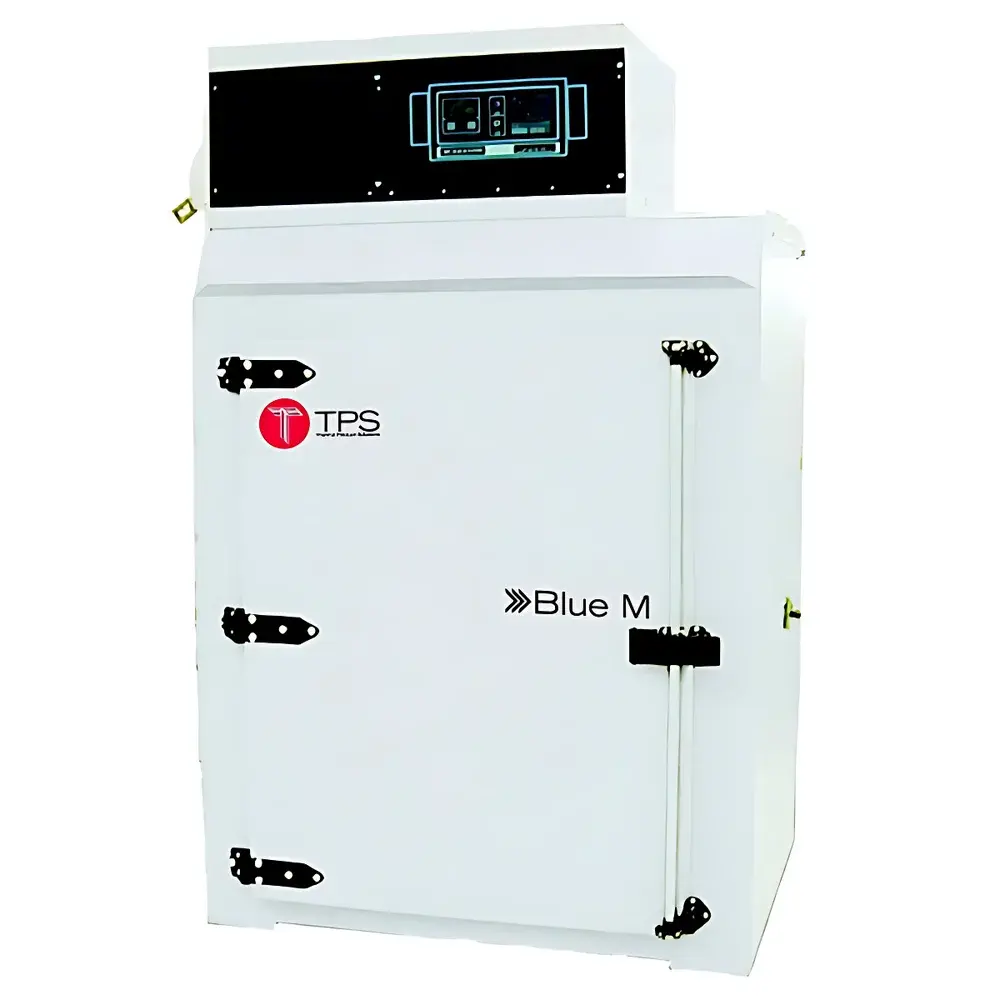
Blue M Model 166/246/326/366/606/966 Industrial Forced-Air Circulating Oven
| Brand | Blue M |
|---|---|
| Origin | USA |
| Model Series | 166, 246, 326, 366, 606, 966 |
| Temperature Range | Ambient to 316°C |
| Temperature Uniformity | ±1.5–2.0% of setpoint |
| Temperature Stability | ±0.5°C |
| Interior Material | 304 Stainless Steel |
| Insulation | 102 mm (4 in) Fiberglass |
| Heating Method | Forced-air convection |
| External Casing | 14–16 gauge cold-rolled steel |
| Finish | White porcelain enamel coating |
| Door | Dual-wall insulated with manual adjustable air inlet/outlet valves |
| Interior Volumes | 16.0–96.0 ft³ |
| Compliance | Designed for GLP/GMP environments |
Overview
The Blue M Model 166/246/326/366/606/966 series represents a line of precision-engineered industrial forced-air circulating ovens designed for laboratory and production-scale thermal processing applications requiring high stability, repeatability, and long-term reliability. These ovens operate on the principle of uniform forced-air convection—where a calibrated blower circulates heated air across internal ducting and perforated baffles—to achieve consistent thermal distribution throughout the chamber. Engineered for continuous-duty operation in regulated environments, each model is constructed to meet rigorous mechanical and thermal performance benchmarks defined in ASTM E145 (Standard Specification for Gravity-Convection and Forced-Ventilation Ovens) and aligned with ISO/IEC 17025 calibration traceability requirements. The temperature control system utilizes a microprocessor-based PID controller with dual-sensor input (chamber and overtemperature safety cutoff), ensuring compliance with IEC 61000-4 electromagnetic compatibility standards and supporting audit-ready documentation under FDA 21 CFR Part 11 when integrated with validated data acquisition software.
Key Features
- Robust dual-wall construction with 14–16 gauge cold-rolled steel exterior panels and seamless 304 stainless steel interior chamber—resistant to corrosion, thermal fatigue, and repeated cleaning cycles.
- High-efficiency 102 mm (4-inch) fiberglass insulation layer minimizes thermal loss and improves energy efficiency across all operating temperatures up to 316°C.
- Manually adjustable air inlet and exhaust valves enable fine-tuned control of chamber airflow dynamics—critical for moisture-sensitive drying, solvent evaporation, or residual stress relief processes.
- Porcelain-enamel white powder-coated exterior finish provides chemical resistance, abrasion durability, and ease of surface decontamination.
- Insulated, counterbalanced door with silicone gasket ensures tight thermal sealing and reduces heat leakage during frequent access cycles.
- Modular design supports field-replaceable heating elements and fan assemblies—reducing mean time to repair (MTTR) and extending service life beyond 15 years under routine maintenance.
Sample Compatibility & Compliance
These ovens accommodate a broad range of sample types—including glassware, metal components, polymer substrates, pharmaceutical excipients, and ceramic precursors—without risk of cross-contamination due to the fully weld-seamed 304 stainless steel interior. Removable shelves and slide-out trays facilitate rapid reconfiguration for batch or rack-based loading. All models are certified for use in Class 1000 cleanroom-adjacent areas (per ISO 14644-1) when equipped with optional HEPA-filtered recirculation kits. Regulatory alignment includes support for IQ/OQ/PQ protocol execution per GAMP 5 guidelines, and full compatibility with third-party thermal mapping systems (e.g., Ellab, Fluke) for qualification under EU Annex 15 and FDA Process Validation Guidance.
Software & Data Management
While the base configuration features analog/manual controls, optional digital interfaces—including RS-485 Modbus RTU, Ethernet/IP, and USB data logging—enable integration into centralized LIMS or MES platforms. When paired with Blue M’s optional BlueLink™ software suite (v3.2+), users gain real-time graphing, alarm history export (CSV/Excel), electronic signature support, and automated deviation reporting compliant with 21 CFR Part 11 Annex 11 requirements. Audit trails record operator ID, parameter changes, door openings, and temperature excursions with timestamped metadata—ensuring full traceability for internal audits and regulatory inspections.
Applications
- Thermal aging and accelerated stability testing of polymers and composites per ASTM D3045 and ISO 2578.
- Drying of filter papers, crucibles, and analytical standards in environmental and clinical laboratories.
- Curing of epoxy coatings, adhesives, and printed circuit board laminates under controlled ramp/soak profiles.
- Moisture content determination in food, feed, and agricultural products (AOAC 950.46, ISO 665).
- Pre-conditioning of test specimens prior to tensile, impact, or fatigue evaluation (ASTM D638, ISO 527).
- Residual solvent removal from pharmaceutical intermediates under cGMP conditions.
FAQ
What is the maximum allowable operating temperature for all models in this series?
All units are rated for continuous operation up to 316°C (600°F), with overtemperature protection set at 343°C (650°F) via independent mechanical limit switch.
Are these ovens suitable for inert-atmosphere processing?
No—standard configurations are air-circulating only. Optional nitrogen purge kits (Model NP-1000 series) are available for low-oxygen applications, requiring third-party gas supply integration and pressure monitoring.
Can the oven be validated for GMP use?
Yes—each unit ships with a factory-issued Certificate of Conformance and supports full qualification (IQ/OQ/PQ) using standard thermocouple mapping procedures and documented protocols.
Is remote monitoring supported out-of-the-box?
Basic remote status indicators (run/fault/door open) are provided via dry-contact relay outputs. Full telemetry requires optional communication modules and configured SCADA or LabVIEW drivers.
What maintenance intervals are recommended for optimal performance?
Blower motor lubrication every 12 months; heating element resistance verification every 6 months; door gasket inspection per quarterly PM; full thermal calibration annually using NIST-traceable reference sensors.



