
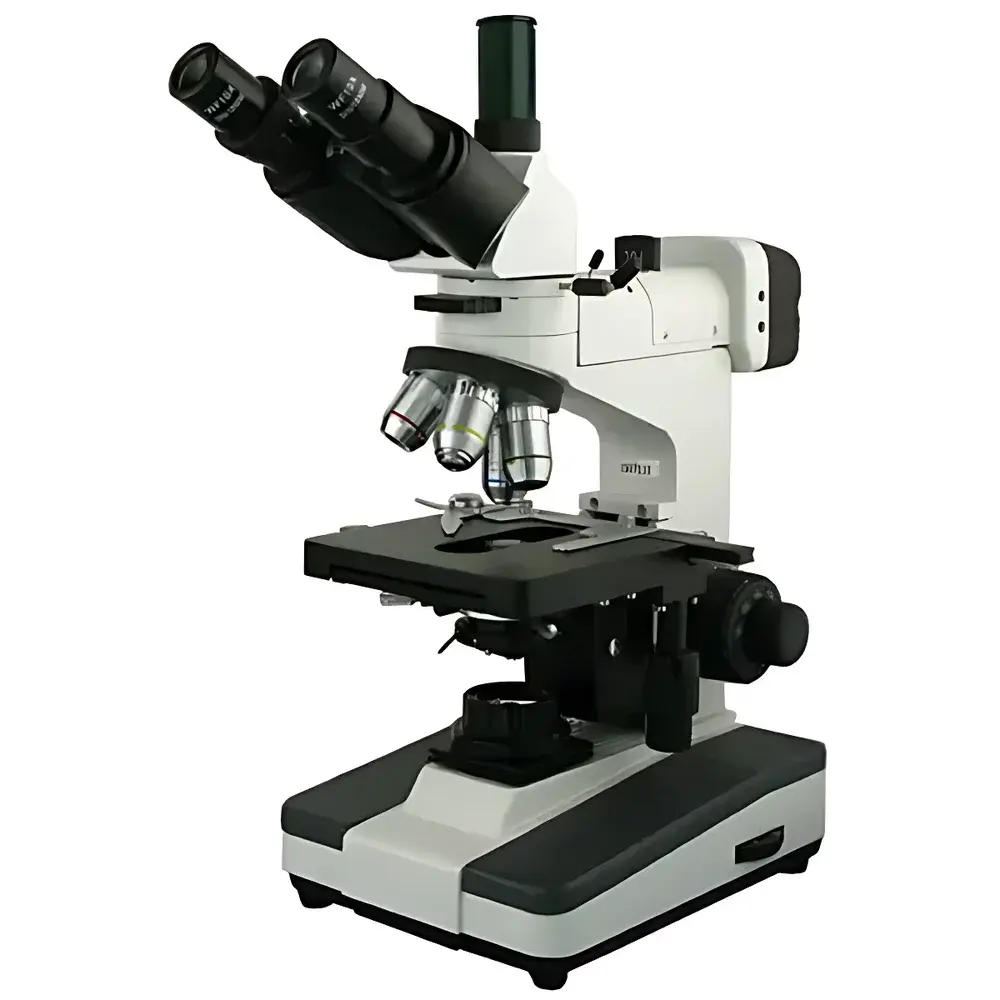
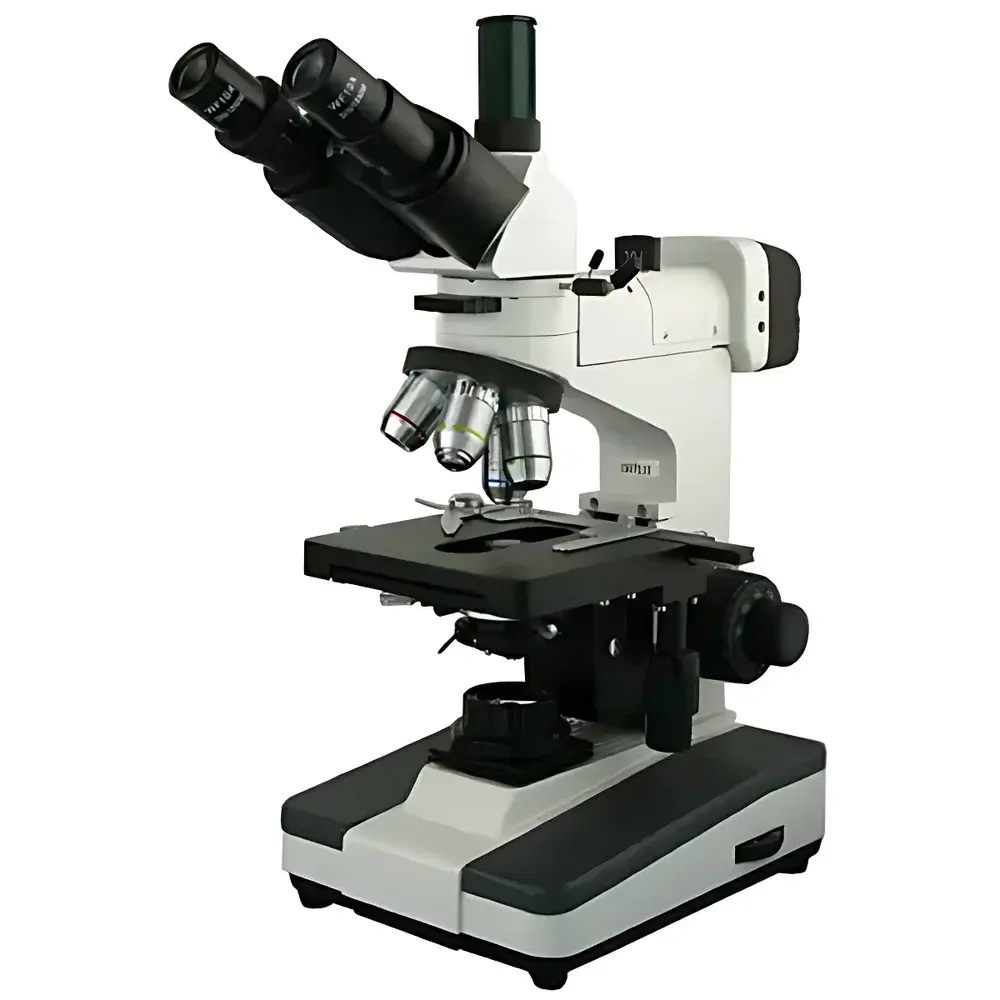
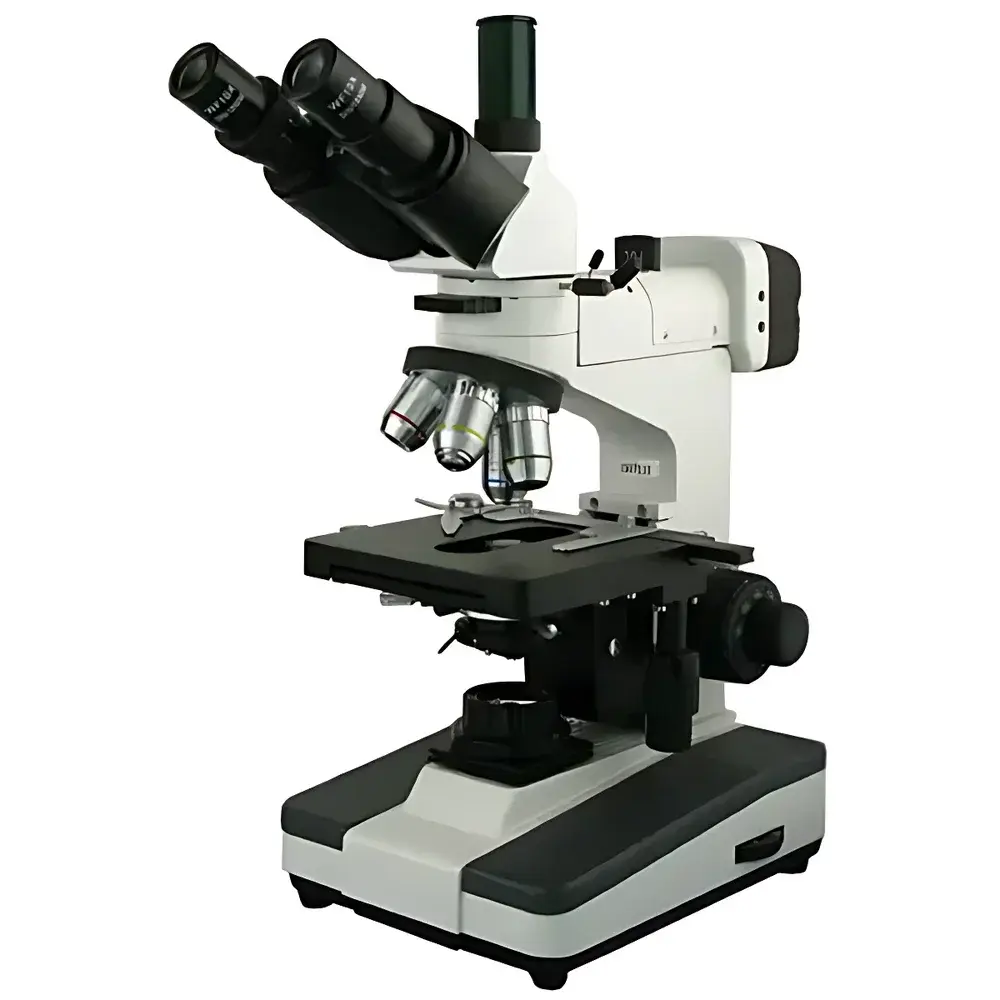
BM-12 Transmitted/Reflected Light Biological Microscope with Polarizing Capability
| Brand | BM |
|---|---|
| Origin | Shanghai, China |
| Model | BM-12 |
| Type | Trinocular Digital Biological Microscope |
| Illumination | Dual-mode (Transmitted & Reflected Halogen, 6V/20W) |
| Eyepiece Port | Trinocular |
| Objective Mount | Standard DIN 4X–100X Oil |
| Condenser | NA 1.25 Abbe with Iris Diaphragm & Centering Mechanism |
| Focusing | Coaxial Coarse/Fine Adjustment (Fine Graduation: 2 µm) |
| Stage | Dual-layer Mechanical Stage (140 × 140 mm, 75 × 40 mm Travel) |
| Polarizer System | Rotatable Analyzer (0–360°), Removable Polarizer & Analyzer |
| Filters | Insert-type Green/Blue/Yellow |
Overview
The BM-12 Transmitted/Reflected Light Biological Microscope is a versatile, research-grade optical instrument engineered for dual-illumination modalities—transmitted brightfield and reflected brightfield or polarized light observation—within a single robust platform. Designed in accordance with DIN-standard mechanical and optical specifications, the BM-12 employs Köhler illumination principles for both illumination paths, ensuring uniform intensity distribution and optimal resolution across magnifications ranging from 40× to 1000× (with oil immersion). Its modular architecture integrates a trinocular head with 30° inclined eyepieces and a dedicated photo-port for digital imaging systems, enabling simultaneous visual inspection and high-fidelity documentation. The microscope’s mechanical stability, precision coaxial focusing mechanism (2 µm fine-focus graduation), and interchangeable optical components support reproducible qualitative and semi-quantitative analysis in academic laboratories, quality control environments, and materials science applications where birefringence or surface microstructure assessment is required.
Key Features
- Trinocular optical path with 30° inclined, rotatable head (360° swivel) and adjustable interpupillary distance (55–75 mm) for ergonomic extended use.
- Dual independent halogen illumination system: transmitted 6V/20W lamp with continuous brightness control and NA 1.25 Abbe condenser; reflected 6V/20W lamp with adjustable intensity and integrated heat-absorbing filter.
- Full polarizing capability: removable linear polarizer and rotatable analyzer (0–360° calibrated scale), supporting quantitative birefringence evaluation and stress analysis in polymers, crystals, and biological tissues.
- Standard DIN objective turret accommodating four objectives: 4× (NA 0.10, WD 37.5 mm), 10× (NA 0.25, WD 7.31 mm), 40× (NA 0.65, WD 0.63 mm), and 100× oil immersion (NA 1.25, WD 0.18 mm).
- High-contrast plan achromatic eyepieces: 10×/Φ18 mm and 16×/Φ11 mm wide-field options, plus optional focusable 10× eyepiece with 0.1 mm reticle scale for spatial calibration.
- Mechanical double-layer stage (140 × 140 mm) with 75 × 40 mm travel range, vernier-calibrated X/Y motion, and specimen clamp for secure positioning during high-magnification work.
Sample Compatibility & Compliance
The BM-12 accommodates standard 1″ × 3″ (25 × 75 mm) glass slides and 12–25 mm diameter circular coverslips for transmitted-light microscopy. In reflected mode, it supports opaque, polished, or sectioned solid specimens—including metallurgical samples, semiconductor wafers, mineral thin sections, and stained histological tissue blocks—without requiring transparent mounting media. All optical components comply with ISO 8578:2017 (microscope mechanical tolerances) and ISO 10934-1:2001 (optical performance of biological microscopes). The instrument meets CE marking requirements for laboratory electrical safety (EN 61010-1) and electromagnetic compatibility (EN 61326-1). While not FDA-cleared as a medical device, its optical traceability and repeatable illumination geometry align with GLP-aligned validation protocols for non-clinical biopharmaceutical characterization and academic morphometric studies.
Software & Data Management
The BM-12 is fully compatible with third-party digital imaging platforms via its C-mount photo-port (standard 23.2 mm thread). When paired with CMOS or CCD cameras meeting USB3.0 or HDMI interface standards, it supports time-lapse acquisition, Z-stack generation, and multi-channel fluorescence (when equipped with appropriate excitation/emission filters). Data management workflows integrate with open-format image processing software (e.g., ImageJ/Fiji, CellSens, or NIS-Elements) for measurement annotation, histogram-based intensity profiling, and export of TIFF/OME-TIFF metadata-compliant files. Audit trail functionality—including timestamped capture logs, user ID tagging, and exposure parameter recording—is achievable through compliant camera SDKs and adheres to ALCOA+ data integrity principles when deployed in regulated environments under documented SOPs.
Applications
- Biological education and routine histology: observation of stained animal/plant tissue sections, blood smears, and microbial cultures under transmitted brightfield.
- Materials science: grain boundary analysis in metals, polymer crystallinity assessment, and defect mapping in thin-film coatings using reflected polarized light.
- Geology and mineralogy: identification of birefringent minerals in thin sections via interference color analysis and extinction angle measurement.
- Electronics QA: inspection of PCB solder joints, wire bonding integrity, and surface contamination on silicon wafers using oblique reflected illumination.
- Pharmaceutical development: crystal habit evaluation of active pharmaceutical ingredients (APIs) and excipient blends under controlled polarized conditions per USP particulate matter guidance.
FAQ
What is the maximum total magnification achievable with the BM-12?
With the standard 10× eyepiece and 100× oil immersion objective, the BM-12 achieves 1000× total magnification. Using the optional 16× eyepiece increases this to 1600×, though practical resolution remains constrained by the objective’s NA (1.25) and visible-light wavelength limits.
Is the BM-12 suitable for fluorescence microscopy?
The base configuration does not include fluorescence excitation sources or dichroic mirrors. However, the trinocular port and standardized filter slot positions allow integration of aftermarket fluorescence modules (e.g., LED-based epi-illuminators and bandpass filter sets) provided mechanical alignment and optical path length are validated.
Can the polarizing components be used independently of the transmitted/reflected illumination modes?
Yes—the polarizer and analyzer are mechanically decoupled from the illumination path. Either component can be inserted or removed from the light path regardless of whether transmitted or reflected illumination is active, enabling flexible experimental configurations such as crossed-polarized reflected-light imaging.
Does the BM-12 meet ISO 9001 calibration traceability requirements?
The instrument itself is not supplied with NIST-traceable calibration certificates. However, its mechanical and optical design conforms to ISO-defined dimensional and performance benchmarks. Users may perform in-house verification using certified stage micrometers and resolution test targets (e.g., ISO 19951 pattern), with records maintained per internal quality management system requirements.
What power input specifications does the BM-12 require?
Both transmitted and reflected halogen lamps operate on universal AC input (85–230 V, 50/60 Hz) via an internal step-down transformer, delivering stable 6 V DC to each 20 W lamp. No external power supply unit is required.



